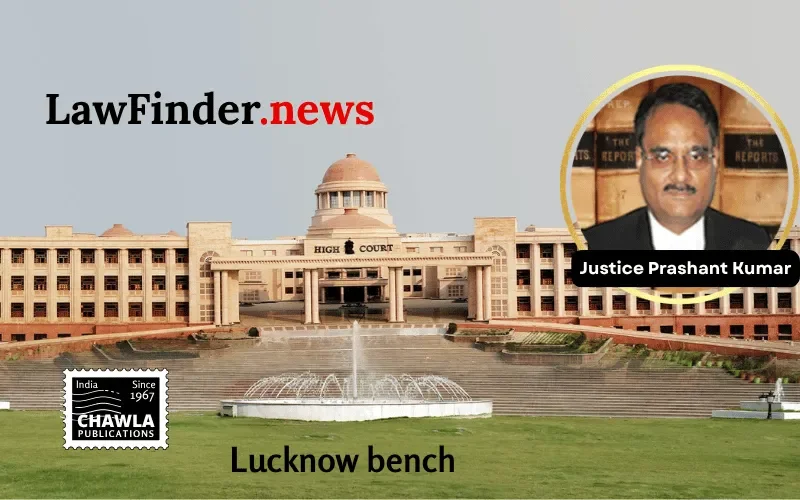
In landmark judgment, High Court underscores courts’ duty to award just compensation under Motor Vehicles Act, 1988, allowing appellate enhancement of awards even when claimants do not file cross-objections.
LUCKNOW, November 18, 2026 — The Allahabad High Court (Lucknow Bench) has delivered a significant judgment in the motor accident claim case of New India Assurance Company Ltd. v. Usha Devi and others, holding that appellate courts have the power to enhance compensation awarded by Motor Accident Claims Tribunals even in the absence of any cross-appeal or cross-objection filed by the claimants.
The judgment, pronounced by Justice Prashant Kumar, arose from an appeal filed by the New India Assurance Company Ltd. challenging an award of Rs. 20,95,000/- granted by the Motor Accident Claims Tribunal, Bahraich, in favor of the claimants, the family of the deceased motorcyclist, Suresh Chandra Misra, who died in a road accident caused by a rashly driven car.
The Court meticulously examined the factual matrix, including the circumstances of the accident, the absence of the offending vehicle’s registration number in the FIR, and the quantum of compensation awarded. The Tribunal had fixed liability on the insurance company and computed compensation based on Rs. 400 per day notional income, multiplier of 15 (applying the Sarla Verma principles), and conventional heads like loss of consortium and funeral expenses.
The appellant insurance company contended that the registration number was missing in the FIR, the compensation quantum was excessive, and the multiplier was incorrectly applied. The claimants argued that the accident liability was well established through reliable evidence, the compensation was inadequate, and the Court had the power to enhance compensation despite no cross-appeal.
In its detailed analysis, the High Court referred extensively to precedents from the Supreme Court, including the landmark judgments of Sarla Verma, Pranay Sethi, Nanu Ram, and Surekha v. Shriram General Insurance Co. The Court held that the FIR is not an encyclopaedia and omissions such as missing vehicle registration number do not bar fixing liability once reliable evidence connects the accident to the offending vehicle.
Critically, the Court applied Rule 220A of the Uttar Pradesh Motor Vehicle Rules, 1998, and Supreme Court precedents to enhance future prospects from 25% to 30% for a self-employed deceased aged between 40-50 years, in line with the statutory provisions. It also significantly enhanced the compensation under conventional heads (loss of consortium, funeral expenses, loss of estate) by applying the escalation formula established in Pranay Sethi, awarding Rs. 48,400 per claimant for loss of consortium to six claimants instead of Rs. 40,000 total as previously granted.
Addressing the contentious issue of appellate power to enhance compensation without claimants filing cross-objections, the Court reaffirmed that the Motor Vehicles Act’s mandate is to ensure “just and fair” compensation. The appellate court’s powers under Order 41 Rule 33 of the Code of Civil Procedure allow it to pass any order necessary for complete justice, including enhancement. The Court distinguished binding precedents cited by the appellant and relied on recent Supreme Court decisions including Surekha and Oriental Insurance Co. Ltd. v. Sardar Singh, affirming that an appeal filed by the insurance company challenging quantum empowers the court to increase compensation if the original award is found inadequate.
Accordingly, the Court modified the award from Rs. 20,95,000/- to Rs. 24,32,700/- with interest at 7% per annum and directed the Tribunal to adjust amounts already paid and disburse the enhanced compensation directly to claimants’ bank accounts.
This judgment strengthens the jurisprudence on the responsibility of courts to grant equitable compensation in motor accident claims and clarifies appellate courts’ power to ensure just relief without procedural technicalities inhibiting claimants’ rights.
Bottom Line:
In motor accident claims, the appellate court has the power to enhance compensation even if the claimants do not file a cross-appeal or cross-objection, provided the awarded compensation is found inadequate or unjust.
Statutory provision(s):
Motor Vehicles Act, 1988 Sections 166, 168, 169, 173; Uttar Pradesh Motor Vehicle Rules, 1998 Rule 220A; Code of Civil Procedure, 1908 Order 41 Rule 33
New India Assurance Company Ltd. v. Usha Devi, (Allahabad)(Lucknow) : Law Finder Doc Id # 3162928