Court recalls earlier order on disputed elections, orders forensic examination of vakalatnamas, and imposes costs on litigants for abuse of process, while urging strict reforms in caveat filing procedures
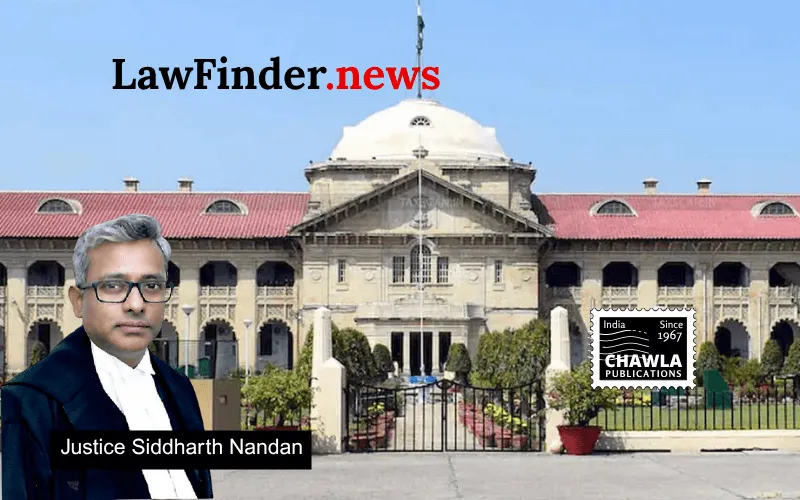
In a significant judgment dated August 24, 2026, the Allahabad High Court, presided over by Justice Siddharth Nandan, delivered a stern verdict addressing the filing of false vakalatnamas, material concealment of facts by advocates and litigants, and its adverse effect on the administration of justice. The case arose from a long-standing dispute over the management elections of Nehru Vidyapeeth Inter College, Reotipur, Ghazipur.
The court reviewed a Review Application filed by Shri Shiv Shankar Singh, disputing the authenticity of a vakalatnama filed on his behalf by Sri R.C. Dwivedi, Advocate, in a caveat application. The applicant denied authorizing any counsel to represent him or filing the caveat application. This led to serious allegations of forgery and professional misconduct involving advocates and litigants alike.
A key concern in the dispute was the claim that the last undisputed elections of the college management were held in 2009. However, the court found that the 2009 elections were under serious cloud due to prior orders, including a 2016 directive from the Joint Director of Education, which had declared those elections doubtful and mandated fresh elections. The court observed that the concealment of these material facts by the petitioner’s counsel, Shri S.C. Dwivedi, amounted to misleading the court and interfering with the administration of justice. The court also noted that the counsel for respondent no. 6 did not contest this assertion, thereby compounding the miscarriage of justice.
To ascertain the truth about the disputed vakalatnamas, the court ordered a forensic examination of the signatures on the vakalatnamas filed in various related writ petitions and caveat applications. The report from the Forensic Science Laboratory (FSL), Prayagraj, revealed that the disputed signature on the vakalatnama did not match the sample signatures or signatures in bank records of Shri Shiv Shankar Singh. Similarly, signatures purportedly by advocate R.C. Dwivedi on the vakalatnama and caveat application showed discrepancies, with some being signed by his clerk without proper authorization.
Despite procedural lapses admitted by Sri R.C. Dwivedi, the court cleared him of deliberate wrongdoing, emphasizing that the primary culpability lay with the petitioner’s counsel for active concealment of material facts and filing false statements. The court decried the filing of frivolous review applications motivated by dissatisfaction with court orders and highlighted the grave impact such actions have on public confidence in the judiciary and the legal profession.
The judgment extensively referenced authoritative Supreme Court decisions underscoring that advocates are officers of the court with a paramount duty to maintain integrity and ethical standards. Filing forged or unauthorized vakalatnamas, concealing facts, or misleading courts constitutes serious professional misconduct, attracting disciplinary action, costs, and possibly criminal prosecution under recent statutes including the Bharatiya Nyaya Sanhita, 2023, and Bharatiya Sakshya Adhiniyam, 2023.
The court imposed costs of Rs. 50,000 each on the petitioner and respondent no. 6 for abusing the court’s process and causing reputational harm to advocates involved. It also recommended amending Chapter XXII Rule 5 of the Allahabad High Court Rules, 1952, to require affidavits supporting caveat applications, to curb misuse arising from filing caveats without proper verification.
Further, the court recalled its earlier order dated May 5, 2026, directing fresh elections, as the foundational premise of the prior judgment—the last undisputed election held in 2009—was found to be incorrect. The matter was directed to be placed before the competent court for fresh adjudication in light of the correct facts.
The judgment serves as a cautionary tale for litigants and advocates about the sanctity of court procedures, the necessity of transparency, and adherence to high professional ethics. It reiterates that the legal profession’s dignity hinges on advocates acting as guardians of justice, not as facilitators of fraudulent litigation.
Bottom Line:
Filing of a false vakalatnama and material concealment of facts by an advocate and litigant amounts to professional misconduct and interference with the administration of justice. Advocates are expected to maintain a high standard of professional ethics and ensure the authenticity of legal documents.
Statutory provision(s):
Advocates Act, 1961, Bar Council of India Rules, Code of Civil Procedure, 1908 (Order III, XXIII, and Section 151), Bharatiya Nyaya Sanhita, 2023 (Sections 227, 229, 318(4), 336, 340, 242, 341), Bharatiya Sakshya Adhiniyam, 2023 (Sections 67(2), 73, 119), Contempt of Courts Act, 1971, Allahabad High Court Rules, 1952 (Chapter XXII Rule 5)