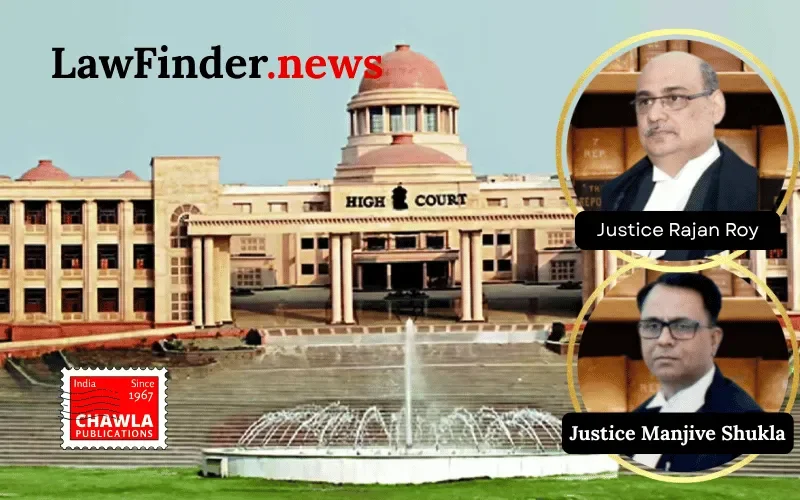
Court reiterates hospitals’ absolute duty to provide immediate treatment in medico-legal cases and seeks detailed State response on Good Samaritan compliance, monitoring, and grievance redressal
The Allahabad High Court, Lucknow Bench, has expressed serious concern over the failure of the Uttar Pradesh government to file a counter affidavit for more than 25 years in a public interest litigation raising the issue of refusal of treatment to accident and medico-legal victims by hospitals.
The Division Bench of Justice Rajan Roy and Justice Manjive Shukla was hearing a PIL filed by Anju Prakash Srivastava in 2000. The petition highlighted an alarming practice in which hospitals allegedly refused to treat medico-legal cases, including burn and accident victims. One of the documents placed before the court included a photograph of a prominent Lucknow hospital displaying a board stating that “medico-legal cases, e.g., burn and accident cases are not treated at this hospital.”
Relying on the Supreme Court’s landmark ruling in Pandit Parmanand Katara v. Union of India, the High Court reaffirmed that every doctor, whether in a government or private hospital, has a “total, absolute and paramount” obligation to provide immediate medical aid to protect life. The court emphasized that procedural requirements, police formalities, or medico-legal concerns cannot be used to delay emergency treatment.
The Bench noted that the Supreme Court had settled this legal position as far back as 1989, specifically to address the recurring problem of hospitals turning away accident victims due to fear of legal complications. Despite this, the issue appears to have persisted, prompting the present PIL.
The High Court also took note of the Supreme Court’s later decision in Savelife Foundation v. Union of India, which recognized and enforced the Good Samaritan guidelines issued by the Ministry of Road Transport and Highways through a notification dated 12 May 2015. These guidelines provide that failure of a doctor to respond in a road accident emergency may amount to professional misconduct. They also require all hospitals to display a charter at their entrance in Hindi, English, and the local vernacular stating that they will not detain a bystander or Good Samaritan or demand money from them for treatment of the victim.
The court observed that all public and private hospitals are required to implement these guidelines immediately, and authorities must act in cases of non-compliance. It further pointed out that the Clinical Establishments (Registration and Regulation) Act, 2010 provides a framework through which authorities can monitor and enforce compliance with such directions.
Expressing displeasure at the State’s “apathy in an important matter of public interest,” the Bench granted Uttar Pradesh a final opportunity of 10 days to file its counter affidavit, subject to payment of Rs. 25,000 as costs to the petitioner, who has pursued the matter since 2000.
The High Court directed the State to disclose in its affidavit the steps taken to comply with the Supreme Court judgments and the 2015 Good Samaritan notification. It also asked the government to place on record the mechanism adopted or proposed for monitoring compliance, details of inspections of hospitals under the 2010 Act, the system for receiving complaints, and any grievance redressal process in place. The court further sought district-wise data, as far as possible, on complaints received regarding denial of treatment or violation of the law laid down by the Supreme Court.
The matter has been listed for further hearing on 1 October 2026.
Bottom Line:
Public Interest Litigation concerning refusal of treatment in medico-legal and accident cases by hospitals - Doctors and hospitals are under an absolute obligation to provide immediate medical aid to accident victims - State directed to disclose steps taken for compliance with Supreme Court decisions and Good Samaritan guidelines, and mechanism for monitoring, inspections, complaint registration and grievance redressal.
Statutory provision(s): Article 21 of the Constitution of India, Clinical Establishments (Registration and Regulation) Act, 2010, Indian Medical Council (Professional Conduct, Etiquette and Ethics) Regulations, 2002, Ministry of Road Transport and Highways Notification dated 12.05.2015
Anju Prakash Srivastava v. State of U.P., (Allahabad)(DB)(Lucknow) : Law Finder Doc id # 2992805