Court holds Arya Samaj certificate alone cannot prove a valid Hindu marriage; directs reinstatement but denies back wages for intervening period
The Allahabad High Court has set aside the removal of a Deputy Commandant of the Sashastra Seema Bal (SSB), holding that the departmental action was based on an unsustainable assumption that he had concealed a prior marriage. The Court ruled that a marriage under Hindu law is valid only if essential ceremonies are performed, and a mere Arya Samaj certificate does not by itself establish a legally valid marriage.
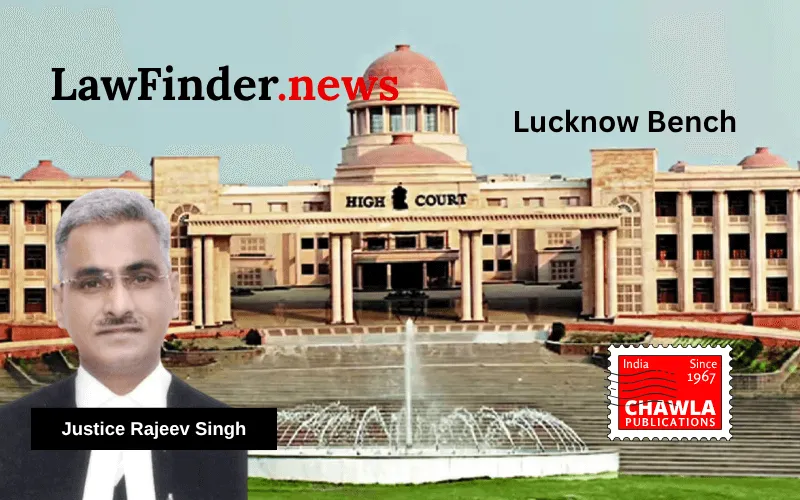
Justice Rajeev Singh passed the order in a writ petition filed by Rohit Pandey, who challenged his removal from service dated 28 April 2022. Pandey had argued that he was falsely implicated on the basis of complaints made by one Sucheta Tiwari, who claimed to be his wife. According to the petitioner, no marriage had ever been solemnized in accordance with Hindu rites, including the essential ceremony of Saptpadi. He further relied on earlier criminal proceedings in which the complainant herself allegedly admitted that the marriage was not performed as per Hindu rituals.
The petitioner also pointed to Supreme Court precedents, including Priya Bala Ghosh v. Suresh Chandra Ghosh and Santi Deb Berma v. Kanchan Prava Devi, to contend that a valid Hindu marriage must be proved by cogent evidence and not merely by oral assertions or documents such as an Arya Samaj certificate.
The Union government, however, defended the removal order, stating that during the departmental inquiry the complainant had asserted that the marriage had taken place at Arya Samaj Mandir in Allahabad on 16 August 2007. The authorities also relied on the statement of the priest and other documents, contending that the petitioner had falsely declared himself unmarried at the time of joining service and had also given incorrect information regarding pending prosecution.
After examining the record, the Court concluded that the central issue was whether the alleged marriage could be treated as valid in law. The Court held that, in light of settled legal principles, a marriage is not legally proved merely because an Arya Samaj certificate exists. Since the complainant herself had stated in trial proceedings that the marriage was not solemnized according to Hindu rituals, the Court found the departmental finding unsustainable.
The Court also rejected the respondent’s argument that the petitioner was unsuitable for service on the basis of the alleged first marriage. It observed that if the 16 August 2007 ceremony was not a valid marriage in the eyes of law, it could not form the basis for disciplinary action against the petitioner.
Accordingly, the High Court quashed the removal order and directed the authorities to allow the petitioner to resume duties forthwith. However, the Court made it clear that the period between the removal order and reinstatement would be treated as “No work, No pay,” though without break in service.
Bottom Line:
Departmental inquiry - Allegations of false declaration of marital status at the time of joining services - Petitioner alleged to have solemnized marriage in Arya Samaj Mandir without essential Hindu ceremonies - Observations based on invalid marriage under Hindu Marriage Act cannot be a basis for removal from service.
Statutory provision(s): Hindu Marriage Act, 1955 (Sections 7, 11), Code of Criminal Procedure, 1973 (Section 125), Indian Penal Code, 1860 (Sections 498-A, 323, 504), Dowry Prohibition Act, 1961 (Sections 3, 4)
Rohit Pandey v. Union of India, (Allahabad)(Lucknow) : Law Finder Doc Id # 2982485