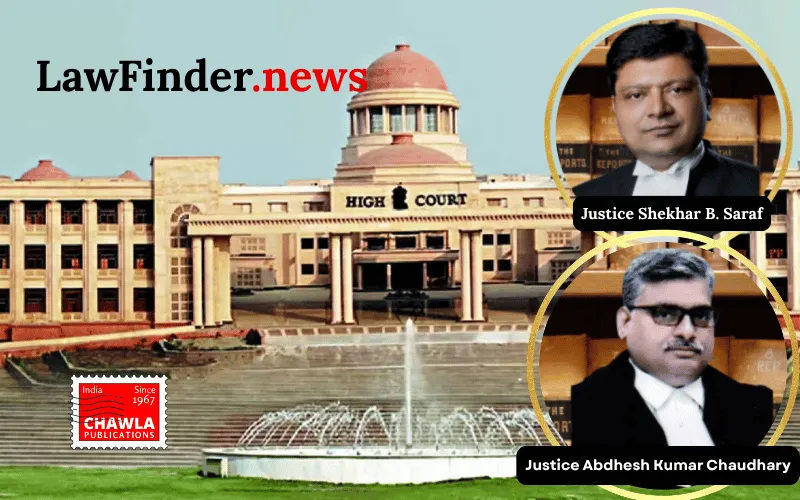
Division Bench quashes dismissal of writ petition for maintainability, directs fresh hearing on merits citing violation of natural justice and procedural lapses in seniority dispute
In a significant ruling delivered on October 5, 2026, the Allahabad High Court Division Bench comprising Justices Shekhar B. Saraf and Abdhesh Kumar Chaudhary quashed a Single Judge's order dismissing a writ petition filed by Vinod Chandra, a college principal, challenging the legality of a seniority determination under the Uttar Pradesh State Universities Act, 1973. The bench restored the writ petition and remanded the matter to the Single Judge for adjudication on merits, emphasizing that the availability of an alternative statutory remedy is not an absolute bar to the exercise of writ jurisdiction, especially when specific allegations of violation of natural justice are raised.
The case arose from a seniority dispute at Sri Jai Narayan Mishra Post Graduate College, affiliated with the University of Lucknow. Vinod Chandra, appointed as Principal based on a seniority list, was later challenged by another teacher who alleged that Chandra's leaves, including sanctioned leaves without pay and abroad academic scholarships, caused breaks in service affecting his seniority. The Vice Chancellor, relying on a committee report, held the challenger senior and modified the seniority list accordingly, leading to Vinod Chandra's displacement from the Principal's post.
Challenging the Vice Chancellor's order and the subsequent management committee resolution, Chandra filed a writ petition asserting that the reconstitution of the committee was done without notice, the basis of seniority computation was altered without hearing him, and the entire process violated the principles of natural justice. However, the Single Judge dismissed the writ petition on the ground that an alternative remedy-an appeal under Section 68 of the Uttar Pradesh State Universities Act-was available, without calling for counter-affidavits or examining the merits of the natural justice plea.
The Division Bench held that the mere existence of an alternative remedy is a rule of self-restraint and not an absolute bar to writ jurisdiction under Article 226 of the Constitution. The Court observed that maintainability (the competence of the petition to be heard) and entertainability (the court's discretion to hear the petition) are distinct concepts. The Single Judge erred in dismissing the petition at the threshold without testing the appellant's plea of breach of natural justice against any counter-affidavit, thus denying the appellant a fair opportunity to be heard.
Referring to precedents, including the Supreme Court's decisions in Radha Krishan Industries v. State of Himachal Pradesh and Whirlpool Corporation v. Registrar of Trade Marks, the Court reiterated that exceptions to the alternative remedy rule include cases involving violation of natural justice, fundamental rights, lack of jurisdiction, or challenge to vires of legislation. Since Vinod Chandra had pleaded specific instances of procedural irregularities and violation of natural justice, the Court directed that the writ petition be heard on merits after the respondents file counter-affidavits.
The Court further noted that the appellant had only one year left in service, underscoring the need for an expeditious hearing preferably within six weeks. The judgment left all issues on merits, including the validity of seniority determination and the impact of leave on service continuity, open for fresh consideration uninfluenced by any observations in the current judgment.
This ruling reinforces the principle that High Courts should not mechanically dismiss writ petitions merely on the availability of alternative remedies, especially where substantial questions of natural justice and fairness are raised. It affirms the discretionary but plenary jurisdiction of High Courts under Article 226 to provide timely and effective relief in administrative disputes affecting public servants.
Bottom Line:
Writ petition cannot be dismissed as not maintainable merely because an alternative statutory remedy exists, when specific pleas of violation of principles of natural justice are raised and remain untested for want of counter-affidavit; maintainability and entertainability are distinct concepts.
Statutory provision(s): Article 226, Constitution of India; Section 68, Uttar Pradesh State Universities Act, 1973; First Statutes of the University of Lucknow, 1975
Vinod Chandra v. State of U.P., (Allahabad)(DB)(Lucknow) : Law Finder Doc Id # 2992338