Court clarifies that absence of court permission under Order 1 Rule 8 CPC means suit cannot be treated as representative, limiting its effect to parties involved and dismisses second appeal on this ground
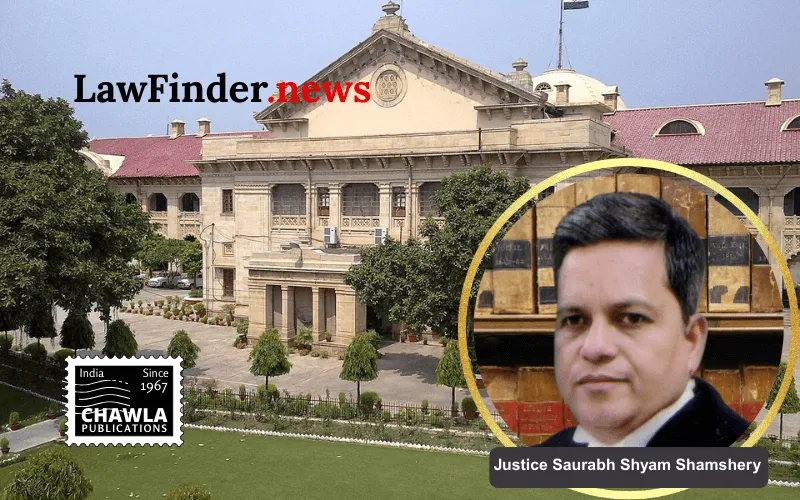
In a significant judgment dated September 10, 2026, the Allahabad High Court, presided over by Justice Saurabh Shyam Shamshery, delivered a ruling in the matter of Babu Lal vs. Shahabuddin and Others (Second Appeal No. 1289 of 1981), clarifying the legal implications of filing a suit under Order 1 Rule 8 of the Civil Procedure Code (CPC) without obtaining prior court permission.
The case arose from a dispute over Plot No. 262, alleged by the plaintiffs-respondents to have been used as a Muslim graveyard for over 300 years. The plaintiffs filed the suit in 1970 under the purported representative capacity, invoking Order 1 Rule 8 CPC, which allows a member of a community to sue on behalf of that entire community with court permission. However, the plaintiffs did not seek or obtain the required permission from the trial court.
The defendant-appellant, Babu Lal, contested the claim, asserting his ownership and right to construct on the disputed land, denying its use as a graveyard in its entirety. The trial court initially partly decreed the suit in favor of the plaintiffs but on appeal, the District Judge set aside the order and remitted the matter for fresh hearing. Subsequently, the trial court allowed the suit in full, declaring the entire 18.14 acres as a graveyard, which was upheld by the appellate court. The appellant challenged this in the present second appeal.
A crucial issue raised in the second appeal was whether the suit could be treated as a representative suit without the mandatory permission under Order 1 Rule 8 CPC, and whether such a failure rendered the suit non-maintainable or limited its binding effect.
Justice Shamshery analyzed precedents, including the Supreme Court's rulings in Kalyan Singh vs. Smt. Chhoti (AIR 1990 SC 396) and Hari Ram vs. Jyoti Prasad (2011) 2 SCC 682. The court emphasized that while a person can file a suit to protect community rights, to treat it as a representative suit binding the entire community, prior permission from the court is mandatory under Order 1 Rule 8 CPC.
The judgment underscored that non-compliance with this procedural requirement does not invalidate the suit per se, but restricts its effects. Specifically, the suit's outcome binds only the parties before the court, not the entire community. This position aligns with the principle that permission safeguards the community's interests before a representative suit is entertained.
Furthermore, the court examined whether the second appeal raised any substantial question of law under Section 100 CPC that warranted interference. Applying the tests laid down in Sheikh Mohd. Murtaza vs. Sheikh Wajid Ali (2025 AHC 208350) and other authorities, the court found no substantial question of law. The factual findings of extensive use of the land as a graveyard were affirmed by evidence and spot inspection reports, not seriously challenged.
Accordingly, the Allahabad High Court dismissed the second appeal, holding that the suit filed without court permission under Order 1 Rule 8 CPC cannot be treated as representative. The judgment thereby clarifies the procedural safeguards for representative suits and the consequences of non-compliance.
This ruling serves as an important precedent for litigants and courts dealing with community or class suits, emphasizing strict adherence to procedural mandates to ensure the suit's representative character and its wider binding effect.
Bottom Line:
A suit purportedly filed under Order 1, Rule 8 CPC but without seeking or obtaining permission from the Court cannot be considered as a representative suit. The outcome of such a suit is binding only on the parties to the suit and not on the entire community.
Statutory provision(s):
Civil Procedure Code, 1908 Order 1 Rule 8, Section 100
Babu Lal v. Shahabuddin, (Allahabad) : Law Finder Doc Id # 2975852