Court holds State's unilateral cancellation without notice violative of Article 14 and natural justice; orders inquiry into officials' conduct for malafide actions.
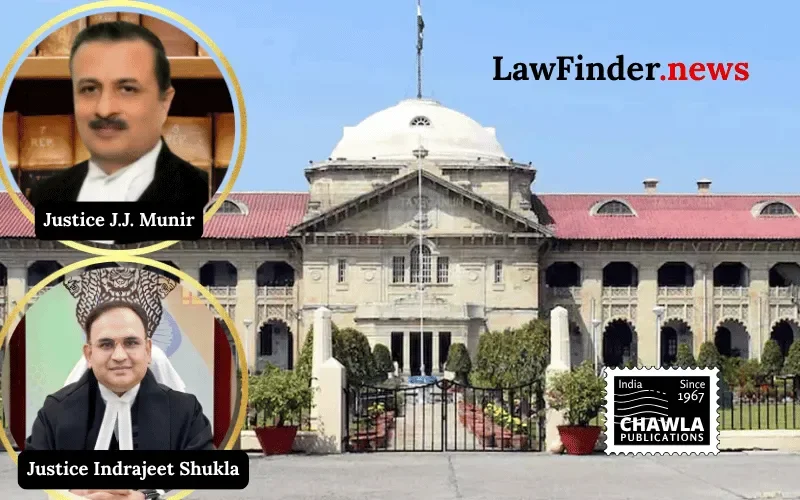
In a significant judgment delivered on October 12, 2026, the Allahabad High Court Division Bench comprising Justices J.J. Munir and Indrajeet Shukla quashed the arbitrary cancellation of a tender awarded to Arvind Kumar Mishra by the State of Uttar Pradesh. The Court found the State's action of cancelling the accepted tender without any written communication or opportunity of hearing was violative of the principles of natural justice and Article 14 of the Constitution of India, which mandates fairness and non-arbitrariness in State action-even in contractual matters.
The petitioner, Arvind Kumar Mishra, had participated in an E-Tender (No. 02/MLCDN/Kh.Banda/2025-26) for a project valued at Rs. 28,83,996/-. Declared the lowest bidder (L-1) on October 22, 2024, he deposited a total security sum of Rs. 5,54,000/- as required performance guarantee, exceeding the stipulated Rs. 5,47,861/-. Despite his compliance and repeated requests for contract execution, the State officials remained non-responsive.
Shockingly, the tender was cancelled on December 10, 2024, citing a shortfall of Rs. 93,861/- in additional performance security. The petitioner was never served any written notice regarding this deficiency nor given a hearing, rendering the cancellation ex parte and legally unsustainable. The State relied on a superseded Government Order dated June 8, 2012, to justify the demand for additional security; however, the Court noted that this order was replaced by a Government Order dated August 9, 2024, which did not require any such additional security. The respondents failed to prove any legitimate communication of the alleged shortfall to the petitioner, and an internal departmental letter purportedly evidencing such notice was found to be unaddressed to the petitioner and likely fabricated after the writ petition was filed.
The Court underscored the established legal principle that State entities, even in the contractual realm, must act reasonably, fairly, transparently, and without arbitrariness, reaffirming Supreme Court precedents such as Madras Aluminium Co. Ltd. v. Tamil Nadu Electricity Board (2023), Shrilekha Vidyarthi v. State of U.P. (1991), and Save Mon Region Federation v. State of Arunachal Pradesh (2026). The judgment emphasized that the State cannot adopt a "Dr. Jekyll and Mr. Hyde" personality by claiming immunity from constitutional scrutiny simply because the dispute arises from a contract.
Given that the tender work had been re-tendered and completed by another contractor, the Court declined to direct execution of the contract but exercised its writ jurisdiction under Article 226 to mould relief by ordering the restitution of the entire security deposit of Rs. 5,54,000/- along with interest at the rate of 8.5% per annum and exemplary costs of Rs. 25,000/- to the petitioner. This restitution was grounded on the principle of unjust enrichment and equitable considerations to restore the petitioner to the position before the unlawful State action.
Furthermore, the Court directed the Principal Secretary of the Minor Irrigation Department, Government of Uttar Pradesh, to institute an inquiry into the conduct of the erring officials responsible for the arbitrary cancellation and non-disclosure of the tender details, and to take appropriate action including recovery of the amount ordered to be paid to the petitioner.
This judgment sends a strong message that even in public procurement and tendering processes, the State must uphold constitutional mandates of fairness, transparency, and natural justice. Arbitrary and clandestine decisions without due process will attract judicial censure and remedies including compensation to the aggrieved parties.
Bottom Line:
Tender matter - State cannot cancel accepted tender and withhold security deposit without written communication of alleged deficiency or opportunity of hearing - Government action in contractual sphere remains subject to Article 14 - Where cancellation is arbitrary and based on a superseded Government Order, Court may mould relief and direct refund of deposited amount with interest and costs instead of ordering execution of contract already completed through re-tender.
Statutory provision(s): Article 14, Article 226, Interest Act 1978 Sections 3 and 4
Arvind Kumar Mishra v. State of U.P., (All)(DB) : Law Finder Doc Id # 3012760