Court Emphasizes Need for Detailed Evaluation of Duties, Responsibilities, Qualifications, and Work Quality Before Applying "Equal Pay for Equal Work" Principle to Contractual Employees
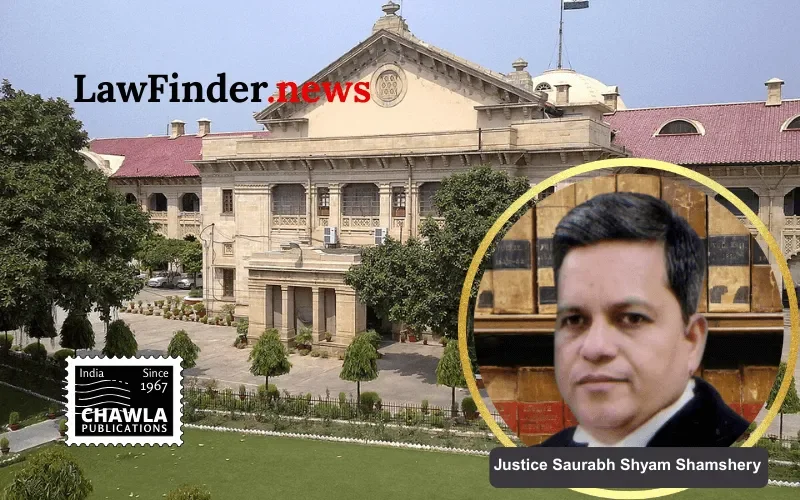
In a significant judgment dated October 15, 2026, the Allahabad High Court, presided over by Justice Saurabh Shyam Shamshery, quashed an order passed by the Labour Commissioner of Uttar Pradesh which had granted contractual workers at Bharat Heavy Electricals Limited (BHEL), Jhansi Unit, wages equal to those of regular employees based on the principle of "equal pay for equal work." The Court found that the Labour Commissioner's order was non-speaking and failed to consider crucial legal parameters and factual elements mandated by Supreme Court precedents, thereby necessitating a fresh adjudication.
The case arose from an application filed by the BHEL Contract Workers Union claiming parity of wages with regular employees, alleging that the contractual workers had been performing similar permanent nature duties for many years. The Labour Commissioner, relying on a variety of documents including duty rosters, log books, gate passes, wage slips, experience certificates, and comparative charts, concluded that the contractual workers were entitled to equal pay.
However, upon judicial scrutiny, the High Court held that the Labour Commissioner's order did not specifically address essential factors such as equivalency of duties, responsibilities, qualifications, mode of engagement, and quality and sensitivity of work. The Court underscored that the principle of equal pay for equal work is not to be mechanically applied but requires cogent and detailed material establishing parity in all relevant aspects. It emphasized that the onus lies on the contractual workers claiming parity to prove that their work is equal in value and quality to that of regular employees.
Rejecting the Labour Commissioner's reliance merely on documents like duty rosters and log books without a reasoned analysis, the Court observed that such evidence, in isolation, was insufficient. It noted that the comparative chart relied upon was merely a list of temporary workers and lacked substantive details demonstrating actual similarity in work performed.
The Court referred extensively to binding Supreme Court judgments, including the landmark three-judge bench decision in State of Haryana v. Charanjit Singh (2006) and the recent Constitution Bench ruling in G.P. Sangeetha v. State of Kerala (2026), which clarified that contractual employees' claims for equal pay must meet strict criteria involving comprehensive comparison of qualifications, mode of recruitment, duties, and responsibilities.
Further, the Court pointed out that the writ petition had remained pending for over two decades without counter affidavits from the Workers Union, despite ample opportunity, which undermined the claim's evidentiary basis. It also noted that the contractual workers' request for regularization had been previously rejected.
Importantly, the Court invoked the principle that a writ court does not act as an appellate authority over factual findings but can intervene through writ of certiorari if the order suffers from a legal error or is based on no evidence. Since the Labour Commissioner failed to provide any reasoned satisfaction that the legal parameters for equal pay were met, the impugned order was held to be legally unsustainable.
The High Court accordingly set aside the Labour Commissioner's order dated January 5, 2005, and remitted the matter back for fresh consideration. It directed that the Labour Commissioner should pass a reasoned order within six months from the date of receipt of the certified copy of the judgment, duly applying the legal principles enunciated by the Supreme Court and examining the evidence on record in detail.
This judgment reiterates the nuanced approach courts take while applying the doctrine of "equal pay for equal work," especially in cases involving contractual employees. It clarifies that contractual status alone does not automatically disqualify workers from claiming parity but that such claims must be supported by clear and cogent proof satisfying multiple parameters including the nature and quality of work, qualifications, and recruitment process.
Bottom Line:
Contract labour - Claim of equal pay for equal work - Labour Commissioner granted parity without examining requisite legal parameters such as parity of duties, responsibilities, qualifications, mode of engagement and quality/sensitivity of work - Mere reference to duty roster, log books, gate passes and list of workers not sufficient - Non-speaking order liable to be set aside and matter remitted for fresh consideration.
Statutory provision(s):
Contract Labour (Regulation and Abolition) Act, 1970; U.P. Contract Labour (Regulation and Abolition) Regulations, 1975; Constitution of India, 1950 Articles 14 and 226
Bharat Heavy Electricals Limited v. State of U.P., (All) : Law Finder Doc Id # 2997838