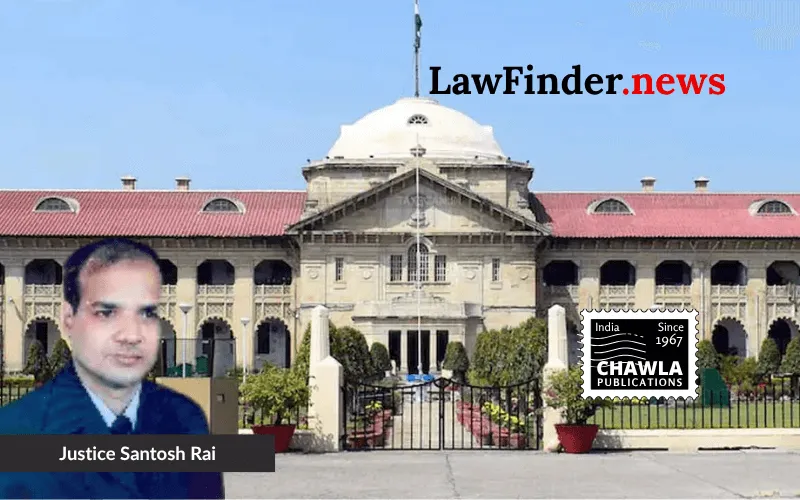
Court quashes proceedings against police personnel citing lack of specific caste-based allegations, non-application of judicial mind, and mandatory sanction under Section 197 CrPC; lays down procedural safeguards for handling final reports and protest petitions in SC/ST cases.
In a landmark judgment dated September 15, 2026, the Allahabad High Court, through Justice Santosh Rai, allowed a criminal appeal filed by thirteen police personnel and others challenging an order of the IInd Additional Session Judge/Special Judge under the Scheduled Castes and Scheduled Tribes (Prevention of Atrocities) Act, 1989 (SC/ST Act). The impugned order had rejected the police's final report and treated a protest petition as a complaint, taking cognizance of offences against the appellants for alleged caste-based atrocities within a police station.
The case arose from allegations by the complainant, Smt. Saroj, that police officers and others had subjected her to caste-based slurs, physical assault, custodial torture, and humiliation after she demanded repayment of a loan. The police investigation submitted a final report recommending closure of the case due to lack of evidence and inconsistencies, but the trial court rejected this report, relying heavily on affidavits, photographs, and newspaper cuttings attached to the protest petition.
Upon hearing the appeal, the High Court found multiple fundamental legal and procedural infirmities in the trial court's order. Key observations and directions from the judgment include:
1. Lack of Specific Caste-Based Allegations: The Court emphasized that mere membership of the complainant in a Scheduled Caste does not suffice for invoking the SC/ST Act. There must be specific, direct allegations showing that the acts were committed with casteist intent. The judgment cited Supreme Court precedents (Hitesh Verma v. State of Uttarakhand, Shajan Skaria v. State of Kerala) holding that insult or intimidation must be because of caste identity, not merely an insult to a person belonging to a Scheduled Caste.
2. Non-Application of Judicial Mind on Final Report: The Special Court failed to independently and objectively scrutinize the investigation material before rejecting the final report. The reliance on affidavits, photographs, and newspaper reports without analyzing their evidentiary value or contradictions was held to be improper. The order was non-speaking and did not disclose reasons for disagreeing with the Investigating Officer's conclusion.
3. Mandatory Prior Sanction under Section 197 CrPC: Since all appellants were police personnel and the alleged acts occurred during the discharge of official duties, the Court held that the trial court ought to have considered the applicability of Section 197 CrPC, which mandates prior government sanction before prosecuting public servants for official acts. The absence of such consideration rendered the cognizance order unsustainable.
4. Procedural Errors in Trial Court: The Special Court treated the protest petition as a complaint but proceeded under procedural provisions applicable to Magistrates (Sections 244, 245 CrPC) instead of following the procedure prescribed for Courts of Session under Chapter XVIII CrPC, as mandated for Special Courts constituted under the SC/ST Act. This constituted a fundamental procedural flaw.
5. Maintainability of Appeal: The Court clarified that the order taking cognizance by treating a protest petition as a complaint is an intermediate order and not merely interlocutory. Therefore, the appeal under Section 14-A of the SC/ST Act was maintainable.
6. Contextual Circumstances: The Court took note of the contemporaneous registration of a criminal case against the complainant herself for offences related to assault on police personnel on the same date, highlighting the need for cautious judicial scrutiny to avoid misuse of the SC/ST Act.
7. Guidelines Issued: To ensure uniformity and legal compliance, the Court issued detailed guidelines for criminal courts in Uttar Pradesh handling final reports and protest petitions under the SC/ST Act and CrPC, including:
- Independent examination of investigation material before accepting or rejecting final reports.
- Avoiding mechanical conversion of protest petitions into complaints.
- Recording specific, brief, and reasoned orders explaining acceptance or rejection of final reports.
- Proper judicial scrutiny of affidavits, photographs, and newspaper clippings submitted with protest petitions.
- Observing the correct procedural provisions applicable to Special Courts and courts of Sessions.
- Considering the requirement of prior sanction under Section 197 CrPC when public servants are accused.
- Prompt disposal of final reports within one month.
- Monitoring by District and Sessions Judges to ensure compliance.
The High Court set aside the impugned order dated October 6, 2018, quashed all subsequent proceedings arising from it, and discharged the appellants from the case. The judgment underscores the importance of judicial discipline, safeguarding statutory protections for public servants, and preventing abuse of criminal process, especially in sensitive cases under the SC/ST Act.
The Court further directed circulation of the judgment to all judicial officers and the Judicial Training and Research Institute in Uttar Pradesh for awareness and implementation of the principles laid down.
Bottom Line:
Guidelines issued for criminal courts in Uttar Pradesh regarding handling of Final Reports, protest petitions, and cognizance orders under CrPC and SC/ST Act to ensure compliance with statutory provisions, judicial reasoning, and procedural correctness.
Statutory provision(s): Scheduled Castes and Scheduled Tribes (Prevention of Atrocities) Act, 1989 Sections 3(1), 3(2), 7, 14, 14-A; Code of Criminal Procedure, 1973 Sections 154(3), 156(3), 172, 190(1)(a), 197, 200, 202, 204(2), 223, 227, 244, 245
Bhuvnesh Kumari v. State of U.P., (All) : Law Finder Doc Id # 2979329