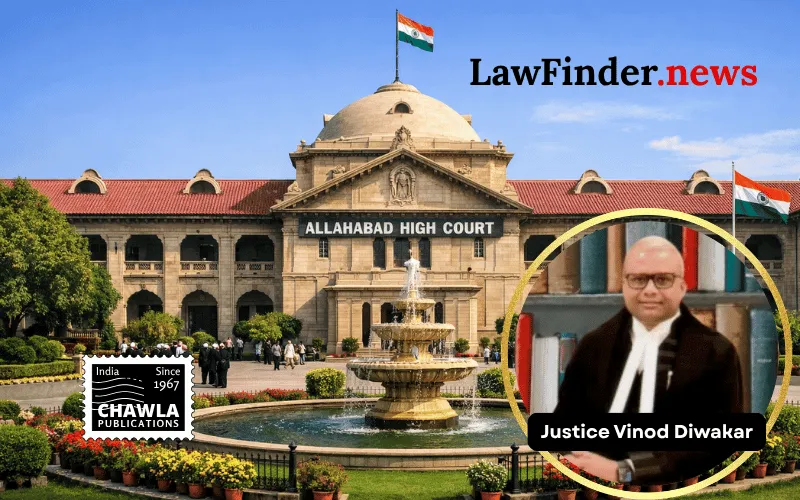
Court orders transfer of criminal cases against advocates to designated districts, mandates Bar Council to initiate FIRs and disciplinary proceedings, and calls for systemic reforms to restore integrity in the legal profession.
In a landmark judgment delivered on June 3, 2026, the Allahabad High Court, presided over by Justice Vinod Diwakar, addressed the alarming infiltration of the legal profession in Uttar Pradesh by advocates involved in multiple criminal cases, including heinous offences, and those possessing fake educational qualifications. The Court exercised its supervisory jurisdiction under Article 227 of the Constitution, issuing comprehensive directions aimed at cleansing the Bar and safeguarding the administration of justice.
The Court’s detailed analysis revealed that out of over 5.14 lakh active advocates enrolled with the Bar Council of Uttar Pradesh, 4,157 advocates are accused in 5,056 criminal cases spanning various districts, with some facing as many as 46 FIRs. The Court also found that the Bar Council’s verification exercise identified only 105 advocates with forged degrees, a figure the Court deemed grossly inadequate and indicative of a superficial verification process lacking police and university verification.
Highlighting the institutional failure, the Court noted that many Bar Associations were controlled by individuals with criminal records and that the Bar Council’s disciplinary machinery was crippled by procedural lapses and electoral cycles, causing pending proceedings to lapse without resolution. The Court further criticized the Registrar of Firms, Societies & Chits for passive regulation of Bar Associations’ societies, which allowed mismanagement and lack of oversight.
To counteract the influence of advocates over local police and courts, the Court mandated the transfer of all criminal cases against advocates from their home districts to designated transferee districts within 100 kilometers, ensuring insulation from professional and social influence. This transfer mechanism is reciprocal and supervised by the District Judges of both districts.
The Bar Council of Uttar Pradesh was directed to register FIRs against advocates with forged degrees and initiate disciplinary proceedings, including suspension of practice licenses pending trial. The Court underscored that the right to practice law is not absolute but subject to conditions imposed by courts and statutory bodies for the protection of public interest and justice.
Further, the Court recommended systemic reforms, including mandatory police verification at the time of enrollment, integration of digital academic verification platforms such as the National Academic Depository and DigiLocker, annual disclosure of criminal cases by advocates, and the establishment of an independent disciplinary tribunal insulated from electoral influence.
The judgment also emphasized the ethical and moral obligation of the legal profession as a public institution committed to pro bono publico service. It warned against the capture of Bar Associations by dominant social groups or criminal elements, which undermines public confidence and the rule of law.
The Court’s directions extend to monthly compliance meetings among the District Judge, District Magistrate, and Police Superintendent to ensure effective implementation, with personal accountability for lapses. The Registrar General was tasked with issuing a notification to operationalize case transfers within 30 days, and the Bar Council must report compliance within the stipulated timeline.
In concluding remarks, Justice Diwakar drew a poignant parallel with the Mahabharata, cautioning that silence or inaction by authorities in the face of injustice causes harm not only to victims but to society at large.
This judgment marks a significant step towards restoring integrity and public trust in the legal profession and the judiciary in Uttar Pradesh.
Bottom line:-
Advocates with multiple criminal cases and/or fake qualifications pose a serious threat to the administration of justice - High Court exercises its supervisory jurisdiction under Article 227 to regulate their practice including transfer of cases and suspension of practice licenses pending disciplinary proceedings or trial.
Statutory provision(s): Article 227 of the Constitution of India, Section 34, 35, 36, 36-B, 38, 49 of the Advocates Act, 1961, Sections 447, 528 of the Bharatiya Nagarik Suraksha Sanhita, 2023, Sections 482, 203, 200, 202, 197, 82 of the Code of Criminal Procedure, 1973, Societies Registration Act, 1860 (with Uttar Pradesh amendments), Sections 499, 500, 323, 504, 506, 324, 325, 326, 120-B, 384, 406, 420, 467, 468, 471 IPC, Section 3/2 of U.P. Gangsters Act.
Mohammad Kafeel v. State of U.P., (Allahabad) : Law Finder Doc id # 2942992