Court affirms conviction under Section 302 IPC, emphasizing the evidentiary value of dying declaration recorded by Executive Magistrate and dismisses appeal citing minor inconsistencies as immaterial
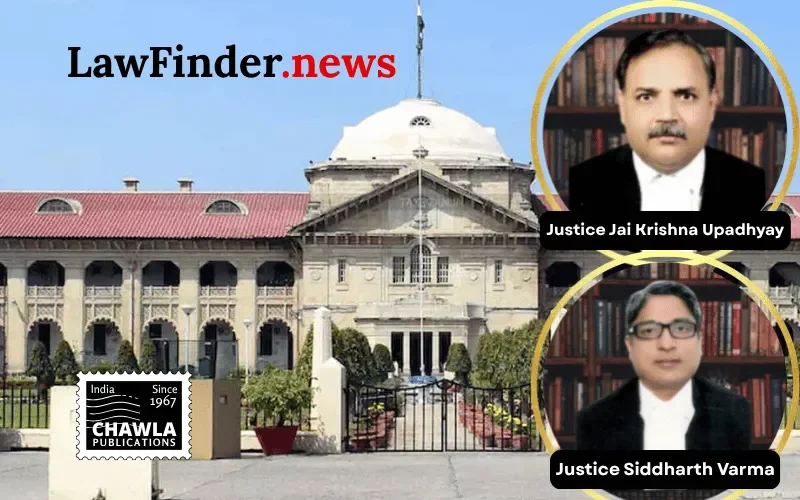
In a significant judgment dated October 16, 2026, the Allahabad High Court (Division Bench comprising Justices Siddhartha Varma and Jai Krishna Upadhyay) upheld the conviction and life sentence imposed on Krishna Kumar @ Kumbh Karan for the murder of Bhim Singh. The appellant's conviction under Section 302 of the Indian Penal Code (IPC) was affirmed on the grounds of a reliable dying declaration recorded by an Executive Magistrate, corroborated by eyewitness testimony and medical evidence.
The case arose from a land dispute leading to a brutal attack on the deceased Bhim Singh on February 24, 1987, near his house in Nekpur, Madhinath. Eyewitness Sohan Lal witnessed the appellant stabbing the deceased in the abdomen with a dagger (gupti) at around 11:15 p.m., under electric light. The deceased managed to reach the hospital but succumbed to his injuries the next morning.
Central to the prosecution's case was the dying declaration recorded at 1:15 a.m. on February 25, 1987, by Executive Magistrate Leeladhar Nainwal after medical certification of Bhim Singh's mental fitness by Dr. D.K. Saxena. The deceased clearly named Krishna Kumar as the assailant. The post-mortem report corroborated the account with a fatal punctured wound and multiple defensive incised wounds on the deceased's left hand, indicating a violent attack.
The defence raised contentions over minor inconsistencies in the mode of conveyance of the injured to the hospital - whether by rickshaw, with assistance of a traffic constable, or a constable - and challenged the credibility of the eyewitness statements, especially since one eyewitness turned hostile and another's statement was recorded after a delay. The appellant also put forth a defence of accidental injury during a scuffle while trying to save his disabled father.
However, the Court, after meticulous scrutiny, held that these minor discrepancies did not undermine the core fact that Krishna Kumar inflicted the fatal blow. The dying declaration was voluntary, truthful, and free from tutoring, recorded under strict medical supervision. The eyewitness testimony of Sohan Lal was consistent and corroborated by medical evidence. The defence's accidental injury theory was dismissed due to lack of supporting evidence.
The Court relied on the principles laid down in landmark Supreme Court judgments, including the recent ones interpreting the Bharatiya Sakshya Adhiniyam, 2023 (which now governs dying declarations under Section 26), emphasizing that a dying declaration, if reliable, can form the sole basis of conviction. Minor inconsistencies unrelated to the cause of death or identification of the accused do not vitiate the prosecution's case.
Accordingly, the Allahabad High Court dismissed Krishna Kumar's appeal and directed him to surrender to serve the remaining sentence. The Court also appreciated the assistance rendered by the Amicus Curiae and directed payment of legal aid fees.
This verdict reaffirms the legal sanctity of dying declarations recorded by competent authorities after medical certification and underscores the judiciary's cautious approach to inconsistencies that do not affect the core truth of the prosecution case.
Bottom Line:
Dying declaration recorded by Executive Magistrate after medical certification of fitness, and corroborated by eyewitness and medical evidence, can form reliable basis of conviction; minor inconsistencies regarding mode of transport of injured to hospital are not material enough to discredit the prosecution case.
Statutory provision(s):
Bharatiya Sakshya Adhiniyam, 2023 Section 26, Indian Penal Code, 1860 Section 302, Indian Evidence Act, 1872 Section 32(1) (referred for principles), Criminal Procedure Code, 1973 Section 161, Section 313
Krishna Kumar v. State of U.P., (Allahabad)(DB) : Law Finder Doc Id # 2998754