Court Dismisses Appeal of Candidate Who Failed to Upload Complete Experience Documents by Cut-off Date, Reinforces Enforceability of Negative Covenants in Recruitment Notifications
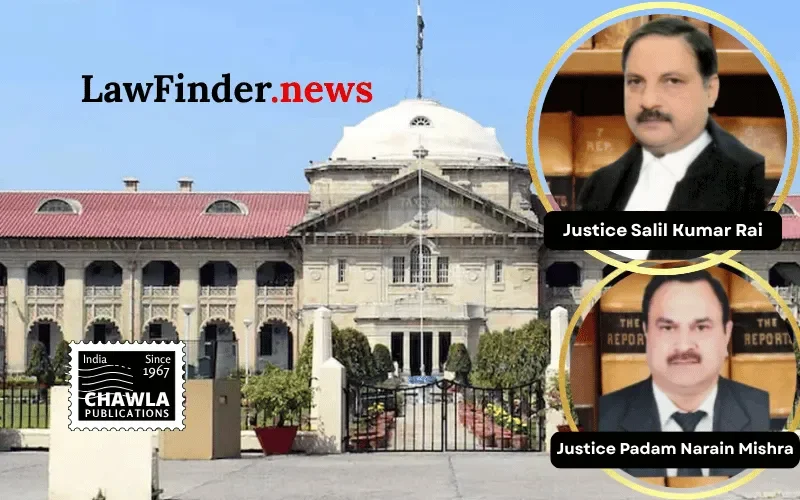
In a significant judgment delivered on August 14, 2026, the Allahabad High Court (Division Bench) has dismissed the appeal filed by Neha Rao challenging her disqualification from the recruitment process for the post of Instructor in Trade of Cosmetology under Advertisement No. 2-Examination/2022 issued by the Uttar Pradesh Subordinate Services Selection Commission (UPSSSC). The Court reaffirmed the mandatory nature and legal enforceability of negative covenants in recruitment notifications that prescribe strict deadlines for submission of eligibility documents, including experience certificates.
Background:
Neha Rao had applied for the post of Instructor in Cosmetology and submitted an experience certificate dated September 19, 2017, showing work experience from September 1, 2014, to August 31, 2017. However, this certificate established only two years and seven months of experience, falling short of the mandatory minimum of three years. A subsequent experience certificate dated January 10, 2022, showing experience from March 1, 2019, to January 5, 2022, was presented only after the document verification stage, when the deficiency was noticed. Notably, this second certificate was not uploaded by the candidate by the prescribed cut-off date of February 28, 2023, as mandated by a later notice dated February 3, 2023, which required all candidates to upload all relevant documents by that deadline, warning that failure to do so would result in forfeiture of eligibility.
Legal Issues and Arguments:
The appellant contended that her eligibility was undisputed as both certificates established her experience, and that inadvertence in not uploading the second certificate should be excused. She argued that the recruitment advertisement did not explicitly require merging or simultaneous uploading of all experience certificates, and that proof of eligibility can be furnished after the application date as long as eligibility existed before the deadline. She relied heavily on Supreme Court precedents such as Charles K. Skaria v. Dr. C. Mathew (1980), Dolly Chhanda v. Chairman, JEE (2005), and Aarav Jain v. Bihar Public Service Commission (2022), which distinguish between existence of eligibility and proof of eligibility and allow for proof to be submitted later in the absence of any negative covenant.
Conversely, the Commission defended the strict enforcement of the negative covenant contained in the February 3, 2023 notice, which explicitly required all documents to be uploaded by February 28, 2023, and warned that no further opportunity would be granted. It contended that the candidate's failure to upload the second experience certificate by the deadline resulted in loss of eligibility, making it impossible to grant relief. The Commission relied on the Supreme Court decision in Divya v. Union of India (2024), which upheld the binding nature of such negative covenants in recruitment processes and denied relaxation of mandatory documentary requirements.
Judgment:
The Court examined the recruitment notices and held that the original advertisement and the subsequent notice dated February 3, 2023, must be read together. The February 3 notice clearly contained a negative covenant mandating submission of all documents, including experience certificates, by the specified cut-off date and stated that non-compliance would result in loss of eligibility and no further opportunity for submission would be given.
While recognizing the distinction drawn in Charles K. Skaria and related cases between eligibility and proof of eligibility, the Court emphasized that these principles apply only in the absence of a negative covenant. Since the recruitment process here contained an unchallenged negative covenant, the appellant was bound by its terms. Consequently, failure to upload the second experience certificate by the deadline resulted in forfeiture of her right to be shortlisted or selected.
The Court also noted that the eligibility criteria, including the requirement of three years' experience post completion of the cosmetology course, was not in dispute. The provisional selection did not preclude the Commission from verifying eligibility at a later stage and rejecting the candidate upon discovery of the deficiency.
The Court dismissed the appeal, upholding the order of the Single Judge who had earlier rejected the writ petition filed by the appellant. It ruled that no discretionary relief could be granted as the negative covenant was valid, binding, and enforceable. The Court clarified that relaxation could only be considered where a defect in the eligibility certificate arose due to the fault of the issuing authority, which was not the case here.
Significance:
This judgment reinforces the principle that candidates participating in recruitment processes must strictly comply with all mandatory conditions, including deadlines for uploading eligibility documents. Negative covenants in recruitment notifications are legally enforceable and cannot be relaxed by courts in the absence of a challenge to their validity. The ruling underscores the importance of timely and complete submission of documents, emphasizing that inadvertence or subsequent submission will not be entertained if a negative covenant exists. This decision serves as an important precedent for public service commissions and candidates alike, ensuring transparency and fairness in recruitment while upholding procedural discipline.
Bottom Line:
Recruitment process - Submission of experience certificate - Mandatory condition requiring submission of all documents, including experience certificates, by a prescribed cut-off date - Failure to comply results in loss of eligibility for selection - Negative covenant in recruitment notifications strictly enforceable.
Statutory provision(s):
UP Instructor Recruitment.
Neha Rao v. State of Uttar Pradesh, (Allahabad)(DB) : Law Finder Doc Id # 2965664