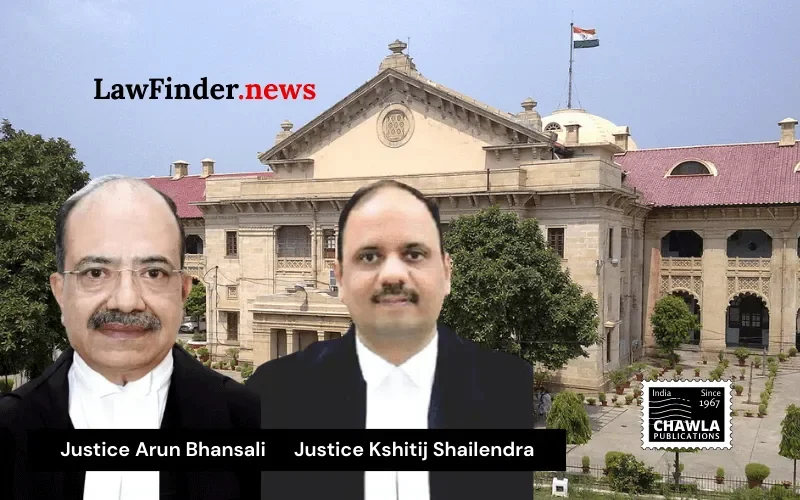
Court finds issuance of second SCN while first was pending as without statutory sanction and contrary to CCS (CCA) Rules, 1965; dismisses Union of India's writ petition
In a significant judgment delivered on November 13, 2026, the Allahabad High Court dismissed the writ petition filed by the Union of India challenging the Central Administrative Tribunal's (CAT) order which set aside a second show cause notice (SCN) issued to a government employee, Pramod Singh Yadav. The case revolves around the legal propriety of issuing a second SCN seeking enhancement of penalty while proceedings under the first SCN were still pending.
Pramod Singh Yadav, appointed as a Postal Assistant in 1996, faced multiple departmental inquiries relating to allegations of embezzlement. Despite being exonerated twice in departmental inquiries, a minor penalty of stoppage of increment for two and a half years was imposed on him on July 20, 2012, which he accepted. Subsequently, a first SCN dated October 3, 2012, was issued proposing enhancement of penalty to stoppage of increment for three years and recovery of Rs. 50,000. Yadav replied to this notice, but no final order was passed.
Without withdrawing the first SCN, the authorities issued a second SCN on December 12, 2012, proposing compulsory retirement as punishment - a major penalty under Rule 29 of the Central Civil Services (Classification, Control, and Appeal) Rules, 1965 ("Rules, 1965"). The second SCN referred to the first SCN and the representation submitted by Yadav in reply to it.
Yadav challenged the second SCN before the CAT, which stayed the notice in January 2013 and later, in September 2024, quashed it on the ground that the issuance of the second SCN while the first was pending and later withdrawn post-interim order was without statutory sanction and contrary to the scheme of the Rules, 1965. The Tribunal held that such enhancement of penalty amounted to harassment, especially when the employee had already undergone a minor penalty after being repeatedly exonerated.
The Union of India contended before the High Court that the second SCN was issued under statutory powers and that the OA before the Tribunal was not maintainable as it was filed against a mere show cause notice without a final order. They also argued that the Director of Postal Services was entitled to enhance the penalty.
The High Court, however, found merit in the Tribunal's reasoning. It emphasized that the first SCN was not withdrawn before issuance of the second SCN, which was contrary to the statutory scheme. The Court rejected the submission that filing a reply to a show cause notice bars a challenge to its issuance. It clarified that an employee can challenge a show cause notice issued without jurisdiction or in violation of rules even before a final order is passed. The Court noted the lack of statutory provision obliging disposal of the SCN reply as a final order, thus allowing preemptive challenge.
Further, the Court observed that the second SCN was not independent but referred to and relied upon the first SCN and the representation made against it. The withdrawal of the first SCN post issuance of the second SCN and after the Tribunal's interim order did not cure the illegality.
The Court also highlighted the apparent motive behind the issuance of the second SCN by the same officer who had earlier disagreed with inquiry reports exonerating the respondent, indicating an attempt to persecute the employee beyond the accepted minor penalty.
Relying on precedents including State of Uttar Pradesh v. Brahm Datt Sharma (AIR 1987 SC 943) and S.S. Rathore v. State of Madhya Pradesh (AIR 1990 SC 10), the Court reiterated that tribunals can interfere with show cause notices issued without jurisdiction and that the principle of exhaustion of remedies may not apply when the remedy is not provided by law.
The Court concluded that the second SCN was issued without statutory sanction, contrary to the Rules, and amounted to harassment. It upheld the CAT's order setting aside the second SCN and dismissed the writ petition of the Union of India.
This judgment reinforces the principle that authorities must strictly comply with statutory procedures when enhancing penalties under service rules and that employees can challenge show cause notices issued without jurisdiction or in contravention of rules before final orders are passed.
Bottom Line:
Issuance of a second show cause notice (SCN) while the first SCN was still pending and subsequently withdrawn post interim order by the Tribunal was without statutory sanction and contrary to the scheme of Central Civil Services (Classification, Control, and Appeal) Rules, 1965. Tribunal's interference in such cases is justified.
Statutory provision(s): Central Civil Services (Classification, Control, and Appeal) Rules, 1965 - Rule 27, Rule 29; Administrative Tribunals Act, 1985 - Section 20
Union of India v. Pramod Singh Yadav, (All)(DB) : Law Finder Doc Id # 3102149