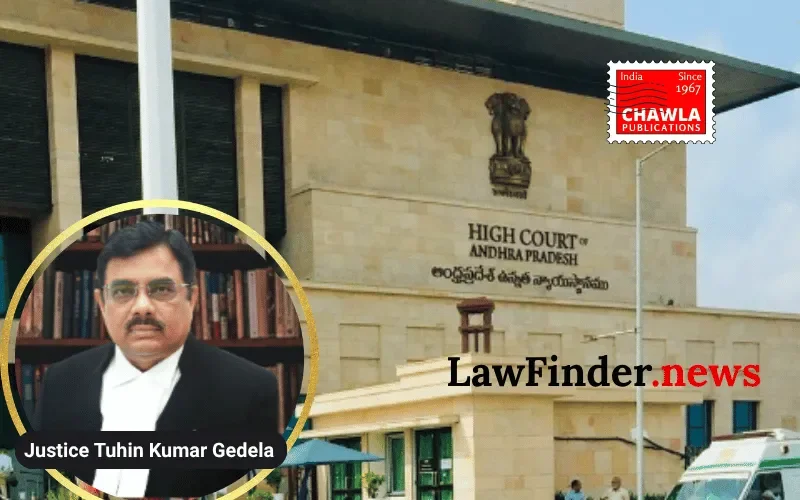
Court Observes Complaint as Counterblast to Prior Conviction, Emphasizes Need for Specific Allegations in Dowry Harassment Cases
In a significant judgment dated August 11, 2026, the Andhra Pradesh High Court, presided over by Justice Tuhin Kumar Gedela, quashed criminal proceedings filed under Section 498A IPC read with Section 34 IPC and Sections 3 and 4 of the Dowry Prohibition Act, 1961, in Criminal Case No. 211 of 2018. The petition was filed by J. Dokka Chinthalaiah and four others challenging the chargesheet and criminal complaint lodged by the complainant wife.
The court's decision came after a thorough examination of the facts and legal precedents, wherein it was found that the complaint lodged by the wife was a retaliatory counterblast to an earlier criminal case initiated by the husband. Notably, the husband had earlier successfully prosecuted the complainant's relatives for offences under Sections 323 and 506 IPC, which resulted in their conviction and sentencing.
The Court observed that the present complaint lacked specific and detailed allegations of cruelty or dowry demand against the husband and his family members. The accusations were vague, omnibus, and devoid of any overt acts or individual roles of the accused persons, which is critical for proceeding in cases under Section 498A IPC. It was underscored that prosecuting the entire family on generalized allegations without clear incriminating evidence is an abuse of the judicial process.
Justice Gedela extensively referred to the Supreme Court precedents, including landmark rulings in Preeti Gupta vs. State of Jharkhand (2010), Geeta Mehrotra vs. State of U.P. (2012), Arnesh Kumar vs. State of Bihar (2014), Dara Lakshmi vs. State of Telangana (2025), and others, which caution courts and investigating agencies against mechanical and indiscriminate prosecution of relatives in matrimonial disputes.
The High Court also highlighted the societal and personal consequences of protracted matrimonial litigation, emphasizing that the criminal justice system must not be misused as a tool of vengeance or harassment. The Court reiterated that Section 498A IPC, while enacted to protect women from cruelty, is often misused, and courts must exercise inherent powers under Section 482 Cr.P.C. judiciously to prevent such misuse.
Given that the trial in the present case had not commenced and considering the lack of prima facie evidence, the High Court held that allowing the proceedings to continue would amount to an abuse of process and consequently quashed the complaint and charge-sheet. The order effectively ends the criminal case registered against the husband and his relatives.
This ruling reinforces the principle that specific, credible allegations backed by evidence are essential to proceed with criminal trials in matrimonial cruelty and dowry harassment matters. It sends a clear message to complainants, legal practitioners, and law enforcement agencies to carefully scrutinize the foundation of such complaints to prevent misuse and safeguard the interests of all parties involved.
Bottom Line:
Quashing of proceedings - General and omnibus allegations against husband and his relatives - Complaint found to be a counterblast to earlier case lodged by husband, in which complainant's relatives were convicted - Charge-sheet did not disclose specific overt acts attracting Section 498A IPC - Continuance of proceedings held to be abuse of process of Court - Proceedings quashed under Section 482 Cr.P.C.
Statutory provision(s):
Penal Code, 1860 Section 498A, Section 34; Dowry Prohibition Act, 1961 Sections 3, 4; Criminal Procedure Code, 1973 Section 173(2), Section 482
J. Dokka Chinthalaiah v. State of Andhra Pradesh, (Andhra Pradesh) : Law Finder Doc Id # 2990453