Court holds habeas corpus maintainable only when remand order is challenged on jurisdictional or legality grounds; travel time exclusion applies to all arrested persons, not just incapacitated accused.
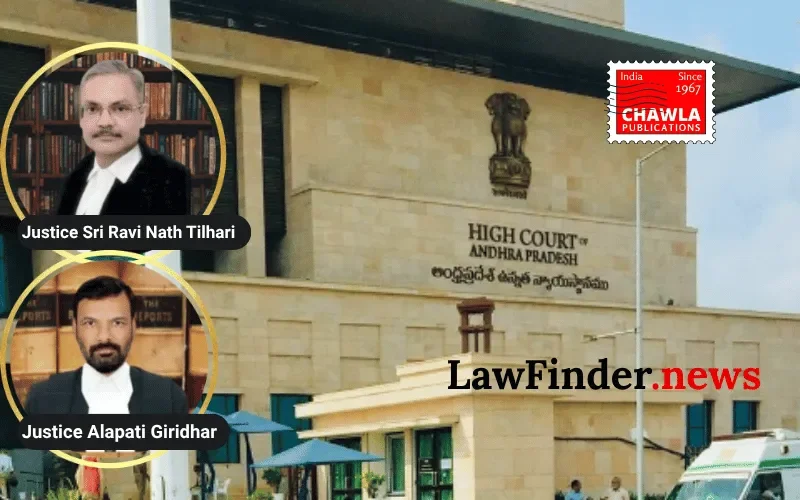
In a significant judgment dated October 16, 2026, the Andhra Pradesh High Court, in a Division Bench comprising Justices Ravi Nath Tilhari and Alapati Giridhar, dismissed a writ petition filed by the Christian Joint Action Committee (CJAC) challenging the judicial remand of Batchalakuri Joseph @ Ravan. The petition contested the validity of the remand order passed by the XII Additional Junior First Class Magistrate at Gannavaram, contending violations of the constitutional safeguards under Article 22(1) and 22(2) of the Constitution of India and procedural irregularities, including alleged delay in production before the Magistrate and lack of territorial jurisdiction.
The petitioner, CJAC, argued that Joseph was arrested on July 4, 2026, near Vempadu Toll Plaza, Anakapalli District, but was produced before the Magistrate at Gannavaram only after more than 24 hours, violating the statutory requirement under Article 22(2) and the Bharatiya Nagarik Suraksha Sanhita, 2023 (BNSS), which mandates production within 24 hours excluding the time necessary for the journey. The petitioners contended that the exclusion of travel time applies only to physically incapacitated accused requiring medical care, which was not the case here, and hence the delay was unlawful. They also raised issues about the territorial jurisdiction of the Magistrate granting remand, alleging the FIR was malicious and that multiple FIRs were registered for the same speech, violating the principle against successive FIRs.
The State, represented by Senior Advocate Siddharth Luthra and the Advocate General, defended the remand order's validity. They emphasized that the FIR pertained to content uploaded on a digital platform accessible statewide, including Gannavaram, thus justifying the FIR and remand jurisdiction. They argued that the production was within 24 hours once travel time was excluded, as mandated by Article 22(2), and that the remand order was a judicial act duly applying mind to the facts. They further submitted that the petitioner had not pleaded non-communication of grounds of arrest with factual foundation, and that no statutory violation occurred regarding the arrest procedure.
The Court examined the maintainability of the writ petition for habeas corpus, reiterating settled Supreme Court precedents that such petitions are maintainable only if the remand order itself is challenged on grounds of lack of jurisdiction, absolute illegality, or mechanical exercise of power. The Court held that since the petition specifically challenged the remand order, the writ was maintainable but stressed that the relief for immediate release would depend on the validity of the remand.
On the key issue of production within 24 hours, the Court interpreted Article 22(2) strictly, holding that the constitutional provision clearly mandates exclusion of travel time from the 24-hour period for production of arrested persons before a Magistrate. The Court rejected the petitioners' submission that travel time exclusion applies only to incapacitated accused, affirming that the language of Article 22(2) is unambiguous and applies to every arrested person regardless of health condition. Based on the petitioners' own submission that travel time was approximately 4 hours and 43 minutes, the Court concluded that the accused was produced within the prescribed period, negating any violation of the constitutional right.
Regarding territorial jurisdiction, the Court noted that since the FIR related to a speech available on a digital platform accessible throughout Andhra Pradesh, including Gannavaram, the FIR's registration and subsequent remand by the Gannavaram Magistrate were valid. The Court cited authoritative Supreme Court rulings affirming that investigation and jurisdiction can extend to multiple territorial areas when offences are committed through digital means or continuing acts.
The Court also addressed the contention on non-communication of grounds of arrest, observing that the petition's affidavit lacked factual foundation on this point. The remand order and report indicated that grounds were communicated, including to the detenu's spouse, and there was no dispute on this in the petition. Hence, no illegality was found.
Importantly, the Court deprecated the recent trend of filing voluminous written submissions and citations not pressed during oral arguments, cautioning the Registry against accepting such without the Court's permission. The Court emphasized that written submissions are no substitute for oral arguments and must remain within the scope of pleadings and points actually argued.
Ultimately, the Andhra Pradesh High Court upheld the remand order, held the detention lawful, and dismissed the habeas corpus petition. The Court observed that any further challenge to the remand order on other grounds must be pursued through appropriate statutory remedies.
This judgment reiterates the careful balance between safeguarding personal liberty under Article 22 and the procedural necessities of criminal investigation, particularly in the evolving context of digital evidence and jurisdiction.
Bottom Line:
Habeas corpus against judicial remand is maintainable only when remand order itself is specifically challenged on grounds of lack of jurisdiction, absolute illegality or mechanical exercise of power - Exclusion of journey time under Article 22(2) of Constitution applies to every arrested person and is not confined to sick or incapacitated accused - Remand by Magistrate in present case held valid and detention not illegal.
Statutory provision(s):
Article 22(1), Article 22(2) of the Constitution of India, Sections 57, 58, 167, 178 of the Code of Criminal Procedure, 1973, Sections 58, 187 of Bharatiya Nagarik Suraksha Sanhita, 2023, Sections 13, 39 of Unlawful Activities (Prevention) Act, 1967, Sections 41A, 48(2) of BNSS, Sections 147, 148, 152, 192, 197(1)(d), 353(1)(b) of Bharatiya Nyaya Sanhita, 2023