Introduction: A changing landscape
The legal profession is standing at the threshold of a profound technological transformation. Artificial Intelligence (AI), once viewed as a distant innovation, is now influencing the way legal information is researched, documents are analysed, pleadings are drafted and professional services are delivered. For advocates, the central question is no longer whether AI has a place in legal practice. It is how to use it intelligently, ethically and responsibly without compromising the independence, accuracy and integrity that define the profession. Like earlier developments in legal technology, AI can be a valuable assistant. It can improve efficiency, help manage large volumes of information and make preliminary analysis faster. But the law is not merely a collection of searchable words. It is a living discipline involving interpretation, precedent, evidence, fairness and the careful application of principles to human circumstances. Technology must serve that discipline—not dictate it.
Where AI can assist advocates
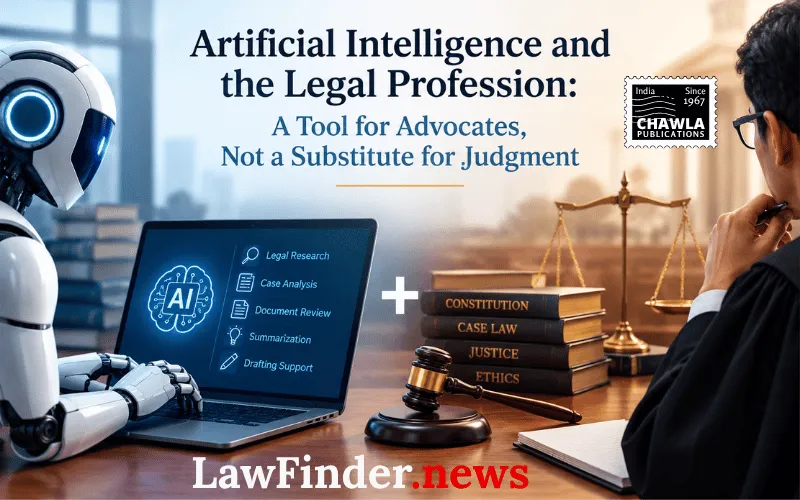
AI tools can support several routine but time-consuming aspects of practice. They may help locate potentially relevant legal issues, summarise lengthy judgments, prepare a chronology from a set of documents, compare versions of a contract, organise pleadings and identify questions that require further research. They can also help advocates improve the structure and clarity of a draft, prepare a first outline of written submissions, or explain complicated legal concepts in plain language for a client. In cases involving voluminous records, AI-assisted document review may help flag repeated names, dates, transactions or apparent inconsistencies. It can assist in creating an index of documents and in comparing a witness’s different statements. These functions may be particularly useful during preparation for trial, bail hearings, civil disputes, commercial litigation and appellate proceedings. However, a flagged inconsistency is only a lead for investigation; it is not, by itself, proof of falsehood or guilt. AI can also help advocates test their own arguments. By asking a tool to identify possible weaknesses, counterarguments or unanswered questions, counsel may obtain a useful checklist before a hearing. The final assessment, however, must be made by the advocate after considering the complete record, applicable law and client’s legitimate interests.
Legal research: Verification is non-negotiable
The most serious risk in AI-assisted legal research is that a system may produce information that sounds authoritative but is wrong. It may invent a case, misstate a holding, attribute a quotation to the wrong judgment, provide an incorrect paragraph number or overlook a later decision that has overruled or distinguished the authority. This is sometimes described as an AI “hallucination,” but the practical consequence is straightforward: unverified material can damage a submission and undermine the advocate’s credibility before the court. Every case citation suggested by AI should be checked through an authentic legal database or the official source wherever available. The advocate should read the relevant passages in the original judgment, verify the court and date, examine the procedural and factual context, and determine whether the decision remains good law. A headnote or a short AI summary should never replace the judgment itself. Statutes, rules, amendments, notifications and jurisdiction-specific requirements must likewise be checked independently. Research should also distinguish binding precedent from persuasive authority. A decision from another jurisdiction may be informative without being binding; an observation made in passing may not constitute the ratio decidendi. AI can help generate search terms and identify possible lines of inquiry, but the advocate must determine the legal weight of each authority and whether it actually supports the proposition for which it is cited.
Drafting and evidence analysis: A starting point, not the final product
AI can assist in preparing the structure of a petition, reply, legal notice, written submission or opinion. It may suggest clearer headings, identify repetitive passages, flag missing dates or help convert a long narrative into a chronology. In criminal matters, it may help organise the prosecution version alongside the defence account, list questions arising from medical or forensic documents, or prepare a checklist of issues for cross-examination. Yet legal drafting depends on precision. A seemingly minor change in wording may alter the scope of a prayer, admit a disputed fact or weaken a defence. A summary may omit an exception, qualification or crucial sentence. A question proposed for cross-examination may be irrelevant, inadmissible or inconsistent with the case strategy. Accordingly, the advocate must compare every AI-assisted draft with the original documents, instructions and applicable law. The tool should improve the advocate’s work—not introduce facts, assumptions or arguments that the record cannot support. In evidence analysis, AI should be used with particular care. A machine may identify a difference between two statements, but it cannot automatically determine whether that difference is material, explainable or legally significant. The evidentiary value of a medical report, DNA result, electronic record or witness statement depends on context, admissibility, reliability and the applicable legal standards. These are matters for careful professional assessment.
Confidentiality, privacy and client trust
The duty to protect client information must remain central to the use of AI. Advocates routinely handle privileged communications, personal details, financial records, medical information, business secrets and investigation papers. Entering such material into a public or unapproved AI platform without understanding its data practices may create risks involving storage, access, retention or further use of the information. Before using any tool, advocates should review its privacy terms, security controls, retention policy and any available organizational safeguards. Identifying details should be removed wherever practicable, and only the minimum information needed for the task should be supplied. Sensitive documents should not be uploaded to a platform unless the advocate has a sound basis for doing so and the necessary safeguards are in place. Chambers and law firms should consider clear policies governing approved tools, access permissions and the handling of client material. Confidentiality is not merely a technical requirement; it is a foundation of the relationship between lawyer and client. Efficiency gained through AI is never worth exposing a client’s private information to avoidable risk.
Professional responsibility and court-facing work
The use of AI does not transfer professional responsibility from the advocate to the software provider. If an AI-generated draft contains an inaccurate statement, a fabricated authority or an allegation unsupported by the record, the advocate remains responsible for checking it before use. Court submissions must be candid, accurate and grounded in the material properly available to counsel. Advocates should follow applicable court directions, professional conduct requirements and any relevant disclosure rules concerning AI-assisted work. They should not use AI to create fictitious evidence, manufacture citations, misrepresent the contents of a document or produce misleading material. Nor should an advocate allow automated output to replace the duty to exercise independent judgment in the client’s interests and in assistance to the court. The correct approach is neither fear nor blind acceptance. It is informed, transparent and accountable use, with a human professional reviewing the work at every consequential stage.
The human element cannot be automated
Justice involves more than processing information. Courts weigh competing submissions, assess evidence, apply legal principles and consider constitutional values and individual circumstances. Advocacy requires judgment, persuasion, empathy, ethical restraint and an understanding of courtroom dynamics. It also requires the ability to recognise when a technically available argument is factually unsustainable, legally inappropriate or contrary to the client’s broader interests. An experienced advocate brings context and professional intuition developed through practice. AI may offer several possible arguments, but it cannot assume responsibility for choosing the right one, making a difficult concession, advising a client about risk or deciding how to present a sensitive matter. The human element is not a weakness in the legal system; it is one of the reasons professional advocacy remains essential.
A practical checklist for responsible use
A disciplined approach to AI can be built around a few simple safeguards:
- 1. Verify every case, citation, quotation, statutory provision and legal proposition against an authentic source.
- 2. Read the original judgment or document rather than relying solely on an AI-generated summary.
- 3. Protect privileged and personal information; use approved tools and remove identifiers wherever practicable.
- 4. Check every draft against the case record, client instructions and applicable procedural requirements.
- 5. Treat AI output as a research aid or preliminary draft, never as an unquestionable legal opinion.
- 6. Keep a human review step before any material is filed, served, communicated as legal advice or relied upon in court.
- 7. Follow applicable professional standards, court directions and disclosure requirements.
- 8. Continue developing technological literacy so that advocates can recognise limitations, bias and inaccurate output.
Bar associations, law schools and continuing legal education programmes can help by offering practical training on safe prompting, legal verification, privacy and responsible use of AI. The goal should be to prepare advocates for technological change while preserving the profession’s core standards.
Conclusion: Use technology, retain judgment AI is likely to become an increasingly common part of legal practice. Advocates who learn to use it carefully may be able to manage information more efficiently, conduct more focused research and devote greater time to strategy and client service. But the quality of legal work will continue to depend on the person who verifies the material, understands the case and accepts responsibility for the result. The future will not belong simply to those who use the most advanced tool. It will belong to those who combine technological competence with legal knowledge, ethical integrity and independent judgment. Rejecting every innovation may mean losing useful opportunities; trusting technology without verification may put accuracy, confidentiality and professional credibility at risk. AI may help an advocate find the law, organise the facts and refine an argument. It cannot take over the responsibility to uphold justice, protect the client’s interests and assist the court honestly. The guiding principle for the profession must be clear: use AI to enhance intelligence, not surrender it; to strengthen advocacy, not replace it; and to serve justice, never to shortcut it.



