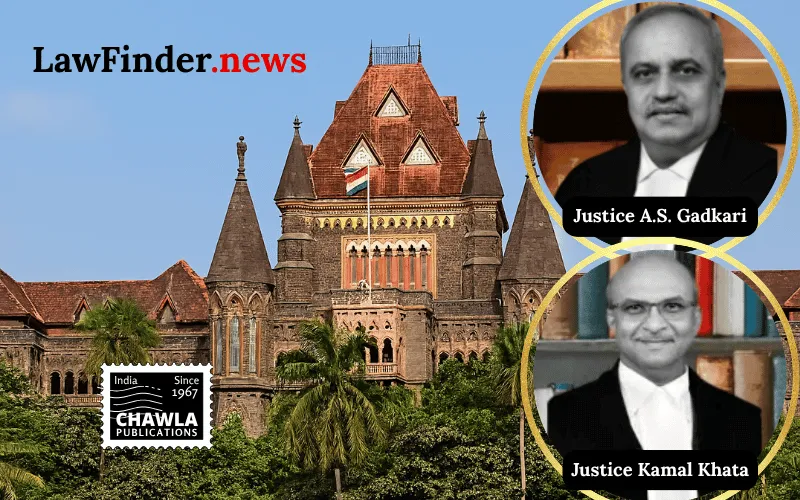
Court refuses to direct Joint Charity Commissioner to follow only Section 41D(2)(c) procedure, terming the petition an attempt to sabotage ongoing proceedings
In a significant judgment dated September 24, 2026, the Bombay High Court (Division Bench comprising Justices A.S. Gadkari and Kamal Khata) dismissed a writ petition filed by Niket V. Mehta, an alleged beneficiary of the Lilavati Kirtilal Mehta Medical Trust. The petitioner sought a direction to the Joint Charity Commissioner-I, Mumbai, to strictly follow the procedure prescribed under Section 41D(2)(c) of the Maharashtra Public Trusts Act, 1950, in an application pending adjudication before the Commissioner.
The petitioner's writ petition was filed under Articles 226 and 227 of the Constitution of India, aiming to restrict the adjudicating authority to follow only the specific sub-clause (2)(c) of Section 41D, rather than the entire procedural framework prescribed under Section 41D of the Maharashtra Public Trusts Act. The petitioner further sought an expeditious disposal of the said application.
The Court, after hearing counsel for the parties at length, expressed its inability to accept the petitioner's insistence on such a limited procedural directive. The bench observed that the writ petition appeared to be an attempt to sabotage and protract the statutory proceedings before the Joint Charity Commissioner by selectively enforcing a part of the procedure instead of the whole. The Court was of the view that it could not direct the adjudicating authority to follow only a particular part of the statutory procedure when the application itself was filed under the comprehensive Section 41D.
Interestingly, the Court indicated a willingness to allow the petition if the specific reference to sub-section (2)(c) was deleted, signifying that it was open to grant reliefs for the expeditious hearing and disposal of the application under the entire Section 41D procedure. However, the petitioner's counsel opposed this suggestion, insisting on the original prayers. The bench deprecated this stance and refused to hear the petition on merits merely to pass the specific order sought by the petitioner.
Consequently, the petition was dismissed in limine. All interim applications connected to the main petition were also disposed of. The petitioner's request to continue an ad-interim relief for two weeks to enable him to approach the Supreme Court was rejected by the bench, which observed that the petitioner seemed inclined to unnecessarily prolong the litigation.
This judgment underscores the Bombay High Court's firm stance against attempts to manipulate or delay statutory adjudication processes through selective procedural demands. It also reaffirms the principle that courts will not interfere with the statutory procedural framework prescribed by legislation unless there is a compelling reason to do so.
Bottom Line:
Maharashtra Public Trusts Act, 1950 - Petition under Articles 226 and 227 seeking direction to Joint Charity Commissioner to follow only procedure under Section 41D(2)(c) in pending Section 41D proceedings - High Court held it cannot direct adjudicating authority to follow only a particular part of statutory procedure instead of entire procedure under Section 41D - Petition seeking such relief viewed as attempt to sabotage/protract proceedings - Petition dismissed in limine and request for continuation of ad-interim relief rejected.
Statutory provision(s):
Maharashtra Public Trusts Act, 1950 - Section 41D, Section 41D(2)(c)
Constitution of India, 1950 - Articles 226, 227
Niket V. Mehta v. Charu K. Mehta, (Bombay)(DB) : Law Finder Doc Id # 2991150



