Court holds disciplinary order unsustainable for violating natural justice and ignoring settled Supreme Court law on choice of treatment.
The Bombay High Court has set aside an order of the Medical Council of India (MCI) that had directed the removal of two doctors from the medical register after finding them guilty of medical negligence in the treatment of a patient suffering from urinary tract and urethral problems.
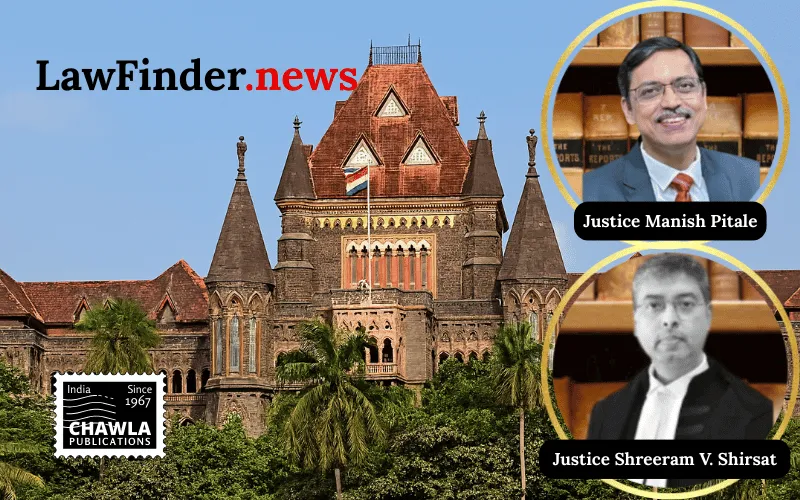
A Division Bench of Justices Manish Pitale and Shreeram V. Shirsat held that the MCI’s order dated 24 August 2013 was unsustainable because it suffered from serious procedural lapses and was based on cryptic, unreasoned findings. The Court found that the doctors were not supplied copies of the appeal memo and supporting documents filed by the complainant, were not given notice of later meetings of the Ethics Committee, and were heard by a committee that did not include any urologist, despite the dispute relating to urological procedures.
The case arose from a complaint by a patient, Murad Hasan Mulla, who alleged that Dr. Munir Sufi Mhaskar and Dr. Jaydeep Arun Date had acted negligently while treating his recurring urinary and urethral ailments. The Maharashtra Medical Council had earlier exonerated both doctors, holding that the treatment given was appropriate for a chronic condition and that there was no violation of medical ethics. However, on appeal by the complainant, the MCI reversed that decision and imposed punishment by directing removal of Dr. Mhaskar’s name from the register for three years and Dr. Date’s name for six months.
Before the High Court, both doctors argued that the MCI proceedings violated principles of natural justice. They contended that they were only given a hearing notice, not the appeal papers or documents, and that the Ethics Committee held meetings on 24 and 25 May 2013 behind their backs. The Court accepted these objections, noting that the respondents did not deny non-supply of the appeal material. It also observed that the absence of a urology specialist on the Ethics Committee was a significant defect in a matter requiring technical medical evaluation.
On merits, the Court relied heavily on Supreme Court rulings including Jacob Mathew, Martin F. D’Souza, Kusum Sharma, and Vinod Jain, reiterating that a doctor cannot be held negligent merely because another recognized treatment could have been chosen. The Court said negligence can be established only if the doctor lacked the requisite skill or failed to exercise reasonable competence.
In Dr. Mhaskar’s case, the Court found material on record showing that cystoscopy, urethral dilatation, and related procedures were part of the MS (General Surgery) curriculum and were performed by general surgeons. It held that the procedure he undertook was within his qualification and training, and that recurrence of urethral stricture by itself could not prove negligence.
In Dr. Date’s case, the Court found that the allegation was essentially that he chose one recognized surgical option over another. The Bench held that this could not amount to negligence, especially when both procedures were accepted in medical practice. The Court also noted that both doctors had taken the patient’s consent.
The Bench further observed that although remand was one possible course, it would not be appropriate in view of the long pendency of the case and the change in law after the enactment of the National Medical Commission Act, 2019. The Court therefore decided the matter on merits and quashed the MCI’s order in full.
Bottom Line :
Medical negligence - Order of Medical Council of India removing names of doctors from Medical Register held unsustainable - Non-supply of appeal memo and documents, absence of urologist in Ethics Committee, and reliance on cryptic, unreasoned findings amounted to violation of principles of natural justice - Doctor cannot be held guilty of medical negligence merely for choosing one recognized course of treatment over another, if treatment was within his skill, qualification and accepted medical practice.
Statutory provision(s): Article 226, Indian Medical Council Act, 1956, Medical Council of India Regulations, 2000, Indian Medical Council (Professional Conduct, Etiquette and Ethics) Regulations, 2002, National Medical Commission Act, 2019, Section 30, National Medical Commission Act, 2019, Section 60
Dr. Jaydeep Arun Date v. Medical Council of India, (Bombay)(DB) : Law Finder Doc id # 2983392