Court validates Supreme Court's transitional directions in Bhumika Trust case, requiring one year of active legal practice for law graduates after August 22, 2025, to apply for Civil Judge Junior Division posts
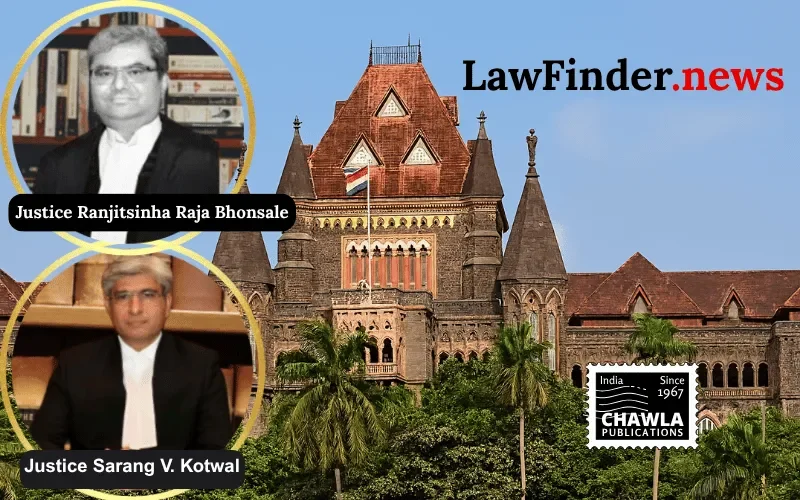
In a significant judgment dated November 5, 2026, the Bombay High Court (Division Bench comprising Justices Sarang V. Kotwal and Ranjitsinha Raja Bhonsale) dismissed writ petitions challenging a corrigendum issued by the Maharashtra Public Service Commission (MPSC) concerning recruitment to the posts of Civil Judge Junior Division and Judicial Magistrate First Class. The petitioners, Satish Maulyawan Patole and Jinesh Jitendra Koli, fresh law graduates enrolled as advocates in June 2026, sought permission to apply for the preliminary examination scheduled pursuant to Advertisement No. 013/2026. They contended that the Supreme Court's decision in Bhumika Trust v. Union of India (2026 SCC Online SC 1687) made all law graduates eligible to apply regardless of the prior practice requirement.
The Bombay High Court, however, upheld the corrigendum dated October 23, 2026, which restricted the deemed benefit of one year of active legal practice only to those law graduates who obtained their degrees before August 22, 2025. The court observed that the Supreme Court in Bhumika Trust did not abolish the requirement of prior court exposure or practice but provided a transitional framework for eligibility during the interim period ending March 31, 2027.
The Supreme Court's directions in the Bhumika Trust case clarified that:
- All law graduates shall be eligible to apply notwithstanding the three-year practice requirement during the transitional period, but those eligible are deemed to have completed one year of active practice only if their law degree was obtained at least one year prior to the judgment (August 21, 2026).
- Candidates selected during this period are designated "Trainee Judicial Officers" and must undergo one year of intensive training at the State Judicial Academy, followed by a one-year structured Law Clerkship under judicial supervision. Both training and clerkship periods are treated as equivalent to one year each of legal practice to satisfy the three-year requirement.
- For recruitment cycles starting April 1, 2027, candidates must have at least one year of actual practice, supported by certification, to be eligible.
Rejecting the petitioners' argument that the Supreme Court's use of the term "all law graduates" in paragraph 73(i) meant fresh graduates after August 22, 2025, were also eligible, the court emphasized that the direction must be read as a whole. The deemed one-year practice benefit applies only as a transitional provision for law graduates who had their degrees at least one year before the judgment date. Fresh graduates who obtained degrees after August 22, 2025, must satisfy the actual one-year practice requirement before applying.
The court further relied on earlier Supreme Court judgments, including the All India Judges Association cases, which consistently recognized the necessity of prior court exposure and practice to develop judicial temperament and competence. The three-year practice norm was not struck down but restructured to include practical experience, institutional training, and supervised clerkship.
The Bombay High Court concluded that the corrigendum issued by MPSC was in consonance with Supreme Court directions and was a valid exercise of compliance. Any contrary direction permitting fresh law graduates without the requisite practice period to apply would violate binding Supreme Court judgments. Accordingly, the petitions were dismissed, and the rule discharged.
This judgment reinforces the importance of practical legal exposure prior to entry into the judiciary and clarifies the scope of transitional provisions in judicial recruitment post the Bhumika Trust ruling.
Bottom Line:
Judicial service recruitment - Civil Judge Junior Division & Judicial Magistrate First Class - Corrigendum restricting benefit of deemed one year active practice to law graduates who had obtained law degree prior to one year from Supreme Court judgment in Bhumika Trust held valid - Supreme Court in Bhumika Trust did not abolish requirement of prior court exposure/practice; it only provided transitional arrangement - Fresh law graduates obtaining degree after 22.08.2025 not entitled to apply under impugned recruitment without satisfying one year requirement as contemplated in transitional directions.
Statutory provision(s): Article 142 of the Constitution of India, Bar Council of India Rules (enrollment of advocates), Service Rules governing judicial recruitment (as per Supreme Court directions)
Satish Maulyawan Patole v. State of Maharashtra, (Bombay)(DB) : Law Finder Doc Id # 3012780