Court rules exemption aligns with cultural and religious practices, does not violate constitutional equality.
In a significant ruling, the Bombay High Court, Nagpur Bench, upheld the exemption for Sikhs from wearing helmets while riding motorcycles, as provided under the Motor Vehicles Act, 1988. The decision came in response to a challenge against the proviso to Section 129 of the Act, which the petitioner argued violated Article 14 of the Indian Constitution.
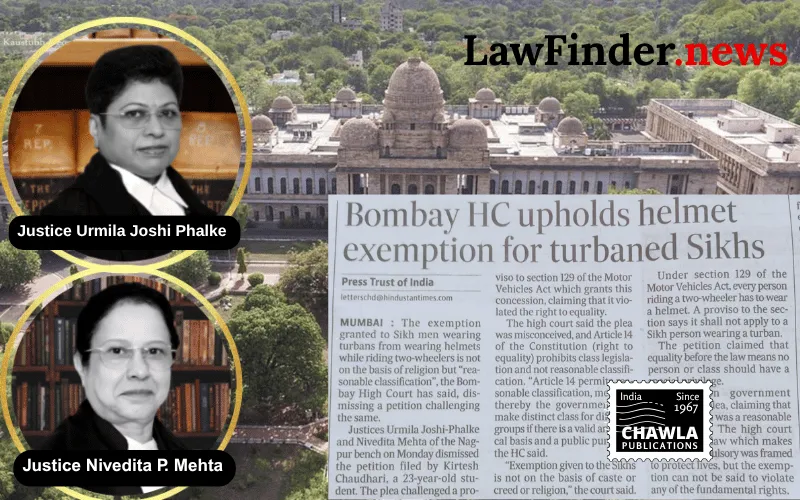
Delivering the judgment on June 29, 2026, a division bench comprising Justices Urmila Joshi-Phalke and Nivedita P. Mehta dismissed the petition, affirming that the exemption is a reasonable classification based on intelligible differentia, which is not arbitrary or discriminatory. The bench emphasized that Article 14 prohibits class legislation but allows for reasonable classification that has a rational nexus with the objective sought to be achieved.
The court noted that the exemption is in recognition of the cultural and religious practices of the Sikh community, particularly the wearing of turbans, which serves a similar protective function as helmets. It further stated that the exemption does not undermine road safety objectives, as it accommodates significant cultural and religious practices.
Citing precedents, the court referenced the Supreme Court's and Delhi High Court's prior decisions, which similarly upheld the exemption for Sikhs under the Motor Vehicles Act. The court remarked that the legal issue had been extensively considered in earlier judgments and found no grounds to declare the proviso unconstitutional.
The judgment also highlighted that the classification under the proviso is not based on caste or creed but rather on the distinctive practice of wearing turbans by Sikh men, which fulfills the provision's intent.
The petitioner, appearing in person, had contended that the exemption constituted class legislation and denied equal protection under the law. However, the court rejected these arguments, reiterating that the exemption is a permissible classification under Article 14.
The decision underscores the judiciary's role in balancing cultural sensitivities with legislative objectives, reinforcing the principle that exemptions based on reasonable classification do not contravene constitutional mandates.
Bottom Line:
Motor Vehicles Act, 1988 - Section 129 - Exemption for Sikhs from wearing helmets while riding motorcycles upheld - Held, such exemption is not violative of Article 14 of the Constitution as it constitutes reasonable classification.
Statutory provision(s): Motor Vehicles Act, 1988, Section 129, Constitution of India, 1950, Article 14
Kirtesh v. Union of India, (Bombay)(DB)(Nagpur Bench) : Law Finder Doc id # 2933096