Court holds that mere recovery of tainted money is not enough for conviction under the Prevention of Corruption Act without clear proof of demand and acceptance.
The Chhattisgarh High Court has set aside the conviction of Murli Prasad Choudhary, an accountant in the District Education Officer’s office at Surajpur, and acquitted him of corruption charges, holding that the prosecution failed to prove the essential ingredient of demand of illegal gratification.
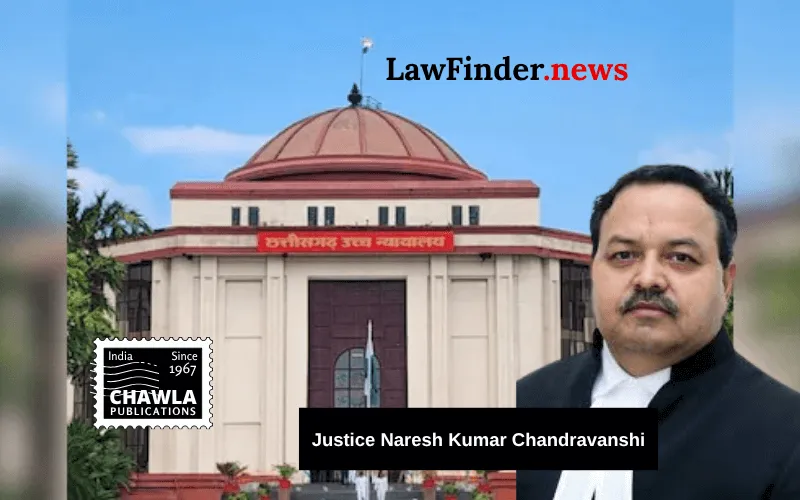
The judgment was delivered by Justice Naresh Kumar Chandravanshi in Criminal Appeal No. 569 of 2017, challenging the trial court’s order dated March 30, 2017, which had convicted the appellant under Sections 7 and 13(1)(d) read with Section 13(2) of the Prevention of Corruption Act, 1988.
According to the prosecution, the complainant, Mohit Ram Rajwade, who was associated with a school management committee, alleged that the appellant had demanded a bribe of ?15,000 for processing school recognition, later allegedly reduced to Rs. 8,000. A trap was laid by the Anti-Corruption Bureau, and currency notes treated with phenolphthalein powder were allegedly recovered from the appellant’s trouser pocket.
However, the High Court found that the case collapsed on the question of demand. The complainant turned hostile and denied that the appellant had ever demanded or accepted any bribe. Another key witness, Kunwar Sai, also did not support the prosecution version and stated that the complainant had forcibly placed the money in the appellant’s pocket. The Court noted that none of the independent witnesses supported the prosecution on the crucial issue of demand.
The Court also rejected the prosecution’s reliance on the recorded conversation and its transcript. It observed that no certificate under Section 65-B of the Indian Evidence Act had been obtained for the electronic recording, and no voice sample or forensic authentication was produced to prove that the voice in the recording was that of the appellant.
Referring to recent Supreme Court decisions, including Neeraj Dutta v. State (NCT of Delhi), P. Somaraju v. State of Andhra Pradesh, and Rajesh Gupta v. CBI, the High Court reiterated that proof of demand and acceptance is a sine qua non for conviction under the Prevention of Corruption Act. The Court emphasized that recovery of tainted currency alone cannot sustain a conviction in the absence of proof of demand beyond reasonable doubt.
Holding that the prosecution had failed to establish the foundational facts necessary for conviction, the Court quashed the trial court’s judgment and acquitted the appellant. It also directed that the appellant’s bail bond be discharged, with the bond to remain operative for six months in terms of the Bharatiya Nagarik Suraksha Sanhita, 2023, and ordered refund of any fine deposited.
Bottom Line:
Prevention of Corruption Act - Proof of demand and acceptance of illegal gratification is a sine qua non for conviction under Sections 7 and 13(1)(d) read with Section 13(2) of the Act - Mere recovery of currency notes does not constitute an offence unless demand and acceptance are proved beyond reasonable doubt.
Statutory provision(s): Section 7, Section 13(1)(d) read with Section 13(2) of the Prevention of Corruption Act, 1988, Section 65-B of the Indian Evidence Act, 1872, Section 374(2) of the Code of Criminal Procedure, 1973, Section 481 of the Bharatiya Nagarik Suraksha Sanhita, 2023
Murli Prasad Choudari v. State of Chhattisgarh, (Chhattisgarh) : Law Finder Doc Id # 2981424