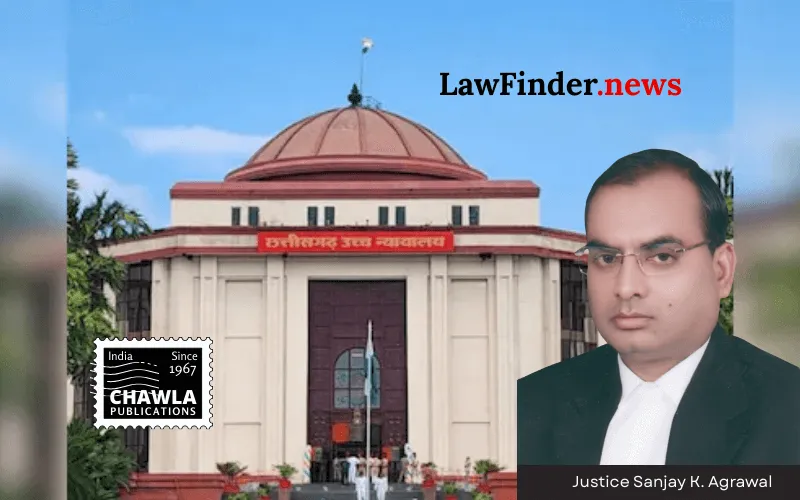
Court Rules Enquiry Officer's Role as Prosecutor Violated Principles of Natural Justice; Directs Fresh Inquiry in Accordance with Law
In a significant judgment delivered on August 31, 2026, the Chhattisgarh High Court set aside the dismissal order against Surendra Singh Kachhawah, a Police Constable in the Department of Police, Wireless (Telecommunication), holding that the disciplinary enquiry conducted against him was vitiated due to violation of the principles of natural justice. The Court observed that the Enquiry Officer, in the absence of an appointed Presenting Officer, had assumed the role of a prosecutor by leading and suggesting evidence in favor of the charges, thereby losing impartiality and fairness required in such quasi-judicial proceedings.
The petitioner was charged with entering into a second marriage during the lifetime of his first wife without prior permission from the Department, allegedly violating Rule 22(1) of the Chhattisgarh Civil Services (Conduct) Rules, 1965. After the departmental enquiry, a penalty of removal from service was imposed, which was confirmed by the appellate authority. Challenging this order under Article 226 of the Constitution of India, the petitioner contended that the enquiry was unfair as no Presenting Officer was appointed and the Enquiry Officer himself acted as prosecutor.
The Court carefully examined the applicability of the Chhattisgarh Civil Services (Classification, Control and Appeal) Rules, 1966 ("Rules of 1966") to subordinate police personnel, including police constables, affirming the position laid down by the Madhya Pradesh High Court in precedents such as Premchandra Dhalpuria v. State and Mahesh Kumar Shrikishan Tiwari v. State of Madhya Pradesh. It was held that these rules apply alongside the Chhattisgarh Police Regulations and govern disciplinary proceedings against subordinate police officers.
Rule 14(5)(c) of the Rules of 1966 provides that a Presenting Officer may be appointed to present the case on behalf of the disciplinary authority but does not make such appointment mandatory. The Court emphasized that the Enquiry Officer must maintain impartiality and cannot act as prosecutor, as doing so amounts to bias and denial of fair hearing. The Court relied on authoritative decisions, including the Madhya Pradesh High Court's ruling in Union of India v. Naseem Siddiqui and the Supreme Court's decision in Union of India v. Ram Lakhan Sharma, which clarify that:
- - Non-appointment of a Presenting Officer does not ipso facto vitiate the enquiry.
- - The Enquiry Officer can ask questions for clarification but cannot conduct examination-in-chief or cross-examination in a manner that supports the prosecution's case.
- - If the Enquiry Officer acts as prosecutor, the enquiry is vitiated due to breach of natural justice and bias.
In the present case, the Court found that the Enquiry Officer cross-examined prosecution witnesses including the petitioner and his second wife by putting leading and suggestive questions to elicit evidence supporting the charges. This conduct was held to be a clear assumption of the prosecutorial role, resulting in loss of impartiality.
Consequently, the Court quashed the orders dated January 23, 2004, and December 28, 2018, which imposed and confirmed the dismissal. The petitioner was directed to be reinstated if he had not yet attained the age of superannuation, with all consequential benefits except back wages. The petitioner was also given liberty to seek back wages by making a representation to the competent authority. The respondents were permitted to conduct a fresh enquiry from the stage of evidence, strictly adhering to the principles of natural justice.
This judgment reinforces the fundamental requirement of impartiality in disciplinary proceedings and provides clear guidance that an Enquiry Officer must not compromise their role by acting as prosecutor, especially in the absence of a Presenting Officer. It underscores the necessity for fair and unbiased enquiry procedures in government service disciplinary matters.
Bottom Line:
Disciplinary proceedings - Non-appointment of Presenting Officer does not ipso facto vitiate the enquiry, but if the Enquiry Officer assumes the role of prosecutor by leading or suggesting evidence in favor of charges, the enquiry is vitiated due to bias and denial of a fair hearing.
Statutory provision(s):
Chhattisgarh Civil Services (Classification, Control and Appeal) Rules, 1966 - Rule 14(5)(c), Chhattisgarh Civil Services (Conduct) Rules, 1965 - Rule 22(1), Article 226 of the Constitution of India