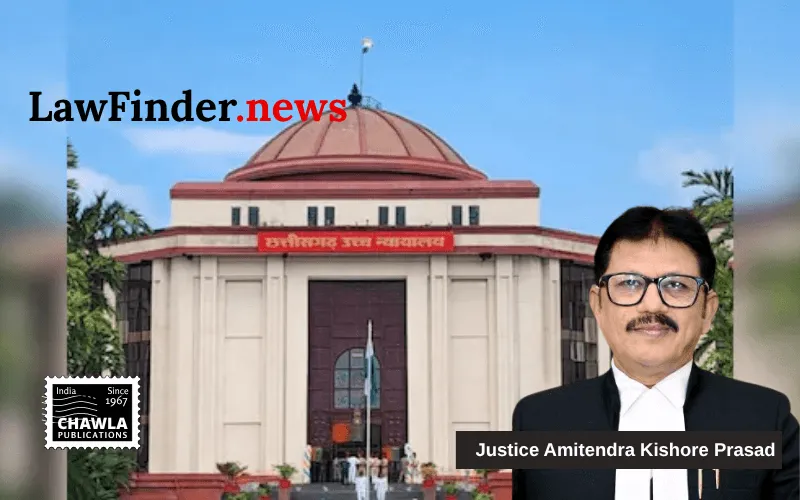
Court Rules Commission Exceeded Jurisdiction, Reiterates Its Role as Recommendatory and Facilitative
In a significant ruling, the Chhattisgarh High Court has quashed the recommendation made by the Chhattisgarh State Women Commission to transfer Digree Lal Patel, the In-charge Principal of a Government School in Raigarh, to another block. The court declared that the commission overstepped its jurisdiction, emphasizing its role as recommendatory and facilitative rather than adjudicatory.
The judgment, delivered by Justice Amitendra Kishore Prasad, arose from a writ petition filed under Article 226 of the Constitution of India, wherein Patel challenged the legality and propriety of the commission's proceedings and recommendations made on July 6, 2026. The recommendation came in response to a complaint lodged by an assistant teacher, who alleged misconduct and other grievances against Patel.
The court observed that the State Women Commission, as per the State Commissions for Women Act, 1993, is authorized to receive complaints and take them up with relevant authorities for remedial measures. However, it lacks the authority to issue binding directions affecting the service conditions of employees, such as transfer orders, which fall under the exclusive domain of competent departmental authorities as per service rules and administrative frameworks.
The court referred to precedents including the Supreme Court's judgment in Bhabani Prasad Jena v. Convenor Secretary, Orissa State Commission for Women, which clarified that state commissions have a recommendatory role and cannot adjudicate or determine the rights of parties. It also cited the case of Mumbai Port Authority v. National Commission for Scheduled Caste, reinforcing that statutory bodies with limited powers cannot transform their fact-finding jurisdiction into adjudicatory authority.
In Patel's case, the court found that the commission's recommendation was not just a request for grievance consideration but a directive for a specific service-related action, which exceeded its statutory jurisdiction. Consequently, the court set aside the recommendation, allowing Patel's writ petition.
The ruling underscores the necessity for statutory bodies to operate within their legally defined roles. It also highlights the importance of procedural fairness and statutory compliance in administrative actions involving service conditions of employees.
The court, however, clarified that its order does not preclude competent authorities from addressing the assistant teacher's grievances within the framework of the law, nor does it restrict the State Women Commission from exercising its lawful powers.
Bottom Line :
State Women Commission does not have the jurisdiction to issue binding directions affecting service conditions of an employee; its role is limited to recommendatory and facilitative functions.
Statutory provision(s): Article 226 of the Constitution of India, State Commissions for Women Act, 1993, Section 10.
Digree Lal Patel v. State of Chhattisgarh, (Chhattisgarh) : Law Finder Doc id # 2967104