Court Rules Municipal Council's Deviation from Lease Terms Justifies Cancellation; Individual Liability for Collective Decisions Not Imposed Without Mens Rea or Dominant Role
In a significant judgment delivered on June 29, 2026, the Chhattisgarh High Court dealt with multiple writ petitions arising from the cancellation of leases granted by the Municipal Council, Balod, under the Integrated Development of Small and Medium Towns (IDSMT) Scheme. The Court upheld the State Government's decision to cancel the leases issued to private allottees, finding that the Municipal Council had violated the explicit terms of the lease agreement which mandated the land be used solely for residential construction for eligible beneficiaries.
The case arose when the Municipal Council, Balod, was allotted approximately 22 acres of government land under the IDSMT Scheme for residential development. The lease was executed on September 17, 2008, between the State of Chhattisgarh (in the name of the Governor) and the Council, with strict conditions prohibiting commercial use and sub-leasing without prior governmental permission. The lease also specified that any deviation would lead to immediate cancellation and forfeiture of the land and structures to the State.
Contrary to these terms, the Municipal Council auctioned plots of undeveloped land directly to private individuals instead of constructing residential houses for eligible beneficiaries. Furthermore, funds generated from these auctions were diverted to pay salaries, electricity bills, and improve civic amenities-uses expressly prohibited under the lease agreement.
While the State Government canceled the leases and directed recovery of diverted funds, it also initiated criminal proceedings against the then Chief Municipal Officer, Toran Singh Thakur, and the then President of the Municipal Council, Rakesh Yadav, for alleged irregularities. The municipal officials challenged the prosecution, asserting that the decisions were collective acts of the Council and not individual misconduct.
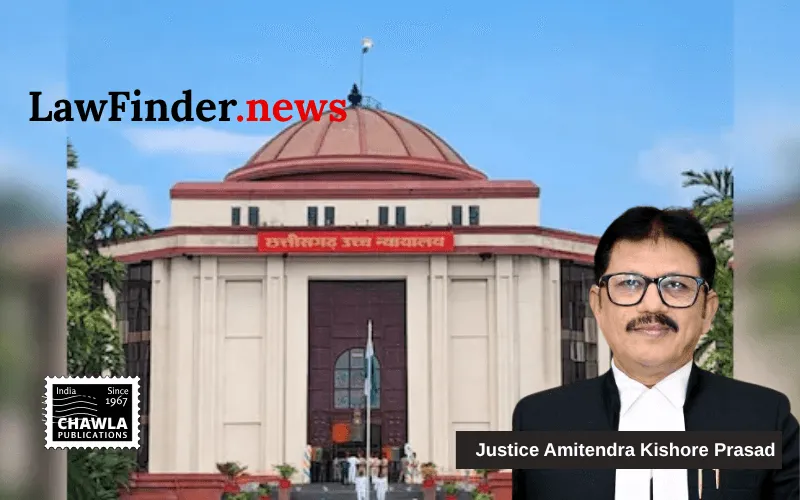
The High Court, presided over by Justice Amitendra Kishore Prasad, consolidated all related petitions and delivered a nuanced verdict. The Court first affirmed the cancellation of the leases, emphasizing the binding nature of lease agreements and the necessity of adherence to their terms. The Court noted that the allotment of vacant plots instead of residential houses constituted a clear breach. It further rejected the petitioners' argument that State Government's approval legitimized the deviation, ruling that no subsequent consent can override the original terms of a legally binding agreement.
However, the Court drew a distinction regarding the criminal liability of municipal officials. Citing the Supreme Court's precedent in Ravi Yashwant Bhoir vs. District Collector, Raigad (2012) and a recent Division Bench decision in Smt. Soni Ajay Banjare vs. State of Chhattisgarh (2026), it held that collective decisions by statutory bodies cannot be converted into personal criminal culpability without proof of a dominant role, mens rea, or manipulation. Since the funds diversion was approved by a unanimous resolution of the entire Municipal Council, the Chief Municipal Officer and President could not be singled out for prosecution.
The High Court thus quashed the orders directing criminal proceedings against these two officials but dismissed the writ petitions challenging the cancellation of the leases. The Court also dismissed the petitions filed by the private allottees, ruling that the leases were rightly cancelled for breach of terms and that the amounts paid stood forfeited without right to refund or compensation.
The Court acknowledged that the cancellation was imposed without prior notice or hearing to the allottees, which violated principles of natural justice. However, it held that this procedural lapse did not invalidate the cancellation given the clear contractual violations.
The judgment provides important clarifications on the enforcement of lease agreements under government schemes, the limits of State approval, and the scope of personal liability for office-bearers in collective municipal decisions.
Bottom Line:
Collective decisions made by municipal councils cannot impose individual criminal liability on specific members unless there is evidence of a dominant role, mens rea, or manipulation in the decision-making process.
Statutory provision(s):
Lease agreement terms under IDSMT Scheme, Principles of Natural Justice (audi alteram partem), Criminal liability principles for collective decision-making bodies.
This detailed report summarizes the key facts, legal issues, arguments, and judicial reasoning of the Chhattisgarh High Court's judgment in the case involving the Municipal Council, Balod and the State of Chhattisgarh regarding lease cancellations and criminal prosecutions. It highlights the Court's dual approach of upholding contractual enforcement while protecting officials from unwarranted individual criminal liability for collective decisions.
Cheman Kumar Deshmukh v. State of Chhattisgarh, (Chhattisgarh) : Law Finder Doc Id # 2932566