New Delhi, Jul 15 The delay in forwarding an FIR to the judicial magistrate becomes significant and raises suspicion if it is coupled with allegations of "ante-timing, ante-dating and fabrication" of records, the Supreme Court said on Wednesday.
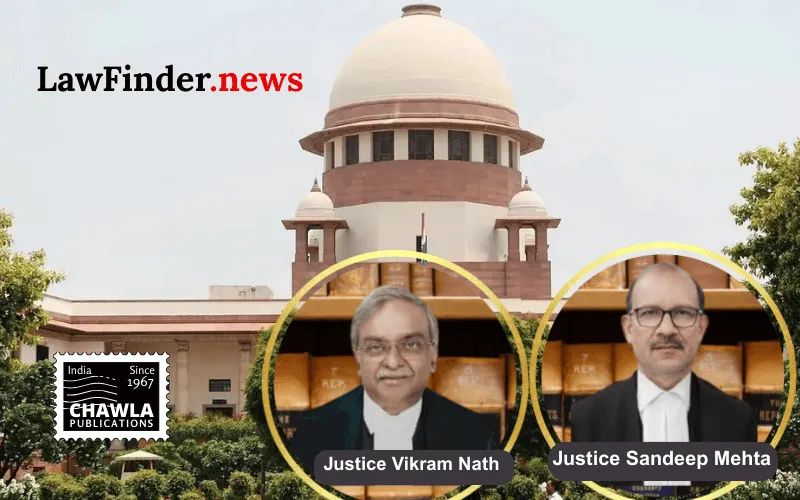
These observations were made by a bench of justices Vikram Nath and Sandeep Mehta in a judgement by which it acquitted five men convicted in a 1977 murder case from Uttar Pradesh.
Writing the 64-page judgement for the bench, Justice Mehta held that the prosecution failed to establish their guilt beyond reasonable doubt due to serious inconsistencies in the investigation, unexplained delays, and doubts over the authenticity of the FIR.
"Mere delay in forwarding the FIR to the magistrate cannot, by itself, be treated as fatal to the prosecution case nor can such delay, in isolation, be made the sole basis for discarding an otherwise credible prosecution version," the verdict said.
It, however, said that where allegations of "ante-timing, ante-dating and fabrication are not merely speculative but find substantive support from attendant circumstances appearing on the record, and are coupled with surrounding facts generating genuine suspicion regarding the fairness and integrity of the investigation, such delay acquires considerable significance".
The bench said, in such a situation, the delay ceases to be a mere procedural irregularity and assumes substantive importance in evaluating the authenticity of the prosecution narrative, the spontaneity of the FIR and the possibility of subsequent embellishment or manipulation.
"The court is then required to assess the effect of such delay not in isolation but cumulatively with the other circumstances brought on record while testing the overall credibility of the prosecution case," the bench said.
The top court set aside the high court judgement of conviction and the order of sentence passed by the trial court in the case.
It allowed the appeals filed by Hira Lal, Raj Bux and Subedar, while appeals relating to Raj Kishore and Deo Prasad had abated following their deaths during the pendency of the proceedings.
A co-accused, Ram Dhani, earlier died during the pendency of the appeal before the Allahabad High Court.
The case arose from the murder of Harihar Saran in Gonda district on June 28, 1977.
The trial court had convicted six accused in 1981 under Sections 147, 148 and 302 read with Section 149 of the Indian Penal Code, sentencing them to life imprisonment.
The high court upheld the conviction in 2011, prompting the present appeals before the Supreme Court. Reversing the concurrent findings of the courts below, the top court held that the prosecution version suffered from significant infirmities that created reasonable doubt.
The bench noted that the victim's body remained unattended at the place of occurrence throughout the night despite the police allegedly reaching the scene shortly after registration of the FIR.
It observed that neither the police nor the victim's family took steps to preserve or secure the body, describing the conduct as unnatural and inconsistent with normal human behaviour.
The bench also found the nearly two-day delay in conducting the post-mortem examination unexplained, observing that the prosecution had failed to justify why the autopsy was performed only on June 30 despite the incident having been reported on June 28.
Another factor weighing with the court was the contradiction regarding who accompanied the complainant to the police station to lodge the FIR.
While the complainant testified that only one witness had accompanied him, the General Diary entries reflected that two different persons had gone with him, casting doubt on the prosecution's version.
The bench further attached significance to the fact that the FIR reached the jurisdictional magistrate only on June 30, two days after its alleged registration, with no satisfactory explanation for the delay.
It held that, when viewed alongside other circumstances, the delay lent support to the defence contention that the prosecution story may have been developed subsequently.
Deo Prasad v. State of Uttar Pradesh, (SC) : Law Finder Doc Id # 2941239