Court holds plaintiff failed to establish prima facie ownership of copyrights; disputed wills and certificates insufficient to prove copyright title.
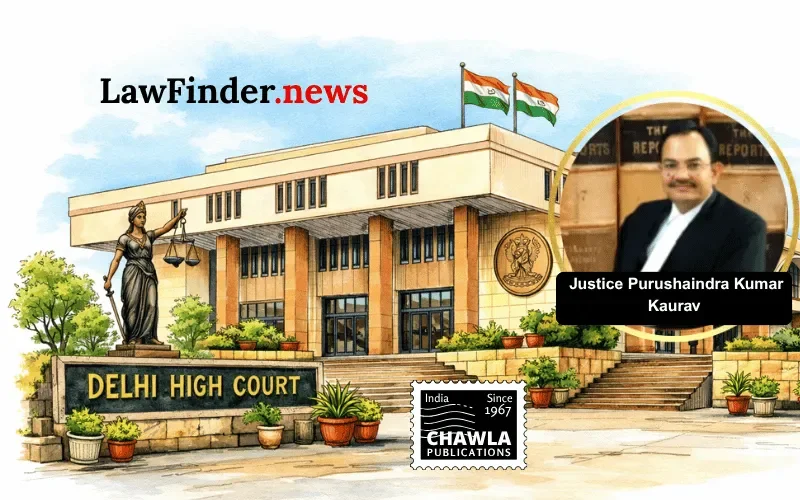
In a significant ruling dated October 7, 2026, the Delhi High Court, presided over by Mr. Purushaindra Kumar Kaurav, J., dismissed an application for an interim injunction filed by Mrs. Shakti Sagar against The Delhi Law House and others. The plaintiff sought to restrain the defendants from using, copying, and selling 47 legal titles, claiming ownership over the copyrights through a certificate dated April 1, 1962, and two wills dated October 17, 1995, and January 21, 2021.
Mrs. Shakti Sagar, the daughter-in-law of the late Sh. R.G. Sagar and widow of late Sh. Subhash Sagar, alleged that she inherited exclusive copyrights from her husband and father-in-law. She claimed that the defendants, who include family members running a partnership firm called The Delhi Law House (TDLH), were unlawfully publishing and profiting from these legal publications without her consent.
The defendants challenged Mrs. Sagar's claim by emphasizing that the copyrights were originally held by the authors of the respective works, whose names appeared on the books. They argued that no valid written assignment of copyrights had been furnished, as required under the Copyright Act, 1957. The defendants also questioned the authenticity and validity of the wills and certificate relied upon by the plaintiff, highlighting that the certificate was vague, unstamped, and unregistered, and that the wills were disputed in terms of execution, registration, and signature.
The Court applied the well-established trinity test for granting interim injunctions, which requires the plaintiff to establish (i) a prima facie case, (ii) balance of convenience in their favor, and (iii) the likelihood of irreparable injury if the injunction is not granted. The Court found that the plaintiff failed to demonstrate a prima facie ownership of the copyrights, as the root of title - the original assignment from the authors - was not disclosed or substantiated. The disputed testamentary documents could not fill this crucial gap.
Further, the Court noted that the plaintiff did not claim any relief related to partnership disputes, and the defendants were partners or members of the partnership firm holding the copyrights. The alleged injury to the plaintiff was monetary in nature and compensable by damages, diminishing the case for irreparable harm. The balance of convenience also weighed against the plaintiff since the titles had been published by the family business for decades.
Additionally, the Court rejected the plaintiff's claim of passing off, observing that the only goodwill pleaded belonged to the partnership firm, which the plaintiff was not a partner of, and she had disclaimed any partnership-related reliefs.
Relying on precedents including the Supreme Court's decisions in Dalpat Kumar v. Prahlad Singh and Shruti Manav Sharma v. Sunanina Singh, the Court reiterated that the grant of interlocutory injunctions is a discretionary remedy that cannot be extended without a clear prima facie right. The Court emphasized that it is not the stage for a mini-trial or a detailed examination of disputed facts.
Consequently, the application for interim injunction was dismissed, and the parties were directed to proceed to trial for adjudication of the complex issues concerning authorship, assignment, and validity of testamentary documents.
This ruling underscores the importance of establishing clear, written copyright assignments and authentic documentation when claiming intellectual property rights, especially in family business disputes involving succession and partnership arrangements.
Bottom Line:
Copyright - Interim injunction refused - Plaintiff claiming copyright in legal publications through disputed Wills and certificate failed to establish prima facie title - Author is first owner of copyright and any assignment must be in writing signed by assignor - Where root of title from original authors was not disclosed, and alleged injury was compensable in damages, no interim injunction could be granted.
Statutory provision(s):
Copyright Act, 1957 Sections 17, 18, 19(1), 55(2); Code of Civil Procedure, 1908 Order XXXIX Rules 1 and 2; Commercial Courts Act, 2015 Section 12A
Shakti Sagar v. Delhi Law House, (Delhi) : Law Finder Doc Id # 2992515