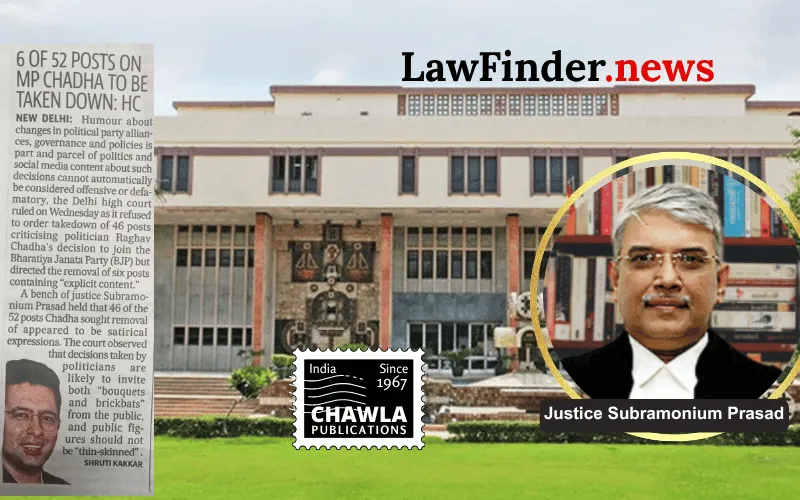
Court orders limited takedown of AI-generated defamatory content, emphasizes tolerance for criticism in public office.
In a significant judgment, the Delhi High Court addressed the delicate balance between freedom of speech and protection against defamation for public figures. The case involved Raghav Chadha, a Member of Parliament, who filed for an injunction against defamatory AI-generated content depicting him in a negative light. The content was disseminated following his political shift from the Aam Aadmi Party to the Bharatiya Janata Party.
Justice Subramonium Prasad presided over the case, assessing the complex interplay between free speech and the misuse of AI technologies such as deepfakes. The court highlighted the necessity for politicians and public figures to withstand criticism and satire, citing it as an intrinsic part of democratic discourse and public service.
The court declined to grant a blanket injunction against all content, identifying only specific documents—namely Documents No. 2, 8, 9, 11, 25, and 40—as containing explicitly profane and vulgar material beyond the scope of acceptable satirical commentary. Consequently, these specific pieces of content were ordered to be removed from social media platforms.
Moreover, the court directed the social media platforms involved to provide basic subscriber information and IP logs related to these documents, emphasizing the need for accountability in digital spaces. Justice Prasad underscored the importance of maintaining a balance between protecting individual dignity and upholding the fundamental right to freedom of speech.
In his judgment, Justice Prasad referenced multiple precedents, both national and international, reinforcing the notion that public officials should expect and tolerate scrutiny and criticism. The court reiterated that unless content is explicitly defamatory or maliciously false, it should not be subject to injunctive relief, thus safeguarding the robust exchange of ideas essential to democracy.
The case will proceed further, with the next hearing scheduled for August 18, 2026, allowing for continued examination of the remaining content and its implications.
Bottom Line:
Right to freedom of speech and expression versus defamation - Public figures in positions of power must accept satirical humor and criticism as an inevitable part of their profession, unless such content is profane, vulgar, or explicitly defamatory.
Statutory provision(s):
Order XXXIX Rules 1 and 2 of the Code of Civil Procedure, 1908
Raghav Chadha v. Ashok Kumar John Doe, (Delhi) : Law Finder Doc id # 2932762