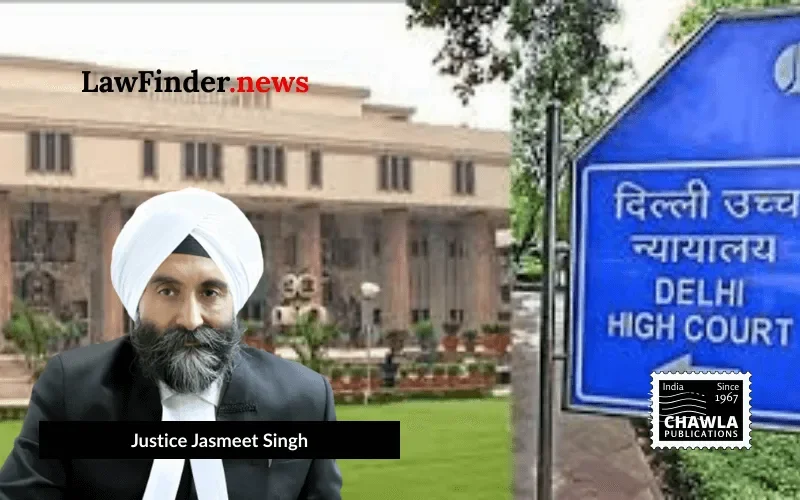
Court holds that interim relief for foreign travel by persons not named as accused in prosecution complaint must be sought from Special Court seized of the matter, while writ challenge to LOCs remains pending.
In a significant judgment delivered on September 1, 2026, the Delhi High Court clarified the procedural route for individuals seeking temporary suspension of Look-Out Circulars (LOCs) issued against them by enforcement agencies during criminal investigations. The judgment arose from two writ petitions filed under Article 226 of the Constitution of India and Section 528 of the Bharatiya Nagarik Suraksha Sanhita, 2023, by Sanjay Dangi and Amit Dangi, who challenged the issuance of LOCs preventing their foreign travel.
The LOCs were issued by the Directorate of Enforcement (ED) in connection with an ongoing investigation (ECIR/STF/17/2025) relating to alleged financial irregularities in Reliance Commercial Finance Limited and Reliance Home Finance Limited during 2017-2019. Neither petitioner was named as an accused in the original FIRs or the combined charge-sheet filed by the Central Bureau of Investigation (CBI). Amit Dangi was cited as a prosecution witness, whereas Sanjay Dangi was neither an accused nor a witness.
Both petitioners sought interim relief for suspension of LOCs to enable them to travel abroad for business purposes. The Court examined whether the relief should be granted by the High Court or the Special Court already seized of the prosecution complaint arising from the same ECIR. The ED contended that the Special Court is the appropriate forum since the LOCs operate akin to a non-bailable warrant and are connected to ongoing criminal proceedings.
The Court, presided over by Justice Madhu Jain, acknowledged that while the writ jurisdiction under Article 226 remains available, in cases where a prosecution complaint is pending before a Special Court, that Court is better placed to assess applications for temporary suspension of LOCs. This is because such relief requires a nuanced balancing of the applicant's right to travel, the purpose and duration of travel, the stage of the criminal proceedings, and the necessity of ensuring the applicant's presence during investigation or trial.
Citing precedents such as Sumer Singh Salkan v. Asstt. Director and Shivani Saxena v. Directorate of Enforcement, the Court ruled that even persons not formally arrayed as accused, but against whom LOCs operate, can approach the Special Court. The absence of an accused status does not preclude the Court seized of the complaint from entertaining applications for temporary relief. At the same time, the writ petitions challenging the validity of the LOCs remain pending before the High Court and will be decided on their merits at a later stage.
The Court granted liberty to the petitioners to approach the Special Court at Rouse Avenue Courts, New Delhi, where the prosecution complaint (CT Case No. 46/2026) is pending. The Special Court was directed to consider and dispose of the applications expeditiously, on merits, and after hearing the parties. The Delhi High Court explicitly clarified that the pendency of writ petitions shall not influence the Special Court's decision.
This judgment establishes an important procedural precedent clarifying that interim suspension of LOCs for foreign travel in cases involving pending prosecution complaints must be sought from the Special Court handling the matter, even if the applicant is not named as an accused. It underscores the balance between protecting individual rights and safeguarding the integrity of ongoing criminal proceedings.
Bottom Line:
Look-Out Circulars (LOCs) - Interim suspension of LOCs for foreign travel must be sought from the Special Court seized of the prosecution complaint, even if the applicant is not formally arrayed as an accused.
Statutory provision(s):
Article 226, Constitution of India, 1950; Section 528, Bharatiya Nagarik Suraksha Sanhita, 2023; Sections 120B, 420 IPC; Section 13(2) read with Section 13(1)(d) Prevention of Corruption Act, 1988; Section 50, Prevention of Money Laundering Act, 2002.
Sanjay Dangi v. Union of India, (Delhi) : Law Finder Doc Id # 2971950