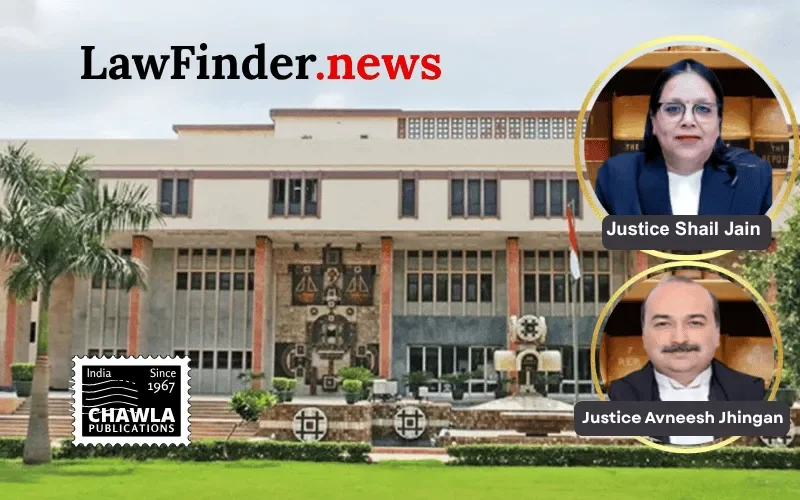
Court reaffirms that appeals filed by the department against CESTAT orders involving amounts below Rs. 2 crores are not maintainable except in cases challenging constitutional validity or legality of notifications, enhancing efforts to reduce government litigation.
In a landmark judgment dated October 14, 2026, the Delhi High Court (Division Bench of Justices Avneesh Jhingan and Shail Jain) dismissed a batch of departmental appeals filed by the Principal Commissioners and Commissioners of CGST and Central Excise against M/s. Riya Travel and Tours India Pvt. Ltd. and M/s. Akbar Travels of India Pvt. Ltd. These appeals pertained to legacy service tax matters involving disputed amounts below Rs. 2 crores.
The judgment primarily addressed the maintainability of departmental appeals filed before the High Court under Section 35G of the Central Excise Act, 1944 read with Section 83 of the Finance Act, 1994. The department challenged the Customs, Excise and Service Tax Appellate Tribunal's (CESTAT) order that had set aside the demand of service tax on air travel agent services rendered by the respondents.
A key preliminary objection raised by the respondents was the applicability of the Central Board of Indirect Taxes and Customs (CBIC) Instruction dated August 6, 2024, which prescribed monetary limits for filing departmental appeals in legacy Central Excise and Service Tax matters. The instruction stipulates that appeals involving disputed amounts below Rs. 2 crores before the High Court are not maintainable unless they fall within two narrow exceptions: (i) challenge to the constitutional validity of the Act or Rule, or (ii) challenge to notifications, instructions, orders, or circulars held illegal or ultra vires.
The department contended that the appeals should be entertained due to the cascading effect and recurring nature of the issues involved, relying on the Supreme Court decision in Commissioner of Income Tax v. Surya Herbal Limited (2011) 15 SCC 482 and supportive High Court judgments from Gauhati and Patna. However, the Delhi High Court, after a detailed analysis of the series of CBIC instructions issued since 2011, held that:
1. The monetary limits prescribed by the Board apply uniformly, including to cases of recurring nature, and even if an appeal is pending in a higher forum, subsequent cases below the threshold need not be pursued.
2. The exception for recurring issues, classification, and refund matters introduced in December 2015 was explicitly withdrawn by the CBIC instruction dated April 3, 2018.
3. The Supreme Court's decision in Surya Herbal Limited merely granted liberty to the department to point out cascading effects but did not override the CBIC instructions.
4. The Gauhati High Court's view treating cascading effect/common principle as an exception is not concurred with, and the department failed to disclose the withdrawal of the recurring issue exception before the Patna High Court.
5. Only two exceptions to the monetary limits are valid under current instructions: constitutional validity challenges and cases where notifications or circulars are held illegal or ultra vires.
Since the disputes in the present appeals did not fall within these exceptions, the appeals were held not maintainable and dismissed. The Court kept open the substantial questions of law proposed by the department for future adjudication if necessary.
The judgment also noted that despite clear and binding instructions aimed at reducing litigation, various Commissionerates continue to file appeals below the prescribed monetary limits. The Court advised the department to take up the issue with the Board or Secretary to ensure uniform compliance and avoid unnecessary litigation.
This ruling reinforces the government's National Litigation Policy and CBIC's efforts to streamline tax dispute resolution by imposing monetary thresholds on departmental appeals in legacy Central Excise and Service Tax matters, thereby discouraging the pursuit of low-value litigations and promoting judicial economy.
Bottom Line:
Central Excise Act, 1944 Section 35R read with Finance Act, 1994 Section 83 - Departmental appeals in legacy Central Excise and Service Tax matters are not maintainable before High Court where disputed amount is below Rs. 2 crores as per CBIC Instruction dated 06.08.2024, unless case falls within the two specified exceptions, namely challenge to constitutional validity of Act/Rule or where notification/instruction/order/circular is held illegal or ultra vires - Cascading effect, recurring issue or bunch matters are not independent exceptions.
Statutory provision(s):
Central Excise Act, 1944 Section 35R, Section 35G; Finance Act, 1994 Section 83