Court Balances Constitutional Right to Liberty Under Article 21 with UAPA Section 43D(5) Restrictions; Releases Sobiya Aziz and Kamran Ashraf Reshi on Stringent Conditions Including Passport Surrender and Communication Restrictions
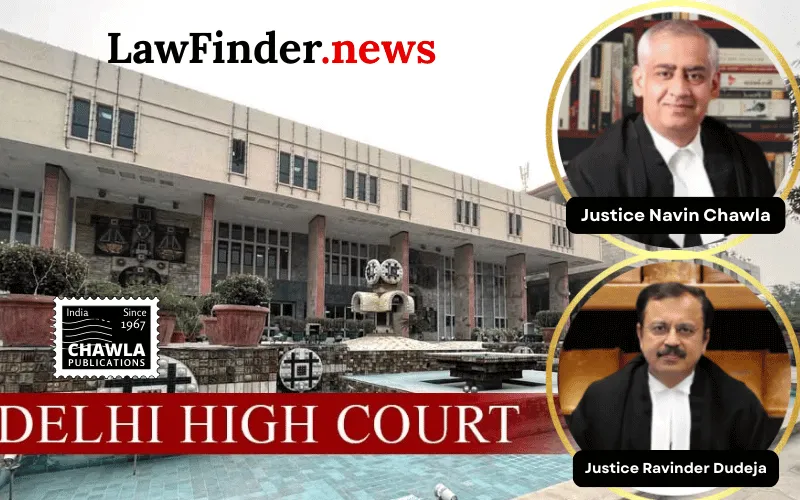
In a significant judgment addressing the interplay between fundamental constitutional rights and statutory restrictions on bail in terrorism cases, the Delhi High Court Division Bench comprising Mr. Justice Navin Chawla and Mr. Justice Ravinder Dudeja has granted bail to two accused persons in a National Investigation Agency (NIA) case involving conspiracy under the Unlawful Activities (Prevention) Act, 1967 (UAPA).
The Case Background
The appellants—Sobiya Aziz (accused no. 17) and Kamran Ashraf Reshi (accused no. 11)—were arrested in October 2021 in connection with alleged conspiracy involving proscribed terrorist organizations including Lashkar-e-Taiba (LeT), Jaish-e-Mohammed (JeM), and The Resistance Front (TRF). The case, registered under RC No. 29/2021/NIA/DLI, involves charges of conspiracy to wage war against India and support terrorist activities in Kashmir and other parts of India.
The prosecution alleged that both accused were part of a larger conspiracy orchestrated by Pakistan-based handlers to radicalize local youth, procure arms and ammunition, and execute terrorist acts. Against Sobiya Aziz specifically, the investigation claimed recovery of diaries containing Islamic State ideology materials and an ISIS flag from her residence. The allegations against Kamran Ashraf Reshi included association with online propaganda groups of proscribed organizations and possession of threatening pamphlets.
The Legal Dilemma
The central issue before the Court was the conflict between Section 43D(5) of the UAPA, which severely restricts bail in terrorism cases, and Article 21 of the Constitution, which guarantees the fundamental right to personal liberty and speedy trial. Section 43D(5) mandates that bail can be granted only if the court is satisfied that there is no prima facie case against the accused.
The trial court had rejected both appellants' bail applications, observing that a prima facie case existed against them and that the trial had progressed reasonably. However, the High Court undertook a comprehensive examination of recent Supreme Court judgments and constitutional principles to reconsider the issue.
The Court's Constitutional Analysis
Justice Chawla's judgment extensively analyzed landmark Supreme Court decisions, particularly K.A. Najeeb v. Union of India (2021) and Gulfisha Fatima v. State (2026), which establish that constitutional courts retain jurisdiction to grant bail even under UAPA's stringent provisions when faced with prolonged incarceration and delayed trials.
The Court noted that the Supreme Court in Gulfisha Fatima held that "Article 21 occupies a central place in the constitutional scheme" and that "pre-trial incarceration cannot, by the mere passage of time, be permitted to assume the character of punishment." The Court emphasized that while Article 21 operates within procedurally established law, statutory restrictions cannot render constitutional guarantees illusory.
The judgment also referenced the Supreme Court's observation in Syed Iftikhar Andrabi v. NIA (2026) that "bail is the rule and jail is the exception" even under the UAPA, and highlighted alarming conviction statistics showing only 2-6% conviction rates nationally under UAPA and less than 1% in Jammu & Kashmir, indicating approximately 94-99% possibility of acquittal.
Key Factual Findings
The Court found that both appellants had been in custody for nearly five years (since October 2021). Critically, out of 359 cited witnesses in the case, only 21 had been examined by the prosecution, rendering it highly unlikely that the trial would conclude in any reasonable time period.
The Court observed that the prosecution had presented prima facie material, including disclosure statements, recovered documents, and witness testimonies. However, it found that several co-accused persons—including Mohd. Manan Dar, Mateen Ahmed Bhatt, Rauf Ahmad Bhat, Adil Ahmed War, Haris Nisar Langoo, Zamin Adil Bhat, and Suhail Ahmad Thokar—had already been granted bail by the trial court, higher courts, and Supreme Court respectively, based on similar considerations of prolonged incarceration.
Regarding Sobiya Aziz specifically, the Court noted her status as a woman, her lack of criminal antecedents, and her medical conditions including chronic headaches, anemia, uterine fibroids, and urinary tract infections. Concerning Kamran Ashraf Reshi, the Court acknowledged his youth (arrested at approximately 21 years of age) and observed that the allegations against him were "predominantly digital and non-violent in nature."
The Court's Reasoning
The judgment established a nuanced framework for bail consideration under Section 43D(5) of UAPA. The Court held that while statutory restrictions must be respected, they operate subject to constitutional guarantees. The inquiry into delay is contextual and must consider:
- - The nature of allegations
- - The statutory field and legislative intent
- - The stage of proceedings
- - The realistic trajectory of the trial
- - Causes contributing to delay
- - The role attributed to the accused
- - Prima facie material strength
- - Availability of intermediate safeguards
- - Risks attendant upon release
The Court emphasized that prolonged custody cannot be permitted to transform pre-trial detention into de facto punishment, particularly where trial completion is unrealistic within a reasonable timeframe.
Stringent Bail Conditions Imposed
While granting bail, the Court imposed comprehensive conditions to ensure public order and trial integrity:
- 1. Financial Securities: Each appellant must execute a personal bond of Rs. 2,00,000 with two sureties of equal amount
- 2. Passport Surrender: Surrender of passports or affidavit confirming non-possession
- 3. Travel Restrictions: Prohibition on leaving India without trial court permission
- 4. Communication Monitoring: Use of only one mobile phone and one landline, always kept operational, with details furnished to investigating officer and court
- 5. Residence Restrictions: No change of residence without seven days' prior written intimation
- 6. Trial Cooperation: Mandatory appearance before trial court on all hearing dates
- 7. Witness Protection: Prohibition on contacting, influencing, or threatening prosecution witnesses or protected witnesses
- 8. Evidence Integrity: No tampering with evidence or electronic materials
- 9. Media Restrictions: Prohibition on public statements about the case through any medium
- 10. Anti-National Activity Ban: Explicit prohibition on joining social media groups sharing anti-national material or uploading/disseminating such content
- 11. Fortnightly Reporting: Regular reporting to the investigating officer at specified intervals
Broader Implications
This judgment represents a significant development in bail jurisprudence under terrorism laws. By recognizing that constitutional rights cannot be entirely eclipsed by statutory provisions, even in national security cases, the Court has rebalanced the scales between state security interests and individual liberty rights. The detailed conditions imposed demonstrate the Court's attempt to craft a middle path—releasing the accused while maintaining robust safeguards against potential threats to witnesses, evidence, and public order.
The Court's reliance on low conviction statistics under UAPA and acknowledgment of the principle that "bail is the rule and jail is the exception" even in terrorism cases suggests a judicial recalibration toward ensuring that pre-trial detention serves investigative and trial purposes rather than functioning as de facto punishment.
Bottom Line:
Grant of bail under Unlawful Activities (Prevention) Act, 1967 on grounds of prolonged incarceration, delay in trial, and specific circumstances of the accused.
Statutory Provisions:
Indian Penal Code, 1860, Sections 120B, Unlawful Activities (Prevention) Act, 1967, Sections 18, National Investigation Agency Act, 2008, Section 21(4), Constitution of India, Article 21.
Kamran Ashraf Reshi, (Delhi)(DB) : Law Finder Doc Id 2972391