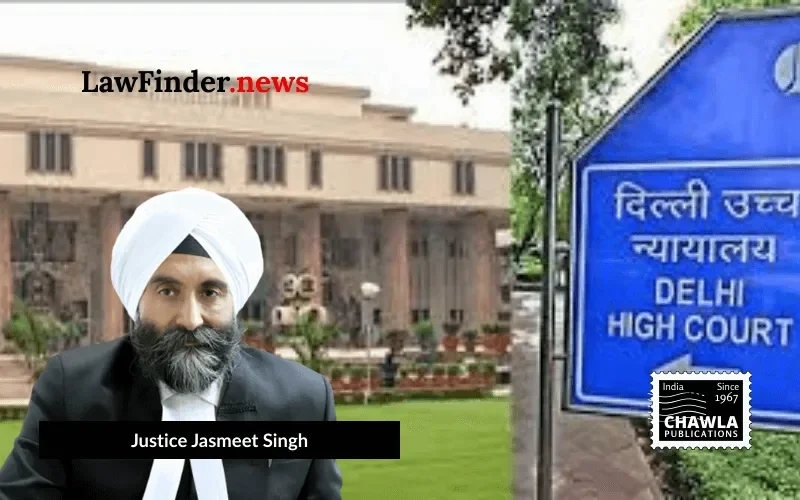
Court awards Rs. 11.01 lakh each, plus 9% interest and litigation costs, finding negligence “writ large” and applying the doctrine of res ipsa loquitur
The Delhi High Court has held the Delhi Development Authority (DDA) and the Delhi Jal Board (DJB) jointly and severally liable for the tragic deaths of two minor boys who fell into an uncovered sewer/manhole in a public park in Pitampura on 16 April 2010.
Justice Jasmeet Singh, deciding two connected writ petitions filed by the parents of Master Robiyal and Master Arjun, ruled that the authorities had failed in their duty to maintain a safe public space. The Court said the negligence was apparent on the face of the record and that the principle of res ipsa loquitur applied, meaning “the thing speaks for itself.” Since the children died after falling into an open sewer in a park meant for public use, the Court found that the burden shifted to the authorities to disprove negligence, which they failed to do.
The petitioners had approached the Court seeking compensation for the death of their sons, who were around 11 and 12 years old at the time of the incident. The respondents argued that the writ petitions were not maintainable because the matter involved disputed facts and should be decided in a civil suit. They also claimed that the sewer area had been protected by RCC walls and that the police had filed a cancellation report in the criminal case.
Rejecting these objections, the Court held that writ jurisdiction under Article 226 of the Constitution can be exercised where foundational facts are undisputed and negligence is evident. The Court noted that the deaths, the location of the incident, and the fact that the boys fell into the sewer were not in dispute. It also emphasized that the park was under DDA’s jurisdiction and that DJB was carrying out the civil work. In such circumstances, the Court said, sending the bereaved parents to a civil suit after more than a decade of litigation would be unjust.
On merits, the Court found that both DDA and DJB owed a heightened duty of care because the incident occurred in a public park accessible to children. It held that even if the sewer had been surrounded by walls, that did not amount to adequate safety precautions. Children, the Court observed, cannot be expected to anticipate hidden hazards in a public park in the same way as adults. The Court also rejected the reliance placed on the cancellation report, holding that criminal investigation standards are different from the standards applicable in a constitutional tort claim for violation of the right to life under Article 21.
For compensation, the Court adopted a structured method based on earlier precedents such as Kamla Devi, Kishan Lal, and Pravesh Kumar. It awarded each petitioner Rs. 2,30,147 as standard compensation and Rs. 8,70,480 as pecuniary loss of dependency, totaling Rs. 11,00,627 per petitioner. The amount was rounded off to Rs. 11,01,000, with simple interest at 9% per annum from the date of filing of the writ petitions until payment. The Court also granted Rs. 1,00,000 as litigation costs in each case.
The liability of DDA and DJB was declared joint and several. The Court, however, held that the Municipal Corporation of Delhi (MCD) had no role in maintaining the park and therefore fastened no liability on it.
The judgment reinforces the principle that public authorities can be held accountable in writ jurisdiction for deaths caused by obvious negligence in the maintenance of public spaces, particularly where the fundamental right to life is involved.
Bottom Line:
The Delhi Development Authority (DDA) and Delhi Jal Board (DJB) were held vicariously liable for negligence leading to the death of two children who fell into an uncovered sewer/manhole in a public park. Compensation was awarded despite objections on maintainability of the writ petition under Article 226 of the Constitution of India.
Statutory provision(s): Article 21 of the Constitution of India, Article 226 of the Constitution of India, Section 91 of the Code of Criminal Procedure, 1973, Section 80 of the Code of Civil Procedure, 1908, Section 304A of the Indian Penal Code, 1860
Shekh Hussain @ Lekhmuddin v. Delhi Development Authority, (Delhi) : Law Finder Doc id # 3162945