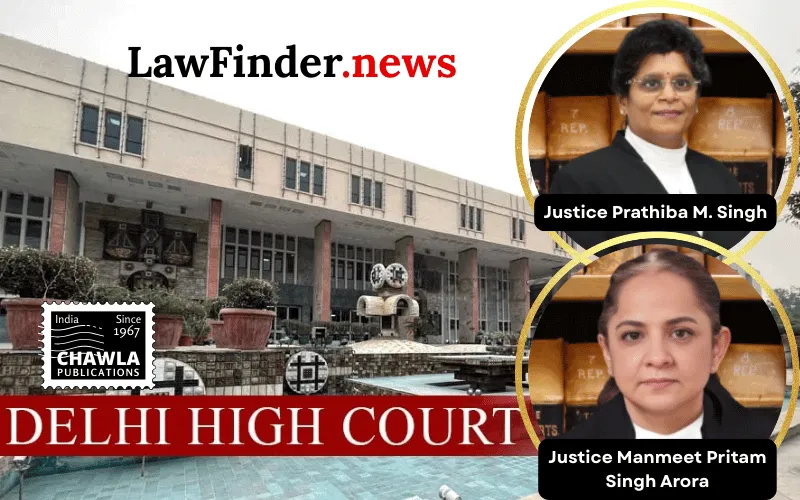
Court directs GNCTD to upgrade CATS helpline 102 for ICU bed queries, ensure three referral coordinators per hospital, fill top administrative vacancies, and report on unused medical equipment.
The Delhi High Court has issued a fresh set of directions aimed at improving emergency access, patient referral systems, staffing, and equipment usage in 38 government hospitals across the Capital.
A Division Bench of Justice Prathiba M. Singh and Justice Manmeet Pritam Singh Arora was hearing matters concerning the functioning of government hospitals when it reviewed the status report filed by the Delhi government following earlier orders. The Court said the response of the authorities showed progress in some areas but remained unsatisfactory on several critical issues.
One of the key developments noted by the Court was the operationalisation of toll-free number 102, run by the Centralised Accident & Trauma Services (CATS), as a common helpline for emergency services and ICU bed enquiries. The Court recorded that CATS staff had been given access to the ICU dashboard and trained to provide live information on bed availability across hospitals. However, after observing the volume of calls and call drops, the Court directed the Head of Operations, CATS, to prepare a data sheet for at least one month showing daily call volume, dropped calls, and the need for more lines and operators. The Court also asked that any requirement for expansion be communicated to the Health Secretary for necessary action.
The Bench also took serious note of the lack of coordination when patients are referred from one hospital to another. Although a list of referral coordinators was placed on record, the Court found that only one coordinator had been nominated in 37 out of the 38 hospitals. The judges held that this was inadequate and observed that at least three referral coordinators should be available round the clock in each hospital, considering shift-based working patterns. The government was directed to update the list accordingly and ensure that a coordinator is available at all times.
On the issue of recruitment and administration, the Court expressed strong dissatisfaction with the Delhi government’s response. It observed that hospitals were facing severe manpower shortages and there was no uniform human resource policy to address recruitment centrally. The Bench said recruitment should be handled in a centralised and methodical manner by the Secretary, Health and Family Welfare, GNCTD, rather than being left to local contractual arrangements. It warned that contractual employment cannot be treated as a permanent solution, noting that such arrangements can lead to inconsistency, attrition, blocked promotions and employee frustration.
The Court directed a fresh meeting between the Secretaries of Health and Services and the Medical Superintendents/Medical Directors of all 38 hospitals. The authorities were asked to prepare a chart showing sanctioned, filled and vacant posts in each hospital and to set a strict timeline for recruitment.
The Bench also dealt with the issue of vacant top posts such as M.S./M.D./Director in government hospitals, including society-run hospitals. It held that no such post should remain vacant in any of the 38 hospitals. If regular recruitment takes time, the Court ordered that one senior faculty member or senior doctor be assigned charge within 15 days of the joint meeting. The Court further directed all hospital heads to submit details of staff strength and vacancies before the next hearing. Heads of the biggest hospitals, including LNJP Hospital, GTB Hospital, DDU Hospital, G.B. Pant Hospital and Sanjay Gandhi Hospital, were directed to appear physically in Court, along with the Health Secretary.
The Court also examined the issue of unused medical equipment, particularly MRI, CT scan, PET scan and USG machines. It noted that hospitals were giving varying interpretations to the term “unused equipment” and that there was confusion about whether equipment was actually functional and supported by manpower. The Bench clarified that random or occasional use by consultants would not amount to proper use. Any machine not available for patient use on a daily basis with adequate manpower would be treated as unused. The Court ordered the filing of a detailed additional status report identifying where such equipment exists and whether regular or contractual staff is available to operate it.
The matter has been listed for further hearing on 10 October 2026.
Bottom Line :
Public health administration - Delhi High Court issued directions for streamlining emergency access and hospital management across 38 government hospitals in Delhi by operationalising toll-free number 102 for ICU bed information, requiring round-the-clock referral coordinators, and directing centralized recruitment and filling of vacancies including M.S./M.D./Director posts, besides seeking details of unused medical equipment.
Statutory provision(s):
Not specified in the judgment excerpt provided
Court on its Own Motion v. Union of India, (Delhi)(DB) : Law Finder Doc id # 2985420