Division Bench affirms validity of Delhi Maintenance and Welfare of Parents and Senior Citizens Rules, 2009 empowering District Magistrate to evict son, daughter or legal heir for non-maintenance and ill-treatment; underscores need to harmonize competing claims between Senior Citizens Act and Protection of Women from Domestic Violence Act.
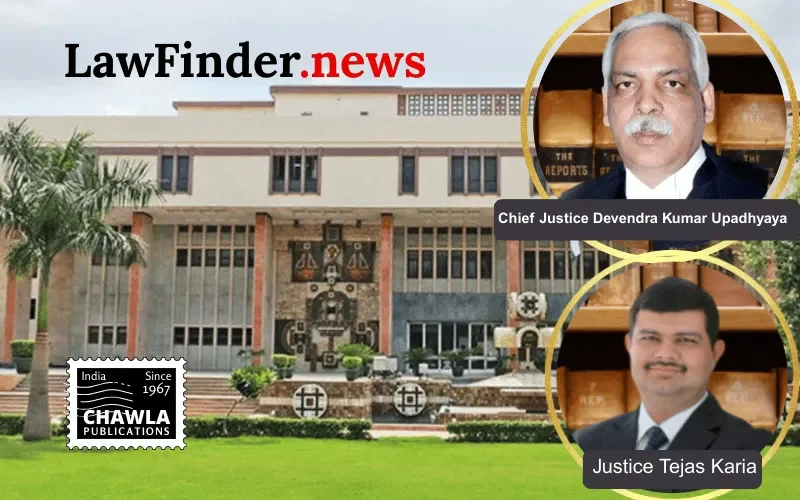
In a significant judgment dated September 30, 2026, the Delhi High Court Division Bench, comprising Chief Justice Devendra Kumar Upadhyaya and Justice Tejas Karia, dismissed a writ petition challenging the validity of Rule 22(3)(1)(i) and (iv) of the Delhi Maintenance and Welfare of Parents and Senior Citizens Rules, 2009. The rules empower the District Magistrate (DM) to evict the son, daughter, or legal heirs from the property of a senior citizen in cases of non-maintenance and ill-treatment.
The petition was filed by Punam, the daughter-in-law of a senior citizen, against the eviction order passed by the Divisional Commissioner, GNCT of Delhi, which directed her to vacate the shared household. Punam contended that the eviction rules were ultra vires the Maintenance and Welfare of Parents and Senior Citizens Act, 2007 ("Senior Citizens Act") and violated her fundamental rights under Articles 14, 15, and 21 of the Indian Constitution. She also relied on the Protection of Women from Domestic Violence Act, 2005 ("DV Act"), which grants women the right to reside in shared households irrespective of ownership or legal title.
The Court examined the statutory framework of the Senior Citizens Act, which primarily provides for maintenance and welfare of senior citizens and their protection of life and property. The Act's Section 22 empowers the State Government to confer powers on the DM for ensuring protection, including prescribing a comprehensive action plan for safeguarding senior citizens. The impugned Rules 22(3)(1)(i) and (iv) specify the procedure for eviction of heirs from senior citizens' properties on grounds of non-maintenance or ill-treatment.
Rejecting the petitioner's argument, the Court observed that although the Senior Citizens Act does not explicitly mention eviction, the power to evict is an incident of enforcing the right to maintenance and protection. This principle was upheld by the Supreme Court in recent decisions including Ravi Kant Gupta v. State of Uttar Pradesh (2026), Samtola Devi v. State of Uttar Pradesh (2025), and S. Vanitha v. Deputy Commissioner, Bengaluru Urban District (2021), which recognized the authority of tribunals under the Senior Citizens Act to order eviction when necessary to protect senior citizens.
The Court further clarified that the impugned Rules are validly framed under Section 32 read with Section 22(2) of the Senior Citizens Act, which mandates the State Government to formulate protective measures. It held that the eviction provisions are not ultra vires the parent statute. The Court distinguished earlier Punjab and Haryana High Court judgments that had invalidated similar provisions, stating these are no longer good law in light of Supreme Court rulings.
Addressing the petitioner's claim under the DV Act, the Court underscored the need to harmoniously construe the competing rights under the two statutes. While the DV Act grants women the right to reside in shared households, this right is not absolute or indefeasible. The Court noted that the petitioner, a Post Graduate Teacher with substantial income and a separate residence, could not claim indefeasible residence against the senior citizen's right to peaceful life and protection from ill-treatment. The Court emphasized that the Senior Citizens Act's overriding effect under Section 3 cannot be used to nullify protections under the DV Act, and vice versa. Instead, reliefs must be moulded considering the competing claims of the parties.
On the scope of the eviction rules, the Court rejected the contention that daughter-in-law is not covered within the ambit of "son, daughter or legal heir" under Rule 22(3)(1). It relied on precedents including Shadab Khairi v. State and Darshna v. Govt of NCT of Delhi which interpreted "legal heirs" broadly to include daughter-in-law, to ensure the welfare and protection of senior citizens is effectively achieved.
The Court further clarified that proceedings for eviction under Rule 22(3)(1) before the DM are independent of maintenance proceedings under Sections 4 and 5 before the Maintenance Tribunal constituted under the Senior Citizens Act. Thus, eviction applications can be maintained even without a concurrent maintenance claim.
Considering the facts of the case, the Court upheld the eviction order passed by the Divisional Commissioner, noting that the senior citizen respondent wished to live peacefully without harassment arising from matrimonial discord between her son and daughter-in-law. The petitioner's substantial means and separate accommodation further weighed against her claim for residence in the senior citizen's property.
In conclusion, the Delhi High Court upheld the eviction powers under the Senior Citizens Act and Rules as constitutionally valid and necessary for safeguarding senior citizens' rights. It recognized the competing entitlements under the DV Act but held that such rights must be balanced and harmonized to ensure both protection of senior citizens and women's rights in shared households.
Bottom Line:
Senior Citizens Act, 2007 and Delhi Maintenance and Welfare of Parents and Senior Citizens Rules, 2009 - Rule 22(3)(1)(i) and (iv) providing for eviction of son, daughter or legal heir from property of senior citizen on ground of non-maintenance and ill-treatment held intra vires - District Magistrate has power to order eviction for protection of life and property of senior citizens - Daughter-in-law is also covered within sweep of said Rule - Right of residence under Domestic Violence Act is not absolute and competing claims must be harmonised.
Statutory provision(s):
Maintenance and Welfare of Parents and Senior Citizens Act, 2007 Sections 3, 4, 5, 7, 8, 21, 22, 23, 27, 32;
Delhi Maintenance and Welfare of Parents and Senior Citizens Rules, 2009 Rule 22(3)(1)(i) and (iv);
Protection of Women from Domestic Violence Act, 2005 Sections 17, 19, 26;
Constitution of India Articles 14, 15, 21.
Punam v. Divisional Commissioner, GNCT of Delhi, (Delhi)(DB) : Law Finder Doc Id # 2989263