Court Rules Lack of Medical Evidence on Mental Disability or Alcohol Dependency Cannot Vitiate Disciplinary Proceedings; Penalty of Removal from Service Affirmed
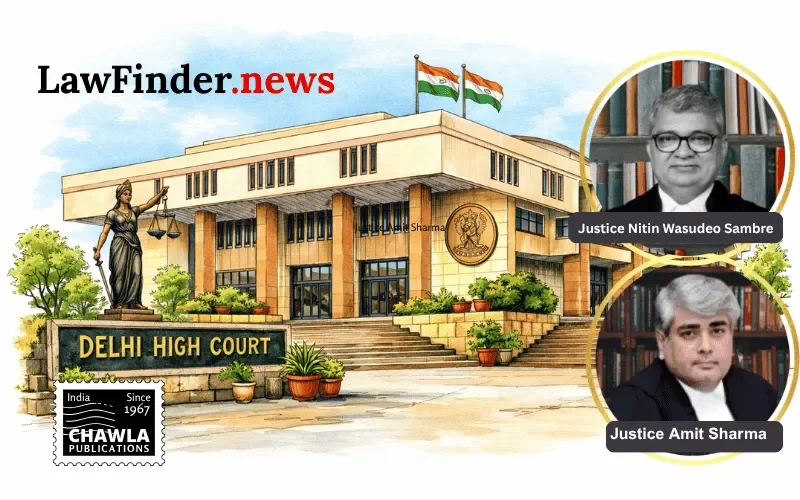
In a significant judgment delivered on November 5, 2026, the Delhi High Court dismissed the writ petition filed by Amit Kumar, a former Constable in the Central Industrial Security Force (CISF), challenging his removal from service following departmental disciplinary proceedings. The Division Bench comprising Justices Nitin Wasudeo Sambre and Amit Sharma upheld the findings of the disciplinary, appellate, and revisional authorities, confirming that the petitioner's repeated misconduct warranted the major penalty of removal from service.
The case arose from multiple charges of misconduct against Amit Kumar, including incidents of drunkenness, assault on a police officer, insubordination, threatening a fellow force member, and non-cooperation with medical procedures. Notably, the petitioner had a prior record involving both major and minor punishments for similar behavior.
Amit Kumar's defense largely rested on the claim of alcohol dependency and mental stress due to personal family issues, including his wife's infertility complications. He contended that these factors should have invoked protections under the Rights of Persons with Disabilities Act, 2016 (RPwD Act) and the Mental Healthcare Act, 2017, thereby invalidating the disciplinary proceedings against him. The petitioner referenced the Supreme Court's ruling in Ravinder Kumar Dhariwal v. Union of India & Ors. (Civil Appeal No. 6924 of 2021), arguing that mental health issues must be duly considered in disciplinary contexts.
However, the Court observed that the petitioner failed to produce any medical report, diagnosis, treatment records, or credible evidence substantiating the existence of mental illness or alcohol dependency during the relevant period. The annual medical fitness records only indicated an orthopedic issue and did not reflect any mental health impairment or unfitness for duty. The Court emphasized that mere assertions of mental stress without corroborative material cannot nullify disciplinary proceedings.
Addressing the evidentiary basis of the charges, the Court held that the departmental inquiry was conducted fairly, with the petitioner being served with charge sheets, given opportunities to defend himself, cross-examine witnesses, and present his case. The Court referenced the Supreme Court's precedent in B.C. Chaturvedi v. Union of India (1995) 6 SCC 749, reinforcing that judicial review does not entail reappreciation of evidence but ensures that inquiries comply with natural justice and that findings are not perverse or baseless.
The Court further dismissed the contention that the findings were based on hearsay evidence or that independent witnesses were not examined. It held that such assertions alone do not demonstrate a lack of evidence or procedural infirmity to warrant judicial interference.
Concerning the penalty of removal from service, the Court noted the serious nature and cumulative impact of the petitioner's misconduct, including his prior disciplinary record. It reaffirmed that CISF personnel, as members of a disciplined force, are expected to maintain high standards of discipline and conduct. The penalty imposed was found neither disproportionate nor shocking to the conscience of the Court, and thus, was upheld.
In conclusion, the Delhi High Court ruled that the petitioner failed to establish any ground to invalidate the disciplinary proceedings or to reduce the penalty. The writ petition was dismissed with no order as to costs.
This judgment underscores the stringent disciplinary standards expected in armed forces and clarifies that claims of mental illness or disability must be substantiated with credible medical evidence to invoke statutory protections during disciplinary proceedings.
Bottom Line:
Departmental proceedings against CISF personnel - In absence of medical material proving mental disability or alcohol dependency, protection under Rights of Persons with Disabilities Act, 2016 and Mental Healthcare Act, 2017 cannot be invoked to vitiate enquiry - High Court in judicial review cannot reappreciate evidence or interfere with punishment unless findings are based on no evidence, proceedings violate natural justice, or penalty shocks conscience - Removal from service for repeated misconduct in disciplined force upheld.
Statutory provision(s):
Article 226 of the Constitution of India, Central Industrial Security Force Rules, 2001 (Rules 36, 54, 91-B), Rights of Persons with Disabilities Act, 2016 (Section 20), Mental Healthcare Act, 2017
Amit Kumar v. Union of India, (Delhi)(DB) : Law Finder Doc Id # 3013928