Court rules that limitation issues require evidence and cannot be decided at the threshold, dismisses application for rejection of plaint.
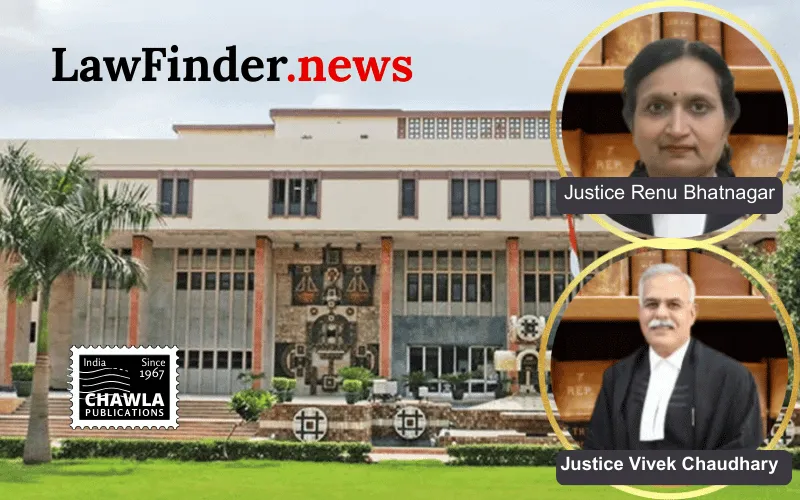
In a significant ruling, the Delhi High Court dismissed an appeal challenging the maintainability of a suit on grounds of limitation, emphasizing that such issues often involve mixed questions of law and fact that necessitate a full trial. The Division Bench, comprising Justices Vivek Chaudhary and Renu Bhatnagar, delivered the judgment on August 22, 2026, in the case of Shri Jai Prakash Tayal v. Smt. Sunita Aggarwal.
The case originated from a suit filed by Smt. Sunita Aggarwal, who sought declarations that a Gift Deed and Will allegedly in favor of the appellants were null and void. The appellants, however, contended that the suit was barred by limitation under Article 58 of the Limitation Act, 1963, as the respondent had knowledge of the documents as early as January 8, 2020.
Despite the appellants' arguments, the Court observed that the plaint disclosed substantial grounds for the exclusion or extension of the limitation period. Notably, the Supreme Court's orders during the COVID-19 pandemic, which extended limitation periods, were considered crucial. The Court also noted the applicability of Section 14 of the Limitation Act, which permits the exclusion of time spent in prosecuting an earlier proceeding pursued in good faith before a court lacking jurisdiction.
The bench referred to precedents, including the Supreme Court's decision in Consolidated Engineering Enterprises v. Principal Secretary, Irrigation Department, highlighting that Section 14 does not extend limitation but allows for the exclusion of time spent in prior bona fide proceedings. It was emphasized that whether the respondent could ultimately benefit from Section 14 would require evidence and could not be decided at the preliminary stage.
The Court concluded that the plaint did not exhibit an unequivocal bar of limitation on its face, thus dismissing the appeal and allowing the suit to proceed to trial. The judgment reinforces the principle that applications for rejection of plaints on limitation grounds must be approached with caution, particularly when the issue hinges on factual determinations that require evidence.
Bottom Line :
A plaint cannot be rejected under Order VII Rule 11(d) of the CPC if the question of limitation requires evidence to be determined and cannot be conclusively decided at the threshold.
Statutory provision(s):
Order VII Rule 11(d) of the Code of Civil Procedure, 1908; Article 58 of the Limitation Act, 1963; Section 14 of the Limitation Act, 1963.
Shri Jai Prakash Tayal v. Smt. Sunita Aggarwal, (Delhi)(DB) : Law Finder Doc id # 2966581