Court sets aside convictions under Section 302 IPC, noting prosecution's failure to prove specific role of accused in fatal head injury during group clash; benefit of doubt extended after 13 years of imprisonment
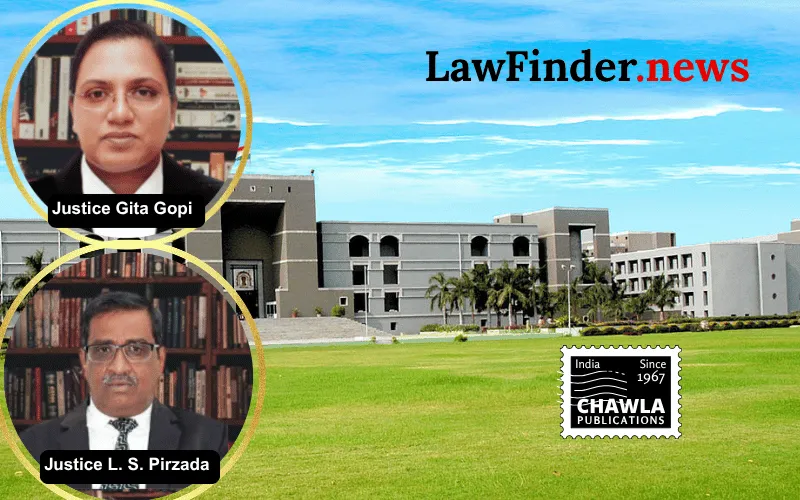
In a significant judgment delivered on September 29, 2026, the Gujarat High Court (Division Bench comprising Justices Gita Gopi and L. S. Pirzada) acquitted Pravinsinh Vajesing Parmar and Tejendrasinh Jagatsinh Parmar, who had been convicted under Section 302 of the Indian Penal Code (IPC) for murder in a group clash case dating back to January 2, 2009. The accused had already undergone over 13 years of imprisonment before their appeals were allowed.
The case arose from a violent altercation involving two groups in the village of Salal, Taluka Prantij, Gujarat, which started with a dispute over a right of way between family members and escalated into a cross clash. The trial court had earlier disbelieved the prosecution's claim of unlawful assembly and common object under Sections 147, 148, and 149 IPC but still convicted the two appellants for murder under Section 302 IPC and sentenced them to life imprisonment along with concurrent sentences under Section 135 of the Bombay Police Act.
On appeal, the Gujarat High Court undertook a meticulous examination of the evidence. The prosecution had alleged that Pravinsinh inflicted a sickle blow and Tejendrasinh a sword blow on the deceased's head. However, the medical evidence demonstrated only a single incised head injury and one cut below the abdomen. Crucially, the doctor testified that the head injury was caused by a sword, not a sickle, contradicting the eyewitness accounts and prosecution case. Additionally, the injury on the abdomen was unexplained by the prosecution.
The complainant and witnesses admitted discrepancies regarding the place of the incident, with blood pools found in front of the accused's residence rather than the complainant's house as alleged. Notably, injuries sustained by the accused during the clash were not explained or investigated adequately, raising suspicion about the prosecution's version of the genesis of the incident.
The Court emphasized that since the trial court had acquitted the accused under Section 149 IPC due to non-existence of common object or unlawful assembly, it was imperative to prove the specific individual acts causing the fatal injury to sustain convictions under Section 302 IPC. The prosecution failed to establish which accused caused the fatal head injury or with which weapon, resulting in irreconcilable doubts.
Further, the Court found the incident to be a sudden fight in the heat of passion without premeditation, supported by mutual injuries on both sides and the absence of motive after an earlier quarrel between women was amicably settled. This brought the case within Exception 4 to Section 300 IPC, which reduces culpable homicide to a lesser offence in cases of sudden fight without undue advantage or cruelty.
Regarding the plea of self-defence raised by the accused, the Court observed that it was not explicitly taken during trial nor supported by positive evidence. The burden to prove self-defence lies on the accused by preponderance of probabilities, and the prosecution evidence did not indicate imminent threat or necessity for private defence by the appellants.
After analyzing the totality of evidence, including the medical reports, eyewitness testimonies, and the investigation records, the Court concluded that the prosecution failed to prove beyond reasonable doubt the culpable act of either appellant causing the solitary fatal injury. The discrepancies and suppression of injuries on the accused further undermined the prosecution's case.
Consequently, the Gujarat High Court set aside the conviction and sentence imposed by the trial court, acquitting both Pravinsinh Vajesing Parmar and Tejendrasinh Jagatsinh Parmar of all charges. The Court directed the refund of any fine paid and discharged the bail bonds. The judgment underscores the necessity for prosecution to establish individual liability clearly in cases involving group clashes and highlights the critical role of medical evidence in corroborating eyewitness accounts in criminal trials.
Bottom Line:
In a cross-case arising out of a group clash, where the trial court disbelieved unlawful assembly/common object under Sections 147, 148, 149 IPC, but still convicted only two accused under Section 302 IPC, the prosecution was required to prove the specific individual act of each accused. Where medical evidence showed only one head injury, eyewitness version alleged two separate head blows by two different weapons, the place of occurrence was suppressed, injuries on accused were not explained, and genesis of occurrence was not truthfully presented, benefit of doubt must go to the accused and conviction cannot be sustained.
Statutory provision(s):
Indian Penal Code Sections 302, 149, 147, 148, 135 Bombay Police Act, 1872 Evidence Act Section 105
Pravinsinh Vajesing Parmar v. State of Gujarat, (Gujarat)(DB) : Law Finder Doc Id # 2990521