Court Rules Posthumously Filed Income Tax Returns Valid for Compensation Calculation; Award Enhanced from Rs.6.01 Lakh to Rs.12.17 Lakh with 9% Interest
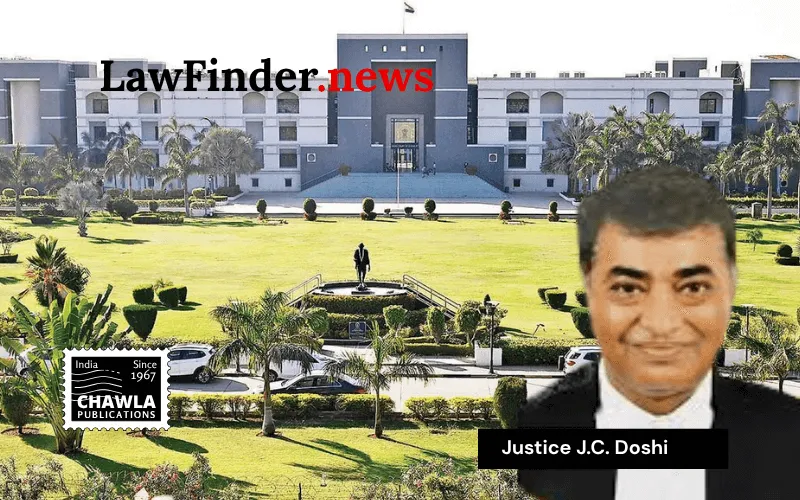
In a significant judgment delivered on September 18, 2026, the Gujarat High Court, presided over by Justice J.C. Doshi, enhanced the compensation awarded to the dependents of a deceased self-employed man who died in a fatal road accident. The case involved the tragic death of Rajubhai Vadilal Shah, who was hit by a rashly driven State Transport bus while riding his scooter in Surat in November 2001.
The original Motor Accident Claims Tribunal (MACT) had awarded a sum of Rs.6,01,400 to the claimants-his widow, children, and mother-based on a monthly income estimate of Rs.3,000. Dissatisfied with this amount, the claimants appealed, contending that the Tribunal failed to properly consider the income tax returns (ITRs) submitted, which documented a far higher income.
The High Court thoroughly examined the submissions and evidence, including the income tax returns for the financial years from 1992 to 2002, some of which were filed posthumously by the claimants. The Court cited recent Supreme Court rulings, notably the case of Sayar & Ors. v. Ramkaran & Ors., and Rashmirekha Tripathy v. Srirram General Insurance Co. Ltd., to hold that there is no legal bar against considering income tax returns filed after the death of the individual, provided the income figures remain consistent and do not reflect artificial inflation.
Applying this principle, the Court took an average of the net income shown in the last three ITRs of the deceased, which amounted to Rs.71,576 annually, as the correct income benchmark. The Court then applied a 25% addition for future prospects, a one-fourth deduction for personal expenses, and a multiplier of 14 (reflecting the deceased's age of 45) to calculate the loss of dependency.
Additionally, the Court awarded Rs.18,150 each for loss of estate and funeral expenses, and Rs.48,400 each as consortium damages to five dependents, in line with Supreme Court precedents. The total compensation was recalculated at Rs.12,17,742, substantially higher than the MACT's original award. The Gujarat State Road Transport Corporation (GSRTC), responsible for the negligent bus driver, was directed to deposit the enhanced amount with 9% annual interest from the date of the claim petition till realization.
Justice Doshi emphasized the beneficial and humanitarian purpose of the Motor Vehicles Act, 1988, stating that compensation must be just, fair, and equitable, and that courts must adopt a liberal and pragmatic approach, avoiding niggardliness. This judgment reinforces the principle that innocent victims and their families should not suffer due to technicalities and that realistic assessments based on credible evidence must guide compensation awards.
This ruling will set a precedent for future motor accident compensation cases, especially involving self-employed deceased persons whose income is best established through statutory financial documents such as income tax returns, even if filed after death.
Bottom Line:
Motor Vehicles Act - Fatal accident compensation - For self-employed deceased, average of net income shown in last three income tax returns can be adopted - Posthumously filed income tax returns are not to be discarded merely because they were filed after death, when income pattern remains consistent and does not indicate manufactured inflation - Compensation enhanced by applying 25% future prospects, 1/4th deduction for personal expenses, multiplier of 14, and conventional heads including consortium to five dependents.
Statutory provision(s):
Motor Vehicles Act, 1988 Sections 166, 168, 173
Heenaben v. Sarosh Jahangirji Dumasiya, (Gujarat) : Law Finder Doc Id # 2990523