Court finds acceptance of mobile phone from practicing advocate, failure to report movable property transactions, and non-disclosure of personal loan as serious misconduct warranting dismissal
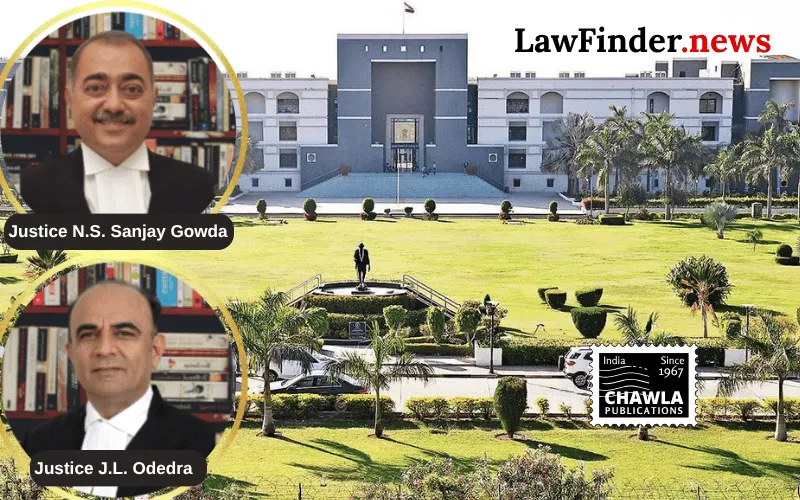
In a significant judgment dated September 25, 2026, the Division Bench of the Gujarat High Court, comprising Justices N.S. Sanjay Gowda and J.L. Odedra, dismissed the writ petition of Amratlal Narendrabhai Vizoda, a Judicial Magistrate First Class (JMFC), thereby upholding his dismissal from service on charges of serious misconduct.
The petitioner was initially suspended in 2008 following a vigilance inquiry into allegations of grave misconduct, including accepting undue favours from a practicing advocate, failure to disclose multiple transactions of movable property, and non-reporting of a personal loan.
The inquiry revealed that the petitioner was in possession of four mobile phones with different SIM cards, three of which were registered in the names of third parties, including one registered to Ms. Pravinaben Kesubhai Patel, a practicing advocate. Evidence showed that the petitioner had frequent telephonic contact with Ms. Patel, making over 6,400 calls in a four-month period, including 186 calls to the advocate herself. Although there was no direct proof that the phone was accepted as a bribe for favourable judicial orders, the Court found this conduct to be "undue favour" and "highest impropriety" amounting to serious misconduct unbecoming a judicial officer.
Further charges related to the petitioner's failure to report the purchase and sale of motor vehicles and a motorcycle, involving transactions exceeding the prescribed limit of Rs. 25,000 under Rule 19 of the Gujarat Civil Services (Conduct) Rules, 1971. The petitioner argued that mentioning vehicle numbers while claiming petrol allowance sufficed as disclosure, but the Court rejected this defence, holding that such reporting must be made explicitly within one month of the transaction. The failure to intimate these transactions was held to constitute misconduct.
Another charge pertained to the non-disclosure of a personal bank loan of Rs. 35,000 taken in 2005, which was not reported to the High Court as required under Rule 16. The petitioner's plea of personal necessity was found insufficient to excuse non-compliance, especially since no post-facto approval was sought.
The Court also examined allegations concerning judicial orders passed by the petitioner, including procedural irregularities and incorrect classification of warrant triable cases as summons triable, leading to premature acquittals. However, the Court held that disciplinary proceedings could not be based merely on judicial decisions or procedural errors, although such conduct may indicate improper intent.
Applying established jurisprudence on departmental inquiries under Article 226 of the Constitution, the Court emphasized its limited scope of interference, which is restricted to cases where evidence is absent or the punishment shocks the conscience. Here, the findings of the inquiry and the disciplinary authorities were found to be supported by cogent evidence.
The Court concluded that the cumulative conduct of the petitioner reflected a lack of integrity, a fundamental quality expected of judicial officers. Consequently, the dismissal was held to be the only appropriate and proportionate punishment. The writ petition was dismissed, affirming the need for judicial officers to maintain the highest standards of propriety and transparency.
This judgment reinforces the principle that judicial officers must avoid any appearance of impropriety, maintain distance from practicing advocates, and strictly comply with disclosure requirements to uphold public confidence in the judiciary.
Bottom Line:
Departmental proceedings against Judicial Officer - Limited scope of interference under Article 226 - Acceptance of mobile phone/SIM from practicing advocate, non-disclosure of transactions relating to movable property, and failure to report personal loan held to constitute serious misconduct and lack of integrity - Dismissal from service upheld - However, disciplinary charge founded merely on passing incorrect judicial order/procedural irregularity in judicial work held not maintainable.
Statutory provision(s):
Article 226, Constitution of India, 1950; Gujarat Civil Services (Conduct) Rules, 1971 - Rule 16, Rule 19
Amratlal Narendrabhai Vizoda v. State of Gujarat, (Gujarat)(DB) : Law Finder Doc Id # 2990525