Court holds corporate veil cannot be lifted mechanically; director of public limited company cannot be held liable for company's tax dues without proof of gross neglect, misfeasance, or breach of duty
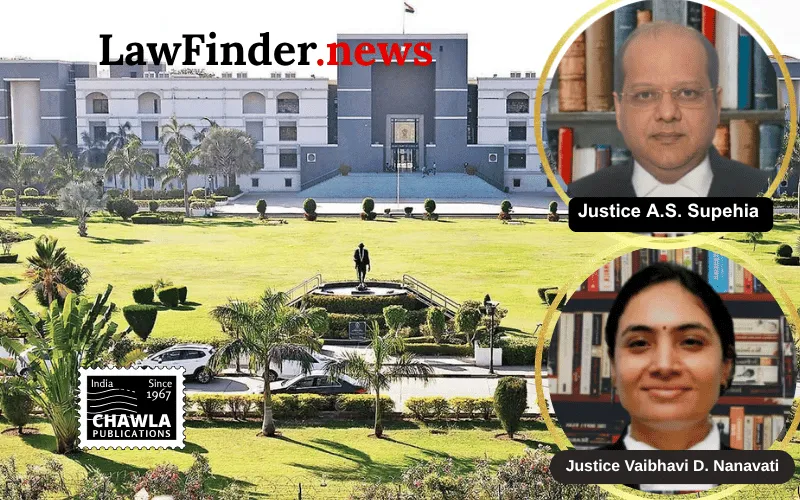
In a landmark judgment dated September 11, 2026, the Gujarat High Court (Division Bench comprising Justices A.S. Supehia and Vaibhavi D. Nanavati) quashed the order passed under Section 179 of the Income Tax Act, 1961, which had held Ajay Surendra Patel, a former director of Hirak Biotech Limited, liable to pay the company's outstanding tax dues for Assessment Year 2006-07. The Court emphasized that Section 179, which imposes liability on directors of private companies for the company's unpaid taxes, cannot be invoked against directors of a public limited company by merely "lifting the corporate veil" to treat it as a private limited company without stringent examination of gross negligence, misfeasance, or breach of duty.
Facts and Background:
Hirak Biotech Limited was incorporated on January 25, 2005, as a public limited company with three directors. Mr. Ajay Surendra Patel was appointed as a director on March 20, 2005, and resigned on September 5, 2005. The company was assessed to additional tax liability of Rs. 2.40 crores for AY 2006-07, which remained unpaid. Consequently, proceedings under Section 179 were initiated against Mr. Patel as a director, alleging he held 98% of the company's shares during his tenure and controlled the company's affairs.
Mr. Patel challenged the order, contending that the company was a public limited company and that Section 179 applies only to private companies. He further argued that he was never involved in the company's management, was not an authorized signatory, and resigned well before the tax assessment. The petition also pointed out that the shareholding attributed to him was not in his individual name but held through a private limited company where he was a director.
Legal Issues and Arguments:
The primary issues before the Court were:
1. Whether the status of Hirak Biotech Limited as a public limited company could be disregarded and treated as a private limited company by lifting the corporate veil solely because of the petitioner's substantial shareholding.
2. Whether the petitioner could be held liable under Section 179 without proof of gross neglect, misfeasance, or breach of duty related to the non-recovery of tax dues.
The Revenue contended that despite the company's public limited status, its shareholding and management were effectively controlled by the petitioner, making it a "one-man show." They relied on lifting the corporate veil to justify treating the company as private and holding the petitioner liable.
Judgment and Reasoning:
The Gujarat High Court meticulously examined the statutory provisions and case law governing Section 179 of the Income Tax Act and the principles of lifting the corporate veil. Key observations include:
- Corporate Veil and Company Status: The Court held that the classification of a company as public or private is determined by its Memorandum and Articles of Association and registration, not by the concentration of shareholding. A public limited company cannot be treated as private merely because a director holds substantial shares or because shares were not offered to the public. The Companies Act and SEBI regulations do not support such reclassification based on shareholding patterns.
- Stringent Conditions for Lifting Corporate Veil: Lifting the corporate veil is an exceptional and stringent exercise permissible only where there is evidence of fraud, misuse of the corporate structure, or to defeat the interests of the Revenue. Mere substantial shareholding or limited public involvement is insufficient.
- Applicability of Section 179: Section 179 applies exclusively to private companies. For a director to be held liable, the authority must prove that the non-recovery of tax dues is attributable to gross neglect, misfeasance, or breach of duty by the director.
- No Evidence Against Petitioner: The Court noted that the petitioner had resigned before the assessment year, was not involved in management, was not an authorized signatory, and did not operate the company's bank accounts. His shareholding was held through a private company, not in his individual capacity. The Revenue failed to establish any gross negligence or breach of duty by the petitioner.
- Violation of Natural Justice: The Revenue relied on a statement of a co-director alleging "accommodation entries" but did not provide the petitioner an opportunity to respond, violating principles of natural justice.
- Precedents: The Court relied on Supreme Court and Gujarat High Court precedents, including M. Rajamoni Amma v. Deputy Commissioner of Income-tax and Maganbhai Hansrajbhai Patel v. Assistant Commissioner of Income-tax, which reiterate that Section 179 liability requires proof of gross neglect or breach of duty and that the corporate veil cannot be lifted lightly.
Outcome:
The Gujarat High Court allowed Mr. Patel's writ petition and set aside the order dated March 31, 2016, holding that Section 179 cannot be invoked against him as a director of a public limited company without the required statutory conditions being met. The Court clarified that directors of public limited companies cannot be held liable for company tax dues under Section 179 on the basis of mere shareholding or lifting the veil unless gross negligence or breach of duty is clearly established.
Significance:
This judgment reinforces the sanctity of corporate personality and the limited circumstances under which the corporate veil may be lifted, especially in tax liability cases. It protects directors of public limited companies from being unfairly held liable for company dues under Section 179, which is specifically designed for private companies. The ruling underscores the necessity for tax authorities to rigorously establish gross neglect or misfeasance before proceeding against directors.
Bottom Line:
Section 179 of the Income Tax Act cannot be invoked against the director of a public limited company by merely lifting the corporate veil and treating it as a private limited company without examining stringent requirements like gross negligence, misfeasance, or breach of duty.
Statutory provision(s):
Section 179, Income Tax Act, 1961; Section 3(1)(iii), Companies Act, 1956