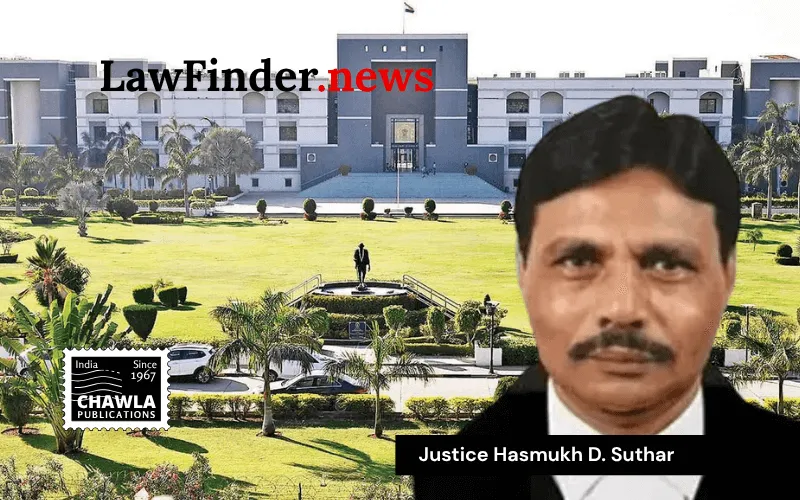
Ahmedabad, Aug 6 The Gujarat High Court has granted bail to a woman accused of beating her two-year-old daughter to death for demanding food, and said the incident was a "heart-wrenching reminder" that hunger is not merely an economic issue but a matter of human dignity, justice, and conscience.
In its order passed last week, the court of Justice Hasmukh D Suthar said that when starvation drives a mother to such an extreme act, such failure is collective rather than individual, and added that the tragedy should be viewed as a clarion call for compassion and a renewed commitment to ensuring that no mother or child is left to suffer the indignity of starvation.
The court allowed the regular bail plea of Lakhiben Solanki, a mother of three children, who was arrested in March 2026 for allegedly beating her daughter to death under the case registered at Varachha police station in Surat.
As per the prosecution, the accused beat up her daughter Eesha after getting annoyed by the latter asking for food due to hunger.
"Herein, the said incident is not merely an individual tragedy but a profound indictment of society and raises fundamental questions of social justice and morality," the court said.
"This court is of the considered view that social justice is founded on the principle that every human being is entitled to basic necessities such as food, shelter, healthcare, and dignity. When starvation drives a mother to such an extreme act, such failure is collective rather than individual," it observed in its judgment.
It further noted that the incident reflects the failure of social welfare mechanisms and highlights the moral responsibility of the state and society to protect vulnerable families, especially women and children.
The court said that under the Indian Constitution, children are given fundamental rights for early childhood care and education until they complete the age of six years, and it is the duty of the state government to raise the level of nutrition and the standard of living to improve public health.
In its judgment, the court quoted from two novels -- Gujarati novel "Manvini Bhavai (Endurance: A Droll Saga) by Pannalaal Patel -- that evokes psychological horror of extreme hunger and societal collapse -- and Victor Hugo's classic "Les Misérables" -- based on the life and struggles of the poor, oppressed, and socially marginalised people in 19th century France.
It also quoted Mahatma Gandhi, Charles Dickens and the Hindu, Islamic and Christian scriptures which talk about feeding the hungry as a sacred duty, and observed that the alleged incident is a "heart wrenching reminder that hunger is not merely an economic issue but a matter of human dignity, justice, and conscience."
As Mahatma Gandhi has said -- 'There are people in the world so hungry that God cannot appear to them except in the form of bread', it said.
"All religions demonstrate that allowing a person to perish from hunger is not merely a social failure but a moral and spiritual failure," it said.
Furthermore, philosophers have also recognised the devastating effects of extreme poverty and hunger, it added, quoting Aristotle who said 'Poverty is the parent of revolution and crime'.
The court said that 19th century British novelist Charles Dickens also depicted how extreme poverty can push people towards crime.
"This tragedy should, therefore, be viewed not only as an offence but also as a clarion call for compassion, social responsibility, and renewed commitment to ensuring that no mother or child is left to suffer the indignity of starvation since one life has to enter in this world," the HC said.
A child also has the right to life, that too with dignity and honour, and to see and ensure that the benefits of the government's benevolent scheme reaches to needy people, it said.
The advocate for the applicant had sought bail on the ground that the accused was seven-month pregnant and had two more children -- a toddler living with her in the jail and another one at home with no one to take care of as the husband of the accused had fled home and the woman was living in a live-in relation with another man before committing the crime.
While the government opposed the plea and said that her involvement was very well established in the crime, the court noted that the murder was the outcome of a mother's inability and failure to maintain her child due to poverty and starvation.
Lakhiben Punabhai Solanki v. State of Gujarat, (Gujarat) : Law Finder Doc Id # 2954641