Calcutta High Court sets aside proceedings before ordinary magistrate, directs case against Member of Parliament to be tried by designated Special Court as per Supreme Court directives
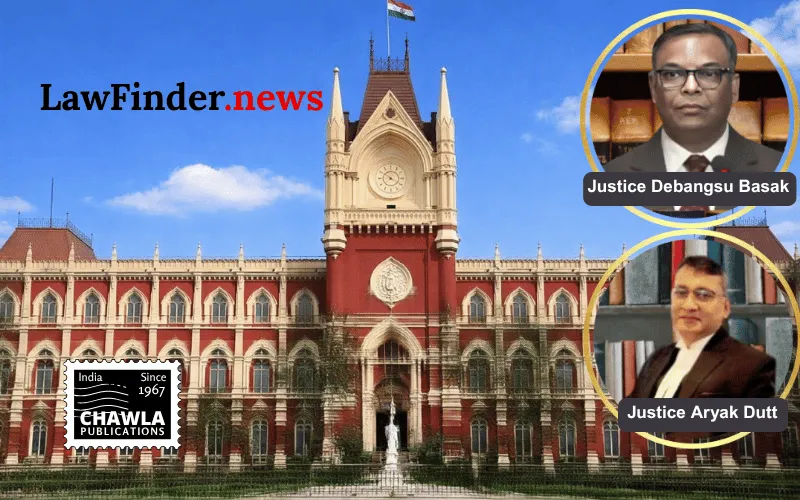
The Calcutta High Court Division Bench, comprising Justice Debangsu Basak and Justice Aryak Dutt, has set aside the cognizance taken against Member of Parliament Mahua Moitra by an ordinary judicial magistrate and ordered the transfer of the complaint case to a designated Special Court dealing with MP/MLA cases. The judgment represents a significant assertion of the Supreme Court's directive that cases involving Members of Parliament must be handled by specialized courts rather than regular judicial magistrates.
The case, Criminal Revision (CRR) 3604 of 2026, challenged the cognizance taken in Complaint Case No. 309 of 2026 pending before the 3rd Judicial Magistrate at Krishnagar, Nadia. The High Court found that the ordinary judicial magistrate lacked proper jurisdiction to take cognizance of a case against a Member of Parliament and therefore exercised its revisional powers to rectify this procedural irregularity.
Key Observations and Legal Reasoning:
Justice Debangsu Basak, writing the judgment, made a crucial observation regarding the Supreme Court's pronouncement in Ashim Kumar Upadhyay vs. Union of India (2017 SCC Online SC 2195). The court noted that the Supreme Court's clear desire has been that proceedings against Members of Parliament or Members of the State Legislature should be dealt with by specified courts with utmost expedience. The High Court found this directive to be binding and applicable to the present case.
The bench observed that while various legal points were sought to be raised, including jurisdictional challenges to the Division Bench's authority to entertain the revision, it did not find it necessary to delve into these contentious debates. Instead, the court focused on the substantive issue that cases involving parliamentarians require specialized handling through designated Special Courts.
Transfer and Procedural Directions:
In a comprehensive set of directions, the High Court ordered:
1. Transfer of Case: The complaint case (C.R. No. 309 of 2026) pending before the 3rd Judicial Magistrate, Krishnagar, Nadia, was transferred to the appropriate Special Court dealing with MP/MLA cases situated at Bidhanagar, North 24-Parganas.
2. Record Transmission: The learned District Judge of Nadia was requested to transmit all records of the complaint case to the District Judge of North 24-Parganas immediately. Subsequently, the District Judge of North 24-Parganas was directed to forward the records to the Special Court at Bidhanagar.
3. Pre-Cognizance Treatment: Upon receipt of the records, the Special Court Judicial Magistrate was instructed to treat the proceedings as being at the pre-cognizance stage, effectively allowing the Special Court to undertake a fresh examination of the complaint.
Nullification of Previous Orders:
In a significant procedural step, the High Court set aside all orders and proceedings taken by the transferor (original) Judicial Magistrate, including the cognizance itself and all consequent orders. This means that the ordinary magistrate's cognizance is treated as null and void, and the case essentially returns to a stage prior to cognizance being taken. This ensures that the designated Special Court will have the complete authority to examine the complaint afresh and determine whether cognizance should be taken.
Constitutional and Judicial Significance:
This judgment underscores the court's commitment to ensuring that proceedings against Members of Parliament adhere to proper institutional mechanisms. The designation of Special Courts for MP/MLA cases reflects a recognition that cases involving elected representatives require expeditious disposal while maintaining procedural fairness and appropriate judicial oversight.
The High Court's decision also demonstrates the hierarchy of judicial directives, with Supreme Court pronouncements acting as binding precedent even when they relate to procedural matters. By relying on Ashim Kumar Upadhyay, the High Court emphasized that institutional arrangements for trying cases against parliamentarians are not matters of mere convenience but constitutional imperatives designed to ensure efficient and specialized adjudication.
Implications:
This judgment has important implications for criminal proceedings against parliamentarians in West Bengal. It establishes that ordinary courts cannot assume jurisdiction over such cases, and any cognizance taken by them is liable to be quashed by higher courts. The directive also signals that all stakeholders—district judges, judicial magistrates, and prosecutors—must be aware of the requirement to route cases against MPs and MLAs to appropriate Special Courts.
The case was heard with counsel representing the petitioner (Mr. Debasish Roy, Mr. Arka Kumar Nag, Mr. Soham De Dhara, and Mr. Akash Ghosh), the State (Mr. Kallol Mondal, Learned Public Prosecutor, and Mr. Anamitra Banerjee), and the de facto complainant (Mr. Krishnendu Bhattacharya, Ms. Tanusree Kar, and Ms. Sneha Ghosh).
Bottom Line:
Complaint against a Member of Parliament must be tried by a designated Special Court dealing with MP/MLA cases, and not by an ordinary judicial magistrate. Transfer of case ordered to the appropriate Special Court.
Statutory Provision(s):
Section 190 of the Criminal Procedure Code, 1973; Section 200 of the Criminal Procedure Code, 1973
Mahua Moitra v. State of West Bengal, (Calcutta)(DB) : Law Finder Doc Id # 2973667