Court Upholds Reinstatement with Continuity of Service, Modifies Labour Court Award to Direct 50% Back Wages with Interest to Workman Denied Full Compensation
In a significant judgment impacting industrial dispute resolution and worker rights, the Himachal Pradesh High Court has modified a Labour Court award that denied back wages to a workman reinstated after illegal termination. The case, titled Chattar Singh v. The Executive Engineer, HPSEBL, involved a daily wage employee terminated in 1997 by the Himachal Pradesh State Electricity Board (HPSEBL) and subsequently reinstated by the Industrial Tribunal-cum-Labour Court Shimla without back wages.
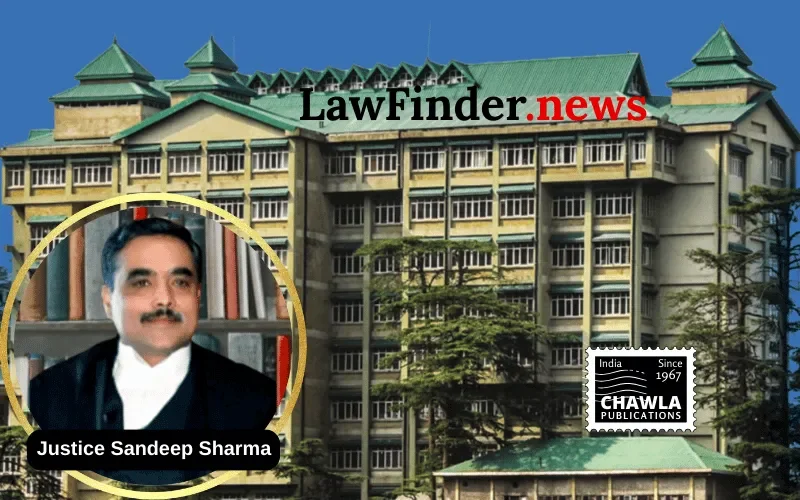
The petitioner, Chattar Singh, challenged the denial of back wages despite reinstatement with continuity of service. The High Court bench, led by Justice Sandeep Sharma, held that the normal rule in cases of wrongful termination is reinstatement accompanied by back wages, unless the employer proves the employee was gainfully employed during the period of termination. The Court emphasized that the workman need only plead non-gainful employment, after which the onus shifts to the employer to specifically prove otherwise with cogent evidence.
The Labour Court had denied back wages on the ground that the petitioner failed to prove non-employment during the termination period. However, the High Court found this reasoning contrary to binding Supreme Court precedents which clarify that the employer must demonstrate gainful employment to justify denial of back wages.
The Court referred extensively to Supreme Court rulings including Deepali Gundu Surwase v. Kranti Junior Adhyapak Mahavidyalaya (2013), Jayantibhai Raojibhai Patel v. Municipal Council (2019), and Hindustan Tin Works (P) Ltd. v. Employees (1979), reiterating the principle that illegal termination entitles a worker to reinstatement with full back wages unless exceptional circumstances exist. It acknowledged that discretion exists to reduce back wages based on factors like the employer's financial condition or the employee's misconduct, but no such circumstances were proven here.
In light of these principles, the High Court set aside the Labour Court's denial of back wages and directed the respondent-department to pay 50% of the back wages with interest at 12% per annum from the date of termination, to be paid within six weeks. Failure to comply would attract interest at 6% per annum thereafter.
This judgment reaffirms the protective ambit of the Industrial Disputes Act, 1947, and highlights the judiciary's role in balancing employer rights with the economic security of workers. It signals to employers that reinstatement without back wages is not automatic and that they must substantiate claims of gainful employment if they seek to deny such relief.
The petitioner's legal team, led by Mr. M.L. Sharma and Ms. Meghna Kashava, welcomed the ruling as a vindication of workers' rights and a reinforcement of legal safeguards against unfair labour practices. The respondent was represented by Additional Advocate Generals Mr. Rajan Kahol and Mr. Vishal Panwar.
This case serves as a precedent for similar industrial disputes where workers are unlawfully terminated and reinstated, underscoring the judiciary's insistence on equitable compensation aligned with statutory provisions and Supreme Court jurisprudence.
Bottom Line:
Industrial Disputes Act - Illegal termination - Once reinstatement with continuity of service is granted, back wages are the normal rule - Workman is only required to plead that he was not gainfully employed - Burden then shifts to employer to specifically plead and prove gainful employment - Labour Court erred in denying back wages without cogent reasons - Award modified and 50% back wages with interest granted.
Statutory provision(s):
Industrial Disputes Act, 1947 Sections 10, 11A; Constitution of India Article 226
Chattar Singh v. The Executive Engineer, HPSEBL, (HP) : Law Finder Doc Id # 2997197



