Division Bench holds trial court passed "mechanical" order without applying judicial mind to charge-sheet material linking accused to secessionist sloganeering and mob violence in Kupwara
The Jammu & Kashmir and Ladakh High Court has set aside the discharge of Mohd Yousuf Lone, an accused in a 2013 case involving anti-national sloganeering, mob violence, and charges under the Unlawful Activities (Prevention) Act (UAPA), ruling that the trial court failed to apply judicial mind and passed a "bare conclusion rather than a reasoned finding" while exonerating the accused at the charge stage.
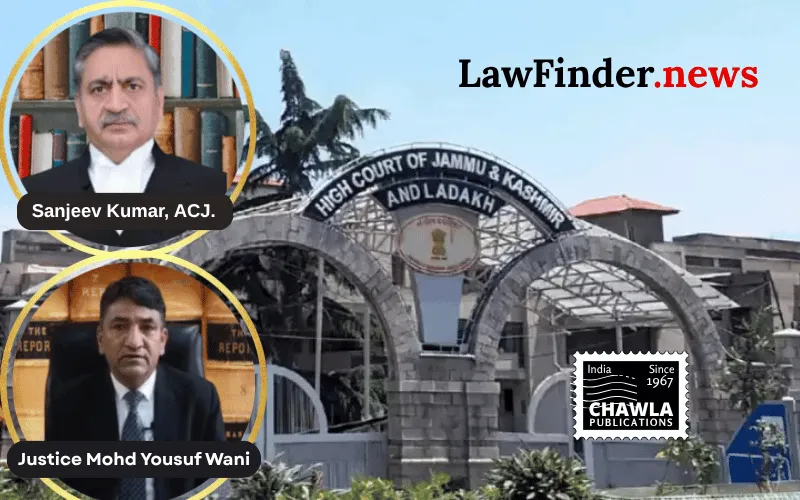
A Division Bench comprising Acting Chief Justice Sanjeev Kumar and Justice Mohd Yousuf Wani allowed the criminal appeal filed by the Union Territory of Jammu & Kashmir against the order dated January 3, 2025, passed by the Additional District & Sessions Judge (Designated Special Court under the NIA Act) at Kupwara, which had discharged Lone from offences under Section 13 of UAPA and Sections 171-C and 171-F of the Ranbir Penal Code (RPC).
The case dates back to November 8, 2013, when police patrolling parties in Kupwara reported that a procession led by the late Syed Ali Shah Geelani — then chairman of the banned Hurriyat Conference — along with Mohd Yousuf Lone emerged from Jamia Masjid, Kupwara. The participants allegedly raised slogans against the unity and territorial integrity of India, incited the public, and pelted stones at security forces. An FIR (No. 279/2013) was registered, and after a prolonged investigation spanning nearly nine years, a charge-sheet was filed in November 2022. Sanction for prosecution under Section 45 of UAPA was duly obtained from the competent authority.
The trial court, however, discharged Lone in a single sentence, holding that the facts "do not fulfil the ingredients of Section 2(o) of ULA(P) Act" — the provision that defines "unlawful activity" to include actions intended to bring about cession of Indian territory, incite secession, or disrupt India's sovereignty and territorial integrity.
The High Court found this approach fundamentally flawed. "The Trial Court has recorded, in a single sentence, that the facts do not fulfil the ingredients... without setting out the reasoning by which the specific statements/conduct attributed to the respondent in the charge-sheet were tested against the statutory definition," the Bench observed, terming it "a bare conclusion rather than a reasoned finding."
Reiterating well-established principles from a line of Supreme Court decisions — including State of Bihar v. Ramesh Singh (1977), Union of India v. Prafulla Kumar Samal (1979), Sajjan Kumar v. CBI (2010), and Asim Shariff v. NIA (2019) — the High Court emphasized that at the charge-framing stage, the court is not required to conduct a "mini-trial" or weigh evidence meticulously. A "strong suspicion" arising from the material on record suffices to frame charges, and discharge is warranted only when the evidence gives rise to "mere suspicion" as opposed to "grave suspicion."
The Bench noted that the prosecution material — including recorded slogans, the leadership role attributed to the accused, his association with the head of a proscribed organization, and the resultant violence against security forces — at the very least disclosed a strong suspicion sufficient to put the accused on trial. "The sloganeering for secession, raised by an accused leading a mob in the company of the head of a proscribed separatist organisation, and coupled with incitement of the public and violence against security forces, is capable, on a prima facie appreciation, of falling squarely within this definition," the court held.
The court was also careful to clarify that it was not expressing any opinion on the ultimate guilt or innocence of the accused. "When specific material is brought on record that, on the face of it, discloses the commission of an offence and the complicity of the respondent, the Trial Court cannot act as a mute spectator and shut the doors of trial without assigning valid legal reasons," the Bench stated.
The High Court also condoned a delay of 57 days in filing the appeal, finding sufficient cause had been shown by the appellant, within the permissible limits under Section 21(5) of the NIA Act, 2008.
The charge-sheet has been restored, and the trial court has been directed to proceed with framing of charges afresh after considering all material on record and providing opportunity of hearing to both sides.
Bottom Line:
The trial court, while discharging an accused under Section 13 of UAPA, must apply judicial mind to the material on record and provide reasoned findings. Strong suspicion arising from the material suffices to frame charges; discharge is warranted only where the evidence gives rise to mere suspicion as opposed to grave suspicion.
Statutory Provision(s): Section 227 of the Code of Criminal Procedure, 1973; Section 13 of the Unlawful Activities (Prevention) Act, 1967; Section 21(5) of the National Investigation Agency Act, 2008; Sections 147, 148, 336, 171-C, 171-F of the Ranbir Penal Code
UT of J&K v. Mohd Yousuf Lone, (J&K and Ladakh)(DB)(Srinagar) : Law Finder Doc Id # 2973669