Court holds that “irrevocable” Power of Attorney is revocable unless coupled with interest; Sub-Registrar cannot refuse registration on merits or direct petitioner to file civil suit
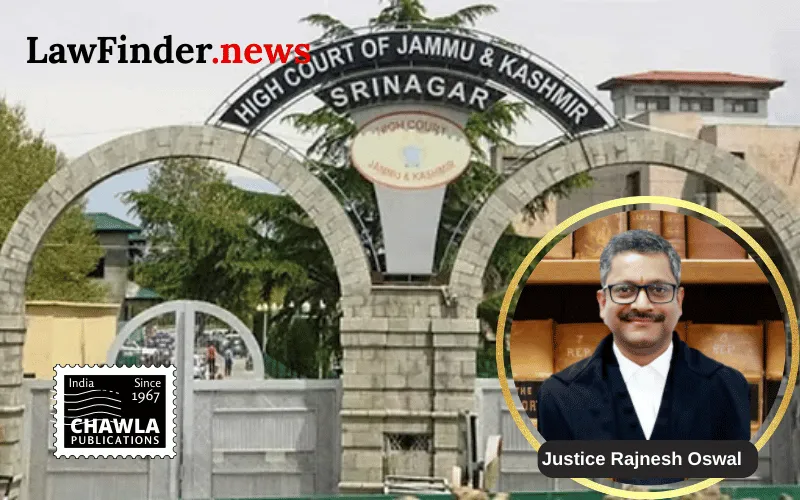
In a significant judgment delivered on August 14, 2026, the Jammu & Kashmir and Ladakh High Court, presided over by Justice Rajnesh Oswal, clarified the scope of powers of Sub-Registrars under the Registration Act, 1908, particularly concerning the registration of revocation of Powers of Attorney. The court ruled that the Sub-Registrar’s role is strictly ministerial, confined to verifying the execution and identity of the parties, and does not extend to adjudicating on the legality or merits of the document. The judgment came on a writ petition filed by Muzaffar Hussain Rather seeking registration of revocation of an “Irrevocable General Power of Attorney” granted in 2009.
The petitioner alleged fraudulent misuse of the Power of Attorney by the holder and sought to revoke it by issuing public and legal notices. However, the Sub-Registrar refused to register the revocation deed without providing any reasoned order, citing the deletion of “Cancellation of Instrument” from the administrative checklist and the lack of a document category for revocation of Power of Attorney on the government’s NGDRS portal. The respondents argued that the petitioner should file a civil suit for cancellation of the instrument, asserting that the Sub-Registrar has no jurisdiction to register such revocations post the 2023 government order.
Rejecting this contention, the High Court relied heavily on Section 34 of the Registration Act, 1908, which limits the Sub-Registrar’s role to verifying the execution and identity of executants, without authority to question the document’s validity. The court reaffirmed the principle from the Supreme Court judgment in K. Gopi v. Sub-Registrar (AIR 2025 SC 1303) that the registering officer cannot refuse registration even if the executant lacks title, provided procedural requirements are met.
The court further clarified the nature of “irrevocable” Powers of Attorney under Section 202 of the Indian Contract Act, 1872. It held that a Power of Attorney is revocable unless it is “coupled with interest,” meaning it creates a distinct right or interest in favor of the attorney holder. Mere nomenclature or a clause stating “irrevocable” does not alter this inherent revocability. The judgment drew on the Supreme Court’s recent decision in M. S. Ananthamurthy v. J. Manjula (2025INSC273) emphasizing that without an interest in the subject matter, the Power of Attorney remains revocable.
The High Court criticized the Sub-Registrar’s stance that the petitioner must file a civil suit under Section 31 of the Specific Relief Act, 1963 for cancellation of the Power of Attorney. It held that filing a civil suit is not a precondition for registering a revocation deed and that the Sub-Registrar has no advisory or adjudicatory role beyond registration formalities.
Importantly, the court observed that the deletion of the “Cancellation of Instrument” entry from the administrative checklist does not divest the Sub-Registrar of the jurisdiction to register revocations of Powers of Attorney where procedural compliance is met. It directed the respondent Sub-Registrar to register the revocation deed within seven days, provided no other legal impediment exists.
This judgment reinforces the limited scope of the Sub-Registrar’s role, protects citizens from bureaucratic hurdles in document registration, and clarifies the legal position on revocability of Powers of Attorney despite “irrevocable” labels. It also underscores that aggrieved parties can challenge wrongful revocation through civil courts but cannot use this as a ground to deny registration.
Bottom Line:
Registration Act, 1908 - Sub-Registrar lacks adjudicatory power to refuse registration of documents based on legality or merits - Revocation of Power of Attorney is not subject to adjudication by the Sub-Registrar and must be registered if procedural requirements are fulfilled.
Statutory provision(s):
Registration Act, 1908 Section 34; Indian Contract Act, 1872 Section 202; Specific Relief Act, 1963 Section 31
This report summarizes the key legal findings and implications of the judgment in Muzaffar Hussain Rather v. Union Territory of J&K, elucidating the boundaries of authority of registration officers and the principles governing Powers of Attorney revocation in Indian law.