Court rejects appeal by government officials citing procedural lapses and lack of evidence, affirms trial court's finding of negligence in road construction causing damage to plaintiff's house
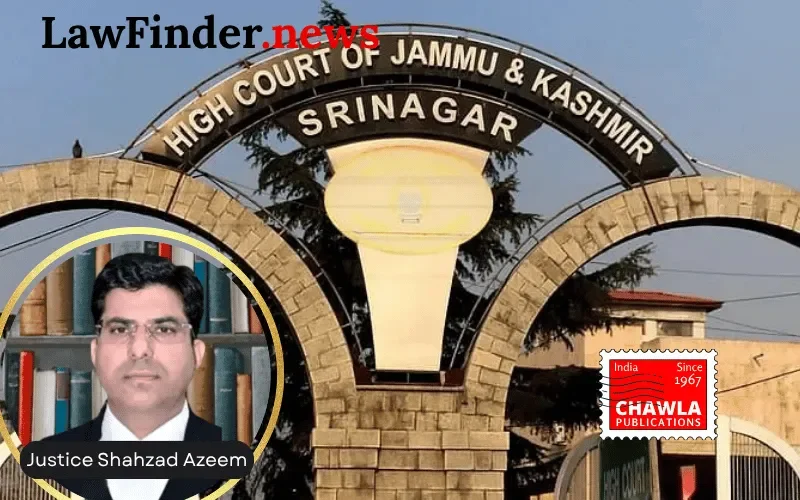
In a significant judgment delivered on October 9, 2026, the Jammu & Kashmir and Ladakh High Court dismissed the appeal filed by the Commissioner Secretary, PMGSY, Government of Jammu & Kashmir, and others, affirming the trial court's decree awarding Rs. 7,20,000 along with interest to Mohd. Iqbal for damages caused to his double-storey house. The damage was attributed to the negligent construction of the Karol-Kumate road and the failure of a protection wall built by the defendants.
The suit arose after earth cutting for the Karol-Kumate road construction near the plaintiff's house in village Kumate, Tehsil Rajgarh, District Ramban, led to a landslide risk. Although the defendants constructed a protection wall to prevent damage, the plaintiff contended that it was built with sub-standard materials and failed to protect his house during rain in March 2014, resulting in cracks and damage.
The defendants contested the claim, arguing that Rs. 1,75,000 had already been paid as compensation, and that the subsequent damage resulted from the plaintiff's own negligence, including the reconstruction of a multi-storey house without technical approval. They also claimed that the damage to the protection wall was caused by natural rains and was promptly repaired.
The trial court framed two issues focusing on ownership and the cause of damage. It held the plaintiff to be the rightful owner and found that the damage was due to the defendants' negligence, awarding Rs. 7,20,000 with 7.5% annual interest from the date of the suit.
On appeal, the government challenged the non-framing of specific issues regarding sub-standard materials and the plaintiff's reconstruction without approval. However, the High Court noted that the defendants had participated fully in the trial without raising objections to the framing of issues or seeking amendments under Order XIV Rule 5 of the Civil Procedure Code (CPC). The defendants also failed to cross-examine the plaintiff's witnesses on critical points or lead evidence to substantiate their defense.
The Court emphasized that non-framing of a more specific issue is not fatal if parties were aware of the controversy and participated without prejudice. It further clarified that the appellate court's powers under Order XLI Rules 25 and 27 CPC to frame additional issues or admit new evidence are discretionary and cannot be used to remedy omissions caused by a party's own failure.
The plaintiff's witnesses clearly established ownership and detailed how the road cutting and insufficient protection wall caused the damage. The defendants' failure to disprove these facts or challenge the quantum of damages assessed by the Assistant Executive Engineer led the court to uphold the compensation amount.
In conclusion, the High Court found no perversity or illegality in the trial court's findings and ruled against reopening the trial or remanding the suit. The appeal was dismissed with no order as to costs, and the judgment and decree awarding damages to the plaintiff were affirmed.
This judgment reiterates the principle that parties must actively participate in the framing and contesting of issues during trial and cannot seek to raise new issues or defenses for the first time on appeal. It also underscores the responsibility of government departments in ensuring safe infrastructure development and accountability for negligence.
Bottom Line:
Civil Procedure Code - Non-framing of a more specific issue is not fatal where parties knew the controversy, participated in trial without objection, did not seek amendment of issues under Order XIV Rule 5 CPC, and failed to cross-examine on material aspects - Appellate Court will not permit remand or reopening of trial to fill omissions in defence - Decree for damages to house caused by road cutting and failure of protection wall upheld.
Statutory provision(s):
Civil Procedure Code, 1908 - Order XIV Rule 5, Order XLI Rules 25, 27; Indian Evidence Act, 1872 - Sections 101, 103