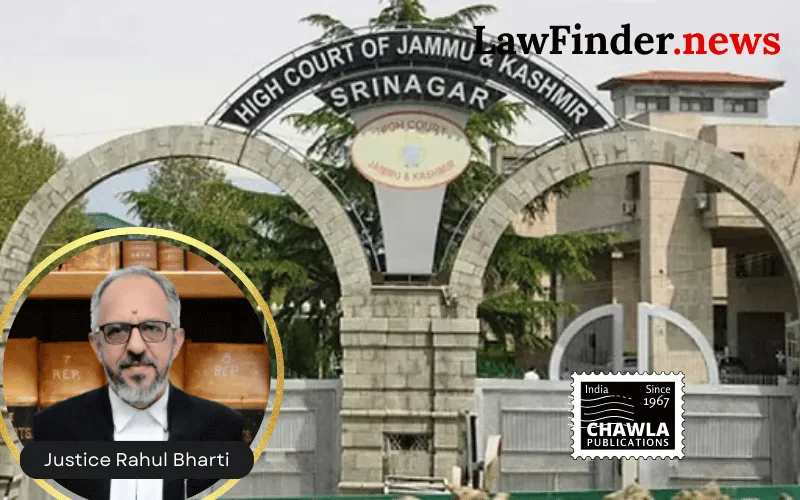
Court directs affidavits on Gurdwara management and donations, emphasizing transparency and curbing factional disputes for Sikh Sangat's benefit
In a significant judgment delivered on September 7, 2026, the Jammu & Kashmir and Ladakh High Court addressed the ongoing internal disputes within the District Gurdwara Prabhandak Committee (DGPC), Jammu, highlighting the urgent need for proper administration and management of Sikh Gurdwaras in the Union Territory. The case arose from a civil suit filed by elected office bearers of the DGPC Jammu, exposing a vertical split between the President and some members on one side, and the Vice-President and Secretary on the other, resulting in conflicting claims over the management of Gurdwaras, notably the Gurdwara Chatti Pathshahi, Talab Tillo, Jammu.
The Court meticulously examined the Jammu & Kashmir Sikh Gurdwaras and Religious Endowment Act, 1973, which governs the administration and management of Sikh Gurdwaras in the region. Under Sections 10, 11, 13, and 14 of the Act, the establishment of District Gurdwara Prabhandak Committees with specified powers for overseeing Gurdwaras' property, income, and religious observances is mandatory. The Court observed that while the Act vests broad powers in the District Committee, the present dispute involves the constitution of local Gurdwara-wise administrative bodies by certain members, which has led to factional litigation and confusion.
Notably, the High Court emphasized that the administration of sacred Sikh institutions must transcend personal politics and factionalism, underscoring the spirit of `sewa' (service) as paramount. It expressed concern over the ongoing infighting among elected members that threatens the proper functioning of the Committee and ultimately disservices the Sikh Sangat and devotees in the district.
In a detailed order, Justice Rahul Bharti directed the petitioners and respondent President to file affidavits clarifying how many Gurdwaras in the Jammu district are directly managed by the District Gurdwara Prabhandak Committee without any locally elected or nominated bodies, and to detail the modalities of such management. The Secretary of the Committee was also instructed to provide audited financial statements for each Gurdwara and the Committee itself, to ensure transparency regarding donations and funds.
Furthermore, the Court suo-motu impleaded the Treasurer and Joint Secretary of the Committee as party respondents to the petition, requiring their participation in the proceedings. The Court made it clear that it would take strict measures to curb any factional litigation that disrupts the administration of religious places and would consider the overarching jurisdiction of the UT Sikh Gurdwara Prabhandhak Board to intervene if necessary.
The case, stemming from conflicting orders by subordinate courts on injunctions relating to the appointment of local Gurdwara administrators, was taken up under Article 227 of the Constitution of India by the High Court to provide a definitive course correction.
The Court scheduled the next hearing for October 5, 2026, by which time the affidavits must be submitted. It reiterated that the paramount duty of the judiciary is to prevent religious institutions from becoming arenas of political conflict, ensuring that the management and administration of Sikh Gurdwaras remain efficient, accountable, and devout.
This judgment underscores the judiciary's proactive role in overseeing the governance of religious endowments and safeguarding the interests of the community by promoting transparency and curbing internal disputes.
Bottom Line:
Administration and management of Sikh Gurdwaras under the Jammu & Kashmir Sikh Gurdwaras and Religious Endowment Act, 1973 - Scope and authority of District Gurdwara Prabhandhak Committee to constitute local Gurdwara-wise administrative bodies - Court's responsibility to ensure proper management and curb factional litigation in the interest of devotees and Sikh Sangat.
Statutory provision(s): Jammu & Kashmir Sikh Gurdwaras and Religious Endowment Act, 1973 Sections 2(d), 3, 10, 11, 13, 14, 56; Jammu & Kashmir Sikh Gurdwaras and Religious Endowment Rules, 1975 (Rules 3-35, 58, 61-64); Civil Procedure Code, 1908 Order 39 Rules 1 & 2; Order 43 Rule 1(r); Constitution of India Article 227