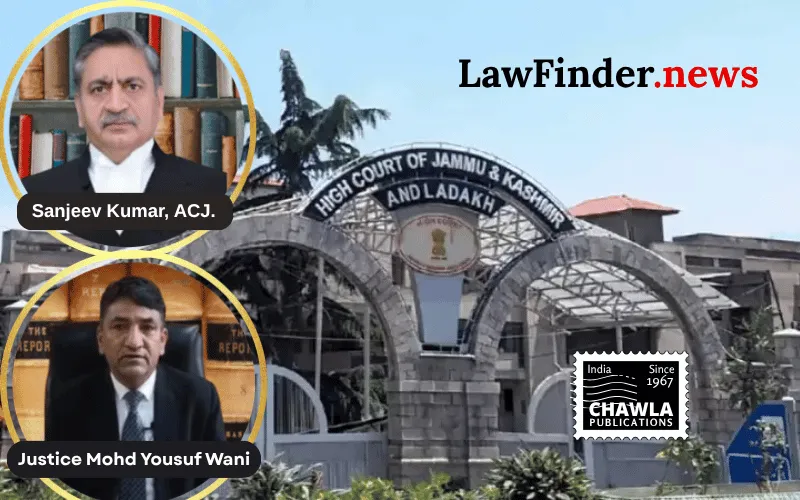
Division Bench rules levy under Cess Act is a "fee" not a tax and confirms applicability of welfare legislation to Jammu & Kashmir post-2007 Board constitution
In a landmark judgment dated September 8, 2026, the Jammu & Kashmir and Ladakh High Court (Division Bench) delivered a comprehensive verdict in the matter of R.G. Buildwell Engineers Ltd. and others vs. Union of India and others, affirming the constitutional validity of the Building and Other Construction Workers Welfare Cess Act, 1996 ("Cess Act"), the Building and Other Construction Workers (Regulation of Employment and Conditions of Service) Act, 1996 ("BOCW Act"), and the Building and Other Construction Workers Welfare Cess Rules, 1998, with respect to the erstwhile State of Jammu and Kashmir.
The petitioners, contractors engaged in executing construction contracts in Jammu and Kashmir, challenged the applicability of the Central Acts and Rules, contending that Parliament lacked legislative competence to extend these legislations to Jammu and Kashmir under the constitutional scheme existing before August 5, 2019, due to Article 370 and the special status of the State. They further contended that the levy of 1% cess deducted from their bills was a "tax" and, thus, not sustainable since no direct service was rendered to them, and that the cess could not be levied before the constitution of the Welfare Board in the State.
The Division Bench, comprising Mr. Sanjeev Kumar, ACJ., and Mohd Yousuf Wani, J., undertook a detailed constitutional and statutory analysis. The Court noted that the issue of whether the levy under the Cess Act is a tax or a fee is no longer res integra following the Supreme Court's decision in Dewan Chand Builders & Contractors v. Union of India (2012), which held the levy to be a fee and not a tax since the amount collected is specifically utilized for the welfare of building and construction workers, not as general government revenue. The Court emphasized that it is not necessary for the benefit of the fee to directly accrue to the person paying it, but there must be a reasonable connection between the levy and the welfare activity funded, which was fulfilled here.
Regarding the legislative competence of Parliament to enact and extend these Acts to Jammu and Kashmir, the Court elaborated on the constitutional framework as it existed under Article 370 prior to its abrogation on August 5, 2019. The Court observed that while Article 248 and Entry 97 of List I (Union List) were applicable to Jammu and Kashmir with modifications, the residuary powers of legislation in the State were limited compared to other States. Entry 97, which deals with residuary matters and taxes not mentioned in Lists II or III, was modified to include only certain specific matters, thereby limiting Parliament's competence under that Entry to Jammu and Kashmir.
However, the Court held that the Cess Act is integrally connected to the BOCW Act, which falls under Entries 23 and 24 of the Concurrent List-entries concerning labor welfare, including conditions of employment and social security of workers. Since the Concurrent List was made applicable to Jammu and Kashmir through the Constitution (Application to Jammu and Kashmir) Order, 1954, and subsequent amendments, Parliament had legislative competence to enact these Acts for Jammu and Kashmir under Entries 23 and 24.
The Court distinguished the Supreme Court's ruling in Dewan Chand Builders, noting that the Supreme Court had not considered the applicability of Entries 23 and 24 of the Concurrent List to Jammu and Kashmir in that case, as the matter did not arise before it. The High Court reasoned that the Cess Act, though described as revenue-collecting, is in substance a welfare legislation aimed at augmenting resources for workers' welfare boards constituted under the BOCW Act. Thus, it falls within the ambit of Entries 23 and 24 of the Concurrent List and is validly enacted by Parliament for Jammu and Kashmir.
Further, the Court addressed the timing of levy applicability, citing the Supreme Court's decision in Prakash Atlanta (JV) v. National Highways Authority of India (2026), which held that the cess could not be levied before the constitution of the Welfare Board. Since the Jammu and Kashmir Building and Other Construction Workers Welfare Board was constituted on July 31, 2007, the levy of cess is sustainable only for contracts executed pursuant to NITs issued after that date. The petitioners could not have factored the cess into their bids prior to the Board's constitution, but were liable to pay cess thereafter.
The Court accordingly dismissed the petitions challenging the constitutional validity of the Acts and Rules and held:
(i) Parliament had legislative competence to enact and extend the BOCW Act and Cess Act to Jammu and Kashmir;
(ii) The levy under the Cess Act is a fee and not a tax;
(iii) The cess rules are constitutionally valid;
(iv) The cess is recoverable from the petitioners at the prescribed rate for contracts awarded after July 31, 2007, with interest at 6% per annum from the due date till recovery.
This judgment clarifies the legislative competence of Parliament vis-a-vis Jammu and Kashmir concerning labor welfare laws and settles the debate on the nature of the levy under the Cess Act, reinforcing the principle that welfare legislation aimed at augmenting funds for workers' benefits is supported by the Concurrent List entries and is constitutionally sustainable.
Bottom Line:
The Building and Other Construction Workers Welfare Cess Act, 1996, and its Rules are constitutionally valid and applicable to the erstwhile State of Jammu and Kashmir. The levy under the Cess Act is a fee and not a tax, aimed at augmenting resources for the welfare of workers under the Building and Other Construction Workers (Regulation of Employment and Conditions of Service) Act, 1996.
Statutory provision(s):
Building and Other Construction Workers (Regulation of Employment and Conditions of Service) Act, 1996; Building and Other Construction Workers Welfare Cess Act, 1996; Building and Other Construction Workers Welfare Cess Rules, 1998; Constitution of India Articles 246, 248, 370; Constitution (Application to Jammu and Kashmir) Order, 1954; Arbitration and Conciliation Act, 1996.