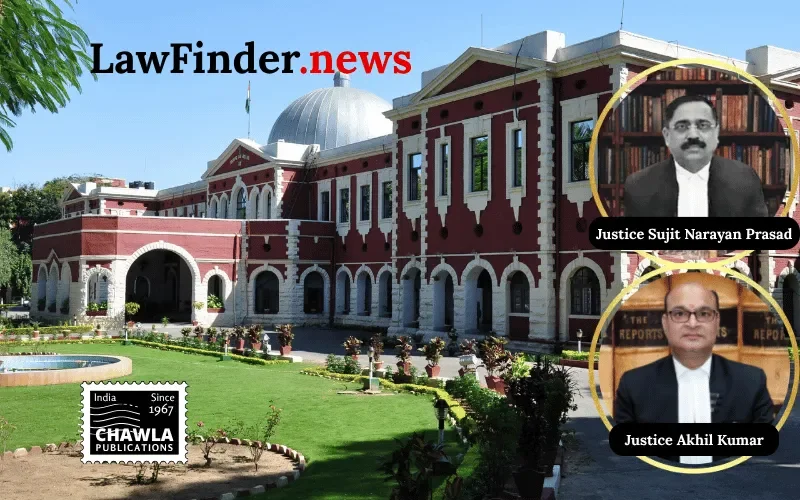
Court Emphasizes Need for Cogent Medical Evidence in Mental Cruelty Claims Under Hindu Marriage Act; Refusal to Take Medication Alone Insufficient Ground for Divorce
In a significant judgment delivered on November 5, 2026, the Jharkhand High Court (Division Bench comprising Justices Sujit Narayan Prasad and Akhil Kumar) quashed and set aside the decree of divorce granted by the Family Court, Koderma, which had dissolved a marriage on grounds of mental cruelty allegedly arising from the wife's mental illness and refusal to take prescribed medication.
The case, titled Anjali Devi v. Shashi Kumar Pandey, arose from a matrimonial dispute where the husband sought divorce under Section 13(1)(ia) of the Hindu Marriage Act, 1955, alleging mental cruelty caused by the wife’s diagnosed schizophrenia, bipolar disorder, and seizure disorder. According to the husband’s pleadings and evidence, the wife refused to take the prescribed medicines, which allegedly worsened her mental condition and subjected the husband and his family to mental cruelty. The Family Court had allowed the suit ex-parte after the wife failed to appear and based its decree largely on the husband's testimony, without examining any medical expert or evidence.
Upon hearing the appeal filed by the wife challenging the ex-parte divorce decree, the High Court undertook a detailed analysis of the facts, evidence, and relevant legal principles. It highlighted that:
- The Family Court failed to produce or examine any medical practitioner who diagnosed or treated the wife, resulting in lack of cogent and reliable medical evidence to substantiate the alleged mental illness or its severity.
- The court erred in equating the wife’s refusal to take prescribed medication with mental cruelty under Section 13(1)(ia). The refusal alone, without establishing the nature, extent, and impact of the mental illness, cannot constitute cruelty.
- There is a critical distinction between mental cruelty under Section 13(1)(ia) and mental disorder as a ground under Section 13(1)(iii) of the Hindu Marriage Act. The former requires conduct adversely affecting the spouse, while the latter concerns the existence of a severe mental disorder making marital cohabitation intolerable.
- The Family Court, in an ex-parte proceeding, cannot mechanically accept the petitioner’s assertions as gospel truth. The obligation to independently scrutinize and evaluate evidence in the interest of substantive justice remains paramount.
- The High Court emphasized the settled legal position that allegations in matrimonial disputes must be proved on the preponderance of probability with reliable and admissible evidence.
The Court further referred to various Supreme Court precedents defining "cruelty" in matrimonial context as conduct which causes reasonable apprehension in the mind of the petitioner that it will be harmful or injurious to live with the other spouse, and that such cruelty must be judged in light of the parties’ social, economic, and personal circumstances.
In view of the absence of any medical evidence and the Family Court’s failure to apply proper legal standards and evidentiary scrutiny, the High Court held the impugned judgment and decree to be perverse and liable to be set aside. The appeal was accordingly allowed, and the divorce decree was quashed.
This landmark ruling reinforces the principle that courts must exercise utmost caution and demand cogent proof before granting divorce on grounds of mental illness or mental cruelty, safeguarding the rights of parties and ensuring justice is not denied by mechanical or unsubstantiated adjudication.
Bottom Line:
In matrimonial disputes, allegations of mental illness as a ground for divorce cannot be mechanically accepted without cogent medical evidence, and refusal to take medication cannot, by itself, amount to mental cruelty under Section 13(1)(ia) of the Hindu Marriage Act, 1955.
Statutory provision(s): Hindu Marriage Act, 1955 Section 13(1)(ia), Section 13(1)(iii); Family Courts Act, 1984 Section 19(1); Indian Evidence Act, 1872 Section 3
Anjali Devi v. Shashi Kumar Pandey, (Jharkhand)(DB) : Law Finder Doc Id # 3016078