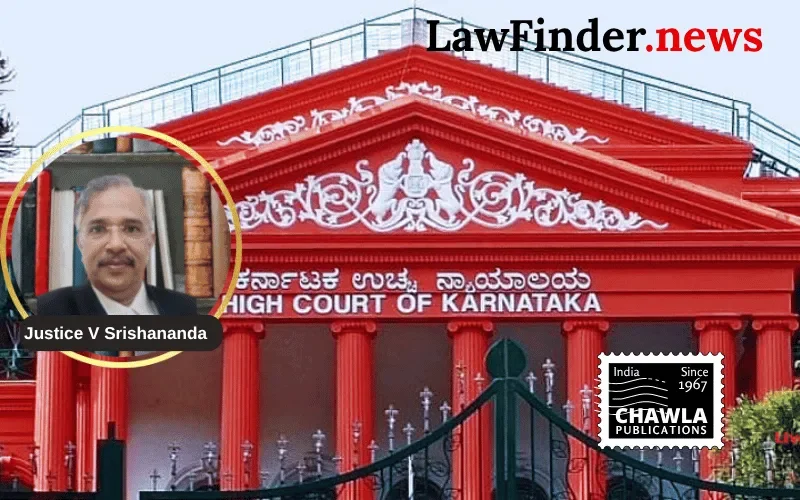
Court holds that prosecution based solely on police testimony without independent witnesses amounts to abuse of process of law
In a significant ruling delivered on October 5, 2026, the Karnataka High Court, presided over by Justice V Srishananda, quashed the charge sheet and cognizance order against Mubarak Shariff and 16 others in a criminal case alleging unlawful assembly and provocative speech. The case pertained to an incident dated October 27, 2019, near the Ghouse Peer Qadri Dargha in Alambadi Kavalu Village, K.R. Pet Taluk, where the petitioners were accused of forming an unlawful assembly and inciting people to indulge in illegal activities to disrupt social tranquility.
The prosecution's case was based primarily on the statements of police officials who claimed to have overheard the accused's provocative utterances while hiding near the incident site. However, the Court noted that there was a conspicuous absence of any independent witness to corroborate these allegations, despite the incident allegedly occurring in a public place. The petitioners contended that the gathering of Muslim persons near the Dargha on a Sunday was natural and that no independent evidence supported the prosecution's version.
The learned counsel for the petitioners, Sri Saddam R. Mulla, argued that the reliance solely on police testimony without any independent witness amounted to an abuse of the legal process. The Court observed that the police officers themselves had been hiding behind a fence to overhear the alleged statements and had not intervened at the time of the incident to prevent any unlawful activity. This raised questions about the credibility and sufficiency of the evidence presented.
After considering the submissions and the absence of any independent material supporting the prosecution's case, the Karnataka High Court held that continuing the criminal proceedings would amount to an abuse of process of law. Consequently, the Court allowed the petition under Articles 226 and 227 of the Constitution of India read with Section 482 of the Code of Criminal Procedure and quashed the charge sheet dated July 26, 2020, as well as the cognizance order dated August 17, 2020.
This judgment underscores the judiciary's commitment to safeguarding individuals from unfounded criminal prosecutions based merely on police versions without independent corroboration. It reinforces the principle that criminal proceedings must be grounded in credible and substantial evidence to prevent misuse of the legal system.
Bottom Line:
Quashing of charge-sheet and cognizance order under Articles 226 and 227 of Constitution of India read with Section 482 CrPC - Where allegation of unlawful assembly and provocative speech was supported only by statements of police officials and there was no independent witness to the alleged utterances, continuation of criminal proceedings held to be abuse of process of law - Charge-sheet and pending proceedings quashed.
Statutory provision(s): Articles 226, 227 of the Constitution of India, Section 482 of the Code of Criminal Procedure, 1973; Sections 143, 153, 117, 149 of the Indian Penal Code, 1860
Mubarak Shariff v. State by K.R. Pet Rural P.S., (Karnataka) : Law Finder Doc Id # 2997212



