Court rules that government-approved irrigation projects cannot be arbitrarily stalled or altered by subsequent political dispensations without lawful reasons, directing authorities to proceed with sanctioned works benefiting marginal farmers of Ibrahimpur and Mannur villages.
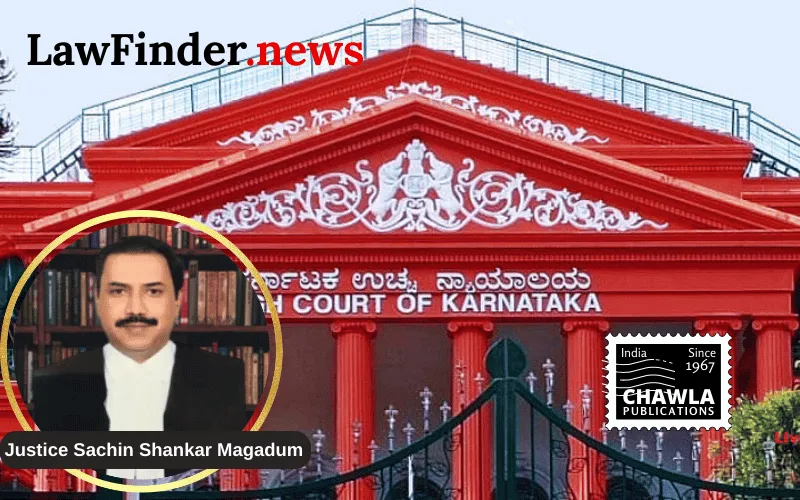
In a landmark decision dated August 31, 2026, the Karnataka High Court (Dharwad Bench) presided by Justice Sachin Shankar Magadum delivered a significant ruling safeguarding the interests of marginal farmers and contractors involved in government-approved irrigation projects. The Court quashed a directive issued by the sitting MLA of Siruguppa Assembly Constituency that sought to shift an irrigation project from Ibrahimpur Village to Nagalapur Village, thereby stalling works already underway and depriving beneficiaries of their legitimate rights.
Background
The litigation arose from three interconnected writ petitions filed by Sri Amaresh H. (the contractor), Smt. Eramma and others, and Sri Doddaveeranagouda and others (farmers/beneficiaries). The petitions challenged executive orders issued following a change in government, which sought to alter or stall irrigation projects initially approved by the previous administration. The projects were designed to provide irrigation facilities to marginal farmers in Ibrahimpur and Mannur villages, areas that previously lacked assured water sources for cultivation.
Key Issues
The Court considered two pivotal questions:
(i) Whether a beneficial irrigation project duly sanctioned and tendered by a previous government could be arbitrarily stalled or altered by the successor government merely through executive circulars or MLA interventions.
(ii) Whether the communication by the sitting MLA directing the shifting of the project was legally sustainable, given the prior approval and issuance of work orders.
Findings
The Court meticulously examined the facts, noting that the irrigation project had undergone all requisite administrative procedures, including preparation of project reports, approval by competent authorities, tendering, acceptance of the contractor's bid, and issuance of formal work orders. For Ibrahimpur Village, substantial execution, such as pipeline laying and transformer installation, had already been completed.
Rejecting the State's contention that the site was not handed over to the contractor due to standing crops and the Model Code of Conduct during elections, the Court observed that the work order was issued well before the Model Code came into effect, thus invalidating it as a valid reason for delay. Moreover, the physical progress on the ground contradicted claims that no work had commenced.
The Court underscored that elected representatives, while entitled to represent their constituencies, cannot unilaterally interfere with already approved government projects, especially after contractual rights have vested and legitimate expectations have been established. It emphasized the doctrine of fairness in administrative action, requiring the State to act reasonably, transparently, and lawfully.
The Court further clarified that a change in political dispensation does not authorize arbitrary alteration or abandonment of approved projects without relevant, sustainable legal grounds such as public interest, technical impediments, or financial irregularities. The impugned MLA directive was found lacking such justification and was therefore quashed.
Directions
- 1. The Court allowed the writ petitions, quashing the MLA's communication that sought to shift the project from Ibrahimpur to Nagalapur.
- 2. It directed the concerned government authorities to inspect the project site, verify the work already executed, and record it officially.
- 3. The authorities were instructed to consider the contractor's invoices and release payments in accordance with the contractual terms within eight weeks.
- 4. The Court ordered immediate steps to commence the irrigation project for Mannur Village as per the work order dated March 6, 2023, with appropriate communication to the contractor within four weeks.
- 5. The irrigation benefits for farmers in Ibrahimpur Village were to be extended lawfully and without undue delay.
- 6. The Court clarified that the competent authorities remain free to consider any independent proposals for irrigation projects in Nagalapur Village in compliance with statutory and financial protocols.
Significance
This judgment reinforces the principle that governmental schemes, particularly those benefiting vulnerable sections like marginal farmers, cannot be held hostage to political changes or executive whims. It safeguards contractual rights arising from transparent tendering processes and upholds administrative fairness. The ruling sends a clear message that development projects sanctioned through due process must be implemented faithfully, ensuring that the intended beneficiaries receive their rightful benefits without arbitrary disruption.
The decision also delineates the limits of political representatives' intervention in administrative matters, emphasizing adherence to statutory procedures and the rule of law.
Bottom Line:
Government-approved irrigation projects cannot be arbitrarily stalled or altered by a subsequent political dispensation without legally sustainable reasons. Beneficiaries' legitimate interests and contractual rights must be upheld.
Statutory provision(s): Model Code of Conduct (related to elections), PWD Department Code 2014 Section 135.3, Tender Terms and Conditions (Clause 25.1), Administrative Law principles relating to fairness and legitimate expectation.